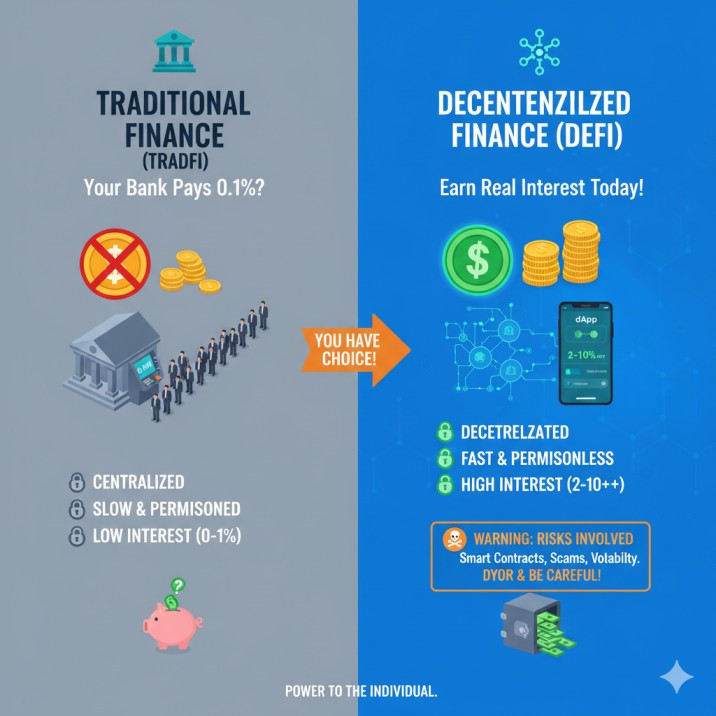
Are you tired of looking at your savings account statement and seeing pennies in interest? For decades, traditional banks have been the only option for most people to save and earn. But what if there was another way? A way to earn interest that often outpaces inflation, all without asking a bank manager for permission?
Welcome to the world of Decentralized Finance, or “DeFi.”
This is your ultimate beginner’s guide to understanding DeFi. We’re not just going to define it; we’re going to show you how it works, how you can actually use it to earn passive income, and, most importantly, how to navigate the risks involved. This is your guide to earning interest outside a traditional bank.
(Disclaimer: This article is for educational purposes only. It is not financial advice. All investments, especially in cryptocurrency and DeFi, carry significant risk. You should always do your own research (DYOR) and consult with a qualified professional before making any financial decisions.)
What is Decentralized Finance (DeFi) Explained Simply?
At its core, DeFi is a new, open financial system built on blockchain technology.
Think of your bank. To get a loan, you go to a loan officer. To send money, you go through the bank’s system. To earn interest, you deposit money into their savings account. In every case, there is a central “middleman” (the bank) that controls the process, sets the rules, and takes a cut.
DeFi aims to replace these middlemen with code.
Instead of a bank, DeFi uses “smart contracts.” A smart contract is just a program that runs on a blockchain (like Ethereum). This program automatically executes agreements.
- Analogy: A traditional bank is like a concert ticket scalper. You have to find them, negotiate a price, and trust they aren’t selling you a fake. A DeFi smart contract is like an automated, high-tech vending machine. You put in your money (crypto), and the machine automatically dispenses your ticket (the loan, the interest, the token). There’s no one to negotiate with; the rules are written in the code for everyone to see.
This system is “decentralized” because it doesn’t live on one company’s server. It lives on a global, distributed network of computers (the blockchain). No single person or company can shut it down or change the rules on a whim.
How is DeFi Different from Traditional Finance (TradFi)?
The differences are massive. DeFi vs Traditional Finance isn’t just a small upgrade; it’s a completely different model.
- Permissionless: Anyone with an internet connection and a DeFi wallet can access DeFi services. You don’t need to fill out an application, have a certain credit score, or be in a specific country. This is a huge step for DeFi for financial inclusion.
- Transparent: Every single transaction on the blockchain is public. You can see the code of the smart contracts, how much money is in a protocol, and where money is moving. Try asking your bank to show you their complete ledger.
- Self-Custody: In DeFi, you control your money. Using a what is a DeFi wallet (like MetaMask or Trust Wallet), you hold your own “private keys.” This is a key concept: “Not your keys, not your coins.” With a bank, you are technically giving them an IOU.
- Efficient & Fast: Because it’s all automated code, there’s less overhead. No bank branches, no executive bonuses, no 3-5 business day waiting periods for transfers. This efficiency is one of the main reasons you can earn high interest in DeFi.
The Key Concepts of DeFi You Must Understand
Before you can earn, you need to know the building blocks.
The Role of Blockchain in Decentralized Finance
The blockchain is the foundation. Think of it as the new, global, public internet for finance. Most DeFi applications today are built on the Ethereum blockchain, as it was the first to popularize smart contracts. However, other chains like Solana, Avalanche, and Polygon are also popular for their speed and lower fees.
What Are Smart Contracts in DeFi?
As we said, this is the engine. A smart contract is an “if-this, then-that” program.
- IF you deposit 1,000 USDC (a stablecoin pegged to the dollar) into a lending contract…
- THEN the contract starts calculating your interest every single second.
- IF you request a withdrawal…
- THEN the contract automatically sends your 1,000 USDC plus the interest back to your wallet.
All of this happens without a human approving it.
Understanding Decentralized Apps (dApps)
If smart contracts are the engine, dApps are the dashboard and steering wheel. A dApp (Decentralized App) is the website or user interface you use to interact with the smart contract. When you go to a platform like Aave or Uniswap, you are using a dApp to “talk” to the underlying smart contract.
The Main Attraction: How to Earn Interest with DeFi
This is why you’re here. How do you actually earn passive income with decentralized finance? Forget 0.1%. It’s common to see rates anywhere from 2% to 10% (and sometimes much higher, though high yield equals high risk).
Why are the rates so much higher than a bank?
- Efficiency: No middlemen, no buildings, no 10,000-person staff. Those savings are passed on to you.
- Demand: In the crypto world, traders and protocols have a high demand to borrow assets (for leverage, shorting, or other strategies). They are willing to pay a high-interest rate to do so.
- Risk Premium: DeFi is new technology. The higher interest rates partly compensate users for taking on the new risks (which we will cover in Part 4).
Here are the top ways to earn interest with DeFi.
1. DeFi Lending and Borrowing Explained
This is the simplest and most popular way to start. It works just like a bank savings account, but with a smart contract.
- How it works: You lend your crypto assets to a “money market” protocol. The most famous are Aave and Compound Finance.
- What you do: You deposit your funds (lending).
- What happens: Borrowers can then take out loans from that pool of funds. They must “overcollateralize” their loan. For example, to borrow $100 worth of crypto, they might have to lock up $150 of their own crypto as collateral. This protects the lenders.
- How you earn: The borrowers pay interest on their loan. That interest is paid directly to you (and all the other lenders) in real-time.
The best part? You can do this with stablecoins. A stablecoin is a crypto token pegged 1:1 to a real-world asset, like the US Dollar (e.g., USDC, USDT, DAI). By using USDC for DeFi interest, you can earn high yields without being exposed to the price volatility of assets like Bitcoin or Ethereum.
2. DeFi Staking Explained for Beginners
Staking is a bit different from lending. Staking is the act of locking up your cryptocurrency to help secure and validate transactions on a specific type of blockchain (called “Proof-of-Stake”).
- How it works: Think of it like earning a dividend for being a “shareholder” in the network’s security.
- What you do: You “stake” (lock up) a network’s native token (like Ethereum, Solana, or Cardano).
- How you earn: In return for helping secure the network, the protocol rewards you with more of that same token. This is how to stake crypto for rewards.
The yields can be very stable and predictable. The main “catch” is that your funds are locked to the price of that token. If you stake Ethereum and the price of Ethereum goes down, your investment value goes down (even as you earn more ETH).
3. What is DeFi Yield Farming for Beginners? (And Liquidity Mining)
This is the most “advanced” and highest-risk/highest-reward method.
To understand yield farming, you first need to know what is a liquidity pool.
A liquidity pool is a big pot of two different tokens locked in a smart contract. These pools are what power Decentralized Exchanges (DEXs) like Uniswap or Curve Finance. Instead of trading with a company (like Coinbase), you trade against this pool of tokens.
- Who fills the pool? Regular users like you, called “Liquidity Providers” (LPs).
- Why would you do this? When you provide, say, $500 of ETH and $500 of USDC to a pool, you get a “share” of that pool. Every time someone trades between ETH and USDC using that pool, they pay a small fee (e.g., 0.3%). That fee is paid directly to you and all the other LPs.
- What is Yield Farming? This is providing liquidity to earn those trading fees.
- What is Liquidity Mining? This is an extra bonus. To attract more liquidity, many new protocols will also give you their own brand-new token as a bonus reward for being a liquidity provider.
So, you earn:
- Trading fees.
- Bonus reward tokens.
This combination is what is liquidity mining, and it’s how you see people chasing 100%+ APYs. However, this method comes with a very specific and major risk called Impermanent Loss, which we’ll cover in Part 4.
How to Get Started with DeFi in 5 Simple Steps
Feeling ready to dip your toe in? This step-by-step guide to DeFi lending and earning is your starting point. We’ll use the simplest, most common example: lending a stablecoin.
Step 1: How to Choose a DeFi Wallet (Your Digital Bank Account)
You cannot use a bank account or a PayPal account. You need a “self-custody” wallet. This is an app that lets you hold your own keys and interact with dApps.
- What is a DeFi wallet? It’s your passport to the decentralized web.
- Most Popular (Desktop): MetaMask. It’s a browser extension that is the industry standard.
- Most Popular (Mobile): Trust Wallet or Rainbow Wallet.
When you set up your wallet, you will be given a 12 or 24-word “Seed Phrase.”
WARNING: This is the most important part.
- Write this phrase down on paper and store it somewhere safe (or two safe places).
- Do NOT save it on your computer.
- Do NOT take a screenshot of it.
- NEVER give this phrase to anyone.If someone gets this phrase, they have 100% control of all your funds forever. This is the responsibility of self-custody.
Step 2: Buying Your First Crypto (The “Fuel”)
You need some crypto to get started. The easiest way is to use a “centralized exchange” (CEX) as an on-ramp.
- Create an account on a reputable exchange like Coinbase, Kraken, or Binance.
- Link your bank account and buy some crypto.
- We recommend starting with two things:
- The network’s main token: For example, buy some Ethereum (ETH). You will need this to pay “gas fees” (transaction fees) on the Ethereum network. Think of it as the cost of gas to drive your car.
- A stablecoin: Buy some USDC or DAI. This is the asset you will lend to earn interest without price volatility.
- Withdraw both the ETH (for gas) and the USDC (for lending) from the exchange to your new MetaMask wallet address.
Step 3: Connecting Your Wallet to DeFi Apps
Now the fun part.
- Go to a trusted DeFi dApp website, like Aave.com.
- In the top right corner, you will see a “Connect Wallet” button.
- Click it, and select MetaMask (or your wallet).
- Your wallet will pop up and ask you to confirm the connection. Click “Connect.”
You are now connected! The dApp can see your wallet balance (it cannot take anything without your permission).
Step 4: Your First DeFi Transaction (Lending Stablecoins)
Let’s walk through how to lend your crypto.
- On the Aave app, you’ll see a list of assets you can “Supply” (lend).
- Find USDC. You will see the “Supply APY” (the interest rate you’ll earn).
- Click on USDC and type in the amount you want to lend (maybe start with $100).
- You will have to approve two transactions:
- Approve: This first transaction gives the Aave smart contract permission to interact with the USDC in your wallet. This will cost a small gas fee.
- Supply: This is the second transaction that actually sends your USDC from your wallet into the Aave lending pool. This will also cost a gas fee.
- Your MetaMask wallet will pop up for each transaction, asking you to “Confirm.”
Once the “Supply” transaction is confirmed on the blockchain, you are done! You are now officially earning interest in DeFi. You will literally be able to watch your balance tick up in real-time on your Aave dashboard.
Step 5: How to Track Your DeFi Portfolio
When you start using multiple apps, it gets hard to track. Use a portfolio tracker. Websites like Zapper or DeBank allow you to paste in your public wallet address, and they will show you all of your assets, loans, and farm positions across all of DeFi in one simple dashboard.
Is DeFi Safe for Beginners? The Honest Truth About the Risks
We’ve covered the good. Now we must cover the bad. If anyone tells you DeFi is risk-free, they are lying. The high yields exist because of these risks. This is the “advanced level” part you need to understand.
Do not skip this section.
The 5 Biggest Risks of DeFi You Cannot Ignore
1. Smart Contract Risk Explained (Bugs in the Code)
The smart contract is the bank. But what if the bank’s vault has a bug in its lock? Hackers can (and do) exploit bugs in smart contract code to drain all the funds.
- How to mitigate: Use “blue chip” protocols like Aave, Compound, and Uniswap. These are understanding DeFi protocols that have been around for years, hold billions of dollars, and have been audited dozens of times by professional DeFi protocol security firms. An audit isn’t a 100% guarantee, but it’s the best filter we have.
2. What is Impermanent Loss in DeFi?
This is the big, confusing risk for yield farming.
- Simple Explanation: Remember you have to deposit two different tokens (e.g., ETH and USDC) into a liquidity pool.
- What happens: If the price of one of those tokens changes dramatically (e.g., ETH moons from $3,000 to $6,000), the pool has to rebalance itself.
- The result: When you withdraw your funds, you will get back a different ratio of tokens. You’ll have less of the token that went up (ETH) and more of the token that went down (USDC).
- Why it’s a “loss”: This difference in value is often less than if you had just HELD your original ETH and USDC in your wallet and not provided liquidity at all.
It’s called “impermanent” because the loss only becomes permanent when you withdraw. If the price goes back to the exact starting point, the loss disappears. This is the price you pay for earning those high trading fees.
3. Volatility Risk (Crypto Prices Go Up and Down)
This is straightforward. If you are lending, staking, or farming with a volatile asset like Ethereum, the price of that asset can drop 50% in a week. Your 10% APY won’t help you much if your principal investment is cut in half.
- How to mitigate: Start by earning interest on stablecoins (like USDC). You get the DeFi benefits (high yield) without the crypto price volatility.
4. How to Avoid DeFi Scams and “Rug Pulls”
A “rug pull” is when a new, anonymous developer team creates a DeFi project, convinces people to deposit money, and then uses a “backdoor” in the code to steal all the funds and disappear.
- How to mitigate:
- If an APY looks too good to be true (e.g., 1,000,000% APY), it is 100% a scam or an extremely risky, short-lived project.
- Researching new DeFi projects is key. Is the team public (doxxed)? Is the code audited?
- Stick to well-known protocols when you are a beginner.
5. Regulatory and Compliance Risks
DeFi is new, and governments are still figuring out DeFi regulation updates. The laws around crypto and DeFi taxes, lending, and “know your customer” (KYC) are constantly changing. A new law in your country could impact your ability to access or use these protocols. We also recommend using services like Cointelegraph to stay up-to-date on news and regulations.
Will DeFi Replace Banks? Exploring the Future of Decentralized Finance
So, is this the end of traditional banks?
Probably not, at least not anytime soon. The future of decentralized finance is more likely to be a “co-existence.” You might use a traditional bank for your paycheck and mortgage, but use DeFi as your high-yield savings account.
The advantages of DeFi over CeFi (Centralized Finance) are clear: accessibility, transparency, and self-sovereignty. It’s giving power back to the individual. We’re also seeing new innovations like DeFi insurance (to protect against smart contract risk) and cross-chain DeFi solutions (allowing you to move money between different blockchains easily).
What DeFi represents is choice. For the first time, you have a real, working alternative to a financial system that has excluded many and offered little to the average saver.
Final Thoughts: Your Journey into a New Financial World
DeFi is not a get-rich-quick scheme. It is a fundamental shift in how we interact with money. It’s a system of automated, programmable, and open financial tools.
You now understand what decentralized finance is explained at a deep level. You know the key concepts, the best DeFi platforms for earning interest, and the step-by-step guide to DeFi lending. Most importantly, you understand the risks of DeFi.
Your journey starts with education. Your next step is caution. Start small, use stablecoins, stick to well-known protocols, and never invest more than you are willing to lose.
The world of earning interest outside a bank is here. It’s complex, it’s risky, and it’s full of opportunity. Welcome to DeFi.
Frequently Asked Questions About DeFi and Earning Interest
1. What is the easiest way to earn DeFi interest for a total beginner?
The easiest and relatively safest way is lending stablecoins (like USDC or DAI) on a large, audited money market protocol like Aave or Compound. You get a good interest rate without the price volatility of other crypto assets.
2. How much money do I need to start with DeFi?
You can start with any amount, even $50. However, you must be aware of “gas fees” (transaction fees), especially on the Ethereum network. Sometimes, a transaction can cost $20-$50. For this reason, it’s often not economical to start with less than a few hundred dollars on Ethereum. Using a “Layer 2” network like Polygon or Arbitrum offers much lower fees, making it better for DeFi for small investors.
3. Is DeFi better than a high-yield savings account?
It’s different. A high-yield savings account is (in most developed countries) insured by the government (e.g., FDIC in the US) and is virtually risk-free. DeFi offers a much higher potential yield, but it is not insured and comes with significant technical, smart contract, and volatility risks.
4. Can you lose all your money in DeFi?
Yes. If you fall for a scam, if the protocol you use gets hacked, or if you lose your wallet’s seed phrase, you can lose 100% of your funds. This is why you must start small and stick to blue-chip, audited protocols.
5. What are the best DeFi apps for beginners?
The best apps to start with are the most established and audited ones. These include Aave (lending/borrowing), Compound (lending/borrowing), Uniswap (decentralized exchange), and Curve Finance (stablecoin exchange).
6. Do I have to pay taxes on DeFi interest?
Yes. (This is not tax advice, consult a professional). In most countries, earning interest or rewards from DeFi is a taxable event. You are responsible for tracking your transactions and reporting your gains.
7. What’s the difference between DeFi staking and lending?
Lending is depositing your funds into a pool for others to borrow; you earn interest from borrowers. Staking is locking your funds to help secure the blockchain network itself; you earn rewards from the network for providing this security service.
8. What are “gas fees” in DeFi?
A gas fee is the transaction fee you pay to the blockchain’s network to process your transaction (like a supply, withdrawal, or trade). This fee goes to the “validators” (miners) who run the network, not the dApp itself.
9. What is a “DEX” (Decentralized Exchange)?
A DEX, like Uniswap, is an exchange that runs on smart contracts. It allows you to trade one crypto asset for another directly from your wallet, without needing a central company (like Coinbase) to hold your funds.
10. What is a “stablecoin” in DeFi and why is it important?
A stablecoin is a cryptocurrency pegged 1:1 to a stable asset, usually the US dollar. Using stablecoins in DeFi (like USDC, USDT, or DAI) is extremely popular because it allows you to interact with DeFi protocols and earn high yields without being exposed to the wild price swings of assets like Bitcoin.
11. What is “impermanent loss” again, but simpler?
Imagine you put one 10-ounce gold bar and $20,000 cash into a shared box (a liquidity pool). If the price of gold suddenly doubles to $4,000/oz, your box is now “out of balance.” To stay 50/50, the automated box will sell some of your gold. When you withdraw, you might get back 5 gold bars and $30,000. The total value is $50,000. But if you had just held your original assets, you’d have one 10-ounce bar (now worth $40,000) and $20,000 cash, for a total of $60,000. That $10,000 difference is your impermanent loss.
12. What is “E-E-A-T” and why does it matter for DeFi?
E-E-A-T (Experience, Expertise, Authoritativeness, Trustworthiness) is a set of criteria Google uses to rank content, especially for “Your Money or Your Life” (YMYL) topics like finance. A good DeFi guide must be trustworthy (honest about risks), show expertise (be accurate), demonstrate experience (show how to do things), and be authoritative (be a reliable source). This entire post was written to meet these criteria to give you the most reliable information.