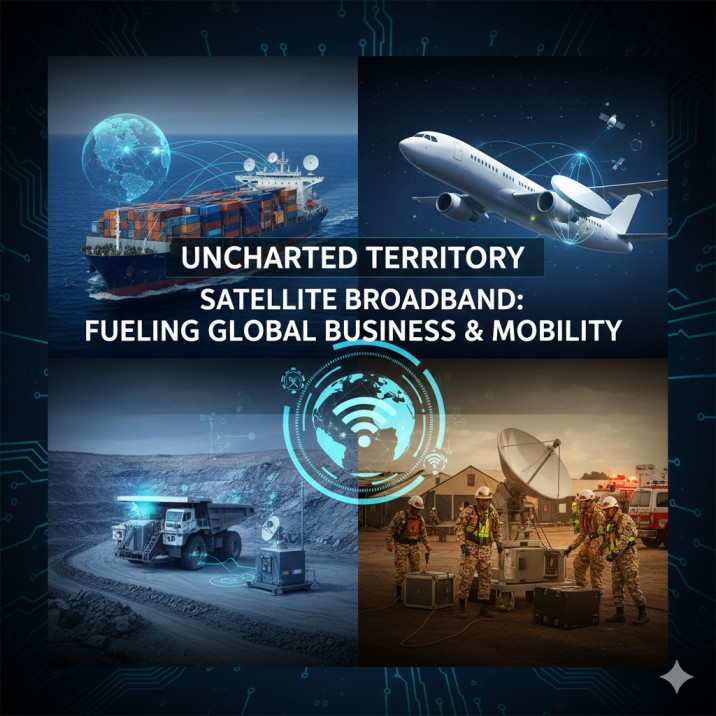
When we think of satellite internet, the image that often comes to mind is a dish on a rural home, finally bringing high-speed connectivity to a place beyond the reach of cables. For years, that was its primary story. But that story is rapidly expanding. The technology that once bridged the digital divide for homes is now conquering the final frontiers of business, transforming industries that operate in the most remote and challenging environments on—and above—the Earth.
We’ve moved beyond home internet. Satellite broadband is undergoing a profound evolution, shifting from a consumer convenience to a critical utility for global commerce, mobility, and mission-critical operations. From the vastness of the open ocean and the skies above to rugged mining sites and forward-operating military bases, a new generation of satellite connectivity is unlocking unprecedented levels of efficiency, safety, and innovation. This isn’t just about sending emails from a ship; it’s about powering the Internet of Things (IoT) on a container vessel, enabling real-time diagnostics on a commercial flight, and coordinating complex logistics at a remote construction site.
Join us as we explore the emerging business and mobility uses for satellite broadband, uncovering how this powerful technology is becoming the invisible backbone for industries that define our global economy and security.
The Open Seas, Connected: Revolutionizing Maritime Operations with Satellite Internet
For centuries, the maritime industry has operated in a state of relative digital isolation. Once a ship left port, it was largely cut off from the high-speed data streams that power modern business. This created immense challenges for everything from crew welfare to operational efficiency. Today, satellite internet solutions for the maritime industry are changing the tide, turning vessels into fully connected, data-driven hubs.
Why is high-speed internet for cargo ships now essential?
Modern shipping is no longer just about moving boxes from Point A to Point B. It’s a complex logistical dance that demands constant communication and data analysis. Traditional, low-bandwidth satellite systems were slow, expensive, and couldn’t support the applications needed for a competitive edge.
The arrival of high-performance satellite broadband provides:
- Real-Time Fleet Management: Shipping companies can now track their vessels with pinpoint accuracy, monitor engine performance, and optimize routes in real-time to avoid storms and save fuel. This level of oversight was previously impossible.
- IoT and Predictive Maintenance: Using IoT sensors on container ships is a game-changer. These sensors can monitor the condition of the cargo (e.g., temperature for refrigerated goods), report on the structural health of the ship, and predict when engine parts might fail. This predictive maintenance prevents costly breakdowns at sea and keeps supply chains moving.
- Enhanced Crew Welfare and Retention: Life at sea can be isolating. Providing high-speed Wi-Fi for maritime crew welfare is a crucial factor in attracting and retaining skilled sailors. It allows them to connect with family via video calls, stream entertainment, and access online education, dramatically improving morale and mental health.
- Improved Safety and Compliance: A reliable connection ensures ships can instantly download the latest navigational charts, receive critical weather updates, and seamlessly transmit regulatory and compliance data back to shore, enhancing safety for everyone on board.
The best satellite internet for commercial fishing fleets and mega-yachts alike is no longer a luxury; it’s a fundamental operational tool that drives efficiency and safety.
The Friendly Skies Get Faster: How In-Flight Wi-Fi is Finally Taking Off
Anyone who has tried to use in-flight Wi-Fi in the past knows the experience could be frustratingly slow and unreliable. Early systems were ground-based or used older satellite technology that couldn’t keep up with the demands of hundreds of passengers. Now, the future of in-flight connectivity solutions is being rewritten by a new generation of low-latency satellite constellations.
What technology is behind reliable aviation satellite communication?
The breakthrough comes from Low Earth Orbit (LEO) satellite networks, like Starlink Aviation, which orbit much closer to the Earth than traditional geostationary (GEO) satellites. This proximity dramatically reduces latency (lag), making the connection feel as responsive as fiber optics on the ground.
This technological leap is enabling a host of new capabilities:
- A True “Office in the Sky”: Business travelers can now do more than just send emails. They can participate in high-definition video conferences, access corporate VPNs, and work on cloud-based documents without interruption. This is a massive boost for productivity.
- Enhanced Passenger Experience: Passengers can stream their favorite movies and TV shows from services like Netflix and YouTube, engage in online gaming, and live-stream their journey on social media. This high-speed internet for private jets and commercial airlines transforms travel time from a boring necessity into an enjoyable, connected experience.
- Operational Data and Safety: It’s not just about the passengers. The flight crew and the aircraft itself are constantly generating data. A powerful satellite connection allows for the real-time transmission of aircraft health monitoring data to ground crews, enabling them to spot potential issues before they become serious problems. This is a core part of modern aviation safety systems with satellite links.
- New Revenue Streams for Airlines: Fast, reliable Wi-Fi is a service that passengers are willing to pay for. It also opens the door for new partnerships, such as sponsored content and e-commerce opportunities, creating ancillary revenue for airlines in a highly competitive market. For a deeper look into aviation technology standards, bodies like the International Air Transport Association (IATA) provide extensive resources on industry best practices.
Powering Progress at the Edge: Enterprise Satellite Solutions for Remote Industries
Some of the world’s most vital industries—construction, mining, and energy—operate in the planet’s most isolated and inhospitable locations. These sites are often hundreds of miles from the nearest cell tower or fiber optic cable, yet they require robust connectivity to function safely and efficiently. Enterprise-grade satellite internet for remote worksites is the critical enabler.
How does satellite internet support remote mining and exploration?
A modern mine is a high-tech environment. From autonomous haul trucks to sophisticated sensor networks that monitor air quality and geological stability, everything relies on data.
- Autonomous Operations: Reliable connectivity for autonomous mining vehicles is paramount for safety and efficiency. Satellite internet provides the low-latency, high-bandwidth connection needed to operate these massive machines remotely, removing humans from potentially dangerous environments.
- Geological Data Transfer: Exploration teams generate terabytes of seismic and survey data. Previously, they would have to physically transport hard drives back to a central office for analysis. Now, this data can be uploaded directly from the field via satellite, dramatically speeding up the discovery process.
- Worker Safety and Communication: Satellite-based communication for oil and gas platforms and mining camps ensures that workers are always connected. It powers VoIP phones, video conferencing for remote expert consultations, and advanced safety systems like personnel tracking and emergency alerts.
Building the Future: Connectivity Solutions for Remote Construction Projects
Large-scale infrastructure projects, such as wind farms, pipelines, and highways, are often built in undeveloped areas. A satellite internet setup for temporary construction sites can be deployed in hours, providing the connectivity needed from day one.
This allows project managers to:
- Coordinate Logistics: Track shipments of materials, manage vehicle fleets, and communicate seamlessly with subcontractors.
- Access Blueprints and BIM Models: Engineers in the field can access massive, data-rich Building Information Modeling (BIM) files from the cloud, ensuring they are always working from the latest plans.
- Enable Remote Monitoring: Drones and on-site cameras can stream high-definition video back to the head office, allowing for remote site inspections and progress monitoring, saving time and travel costs. More information on construction technology can often be found through organizations like the Associated General Contractors of America (AGC).
Mission Critical: The Role of Satellite Broadband in Government and Military Operations
For defense, intelligence, and government agencies, communication is not just about efficiency—it’s about national security and saving lives. Operations often take place in denied or contested environments where traditional communications are unavailable or compromised. Secure satellite communication for military applications provides a resilient, independent network that can be relied upon in any scenario.
Why is resilient connectivity crucial for modern defense?
Modern military strategy revolves around information superiority. This means collecting, processing, and disseminating intelligence faster and more effectively than the adversary.
- Connected Battlefield (JADC2): The concept of Joint All-Domain Command and Control (JADC2) aims to connect every sensor, soldier, and system—from a pilot in a fighter jet to a commander at a central base—into a single, unified network. High-throughput, low-latency LEO satellite internet is a key technology to make this ambitious vision a reality.
- Intelligence, Surveillance, and Reconnaissance (ISR): Drones and other ISR platforms gather vast amounts of high-resolution imagery and video. Military-grade satellite internet for ISR data transfer allows this critical intelligence to be sent back for analysis in real-time, providing commanders with an up-to-the-minute view of the operational environment.
- Communications on the Move (COTM): Military forces are, by nature, mobile. Satellite terminals mounted on vehicles, ships, and aircraft ensure that units maintain uninterrupted command and control communications even while moving at high speeds through remote terrain.
- Disaster Response and Humanitarian Aid: When governments respond to natural disasters at home or abroad, the first infrastructure to fail is often communications. Deployable satellite networks for emergency services, like FEMA, provide an instant communication backbone for first responders, allowing them to coordinate relief efforts effectively. The U.S. Department of Defense’s Space Force is a key player in advancing these space-based capabilities.
Conclusion: A New Orbit for Global Business
The narrative around satellite internet has fundamentally changed. It has broken free from its terrestrial confines and is now a driving force in the air, on the sea, and in the most remote corners of the globe. This shift from a consumer service to a critical business utility is unlocking efficiencies and creating possibilities that were unthinkable just a decade ago.
For the maritime and aviation industries, it means safer, more enjoyable, and more profitable journeys. For enterprise sectors like mining and construction, it means connecting the last mile of productivity and ensuring worker safety. And for government and military operations, it provides a resilient communications advantage that is vital for national security. As satellite technology continues to advance, its role as the ultimate enabler for business and mobility in an increasingly connected world is only just beginning.
Frequently Asked Questions About Commercial and Mobility Satellite Broadband
1. What is the main difference between consumer and enterprise satellite internet?
Enterprise-grade satellite internet is designed for higher performance, reliability, and security. It often features more robust hardware built to withstand harsh environments (like on a ship or mining site), prioritized network traffic, dedicated customer support, and service level agreements (SLAs) that guarantee a certain level of uptime.
2. How fast is satellite internet for businesses?
Speeds can vary significantly by provider and plan. Modern LEO satellite services, such as Starlink Business, can offer download speeds of over 200 Mbps, which is comparable to high-speed fiber. This is more than enough for video conferencing, large file transfers, and running cloud-based enterprise applications.
3. Can LEO satellite internet be used on a moving vehicle?
Yes. Many providers now offer high-performance, flat-panel antennas specifically designed for “in-motion” use. These terminals can maintain a consistent, high-speed connection on vehicles, vessels, and aircraft, making them ideal for mobility applications.
4. Is enterprise satellite internet secure enough for sensitive data?
Yes. Leading providers use strong, end-to-end encryption (like WPA2/3) on their networks to protect data in transit. For industries with higher security requirements, like military or finance, data can be further secured by using a VPN (Virtual Private Network) over the satellite link.
5. What is the cost of satellite internet for a business like a shipping company?
The cost is typically higher than a residential plan and consists of a one-time hardware fee and a recurring monthly service fee. For a maritime solution, this can range from several hundred to a few thousand dollars per month, depending on the required data speeds, coverage area (regional vs. global), and hardware capabilities.
6. How does weather impact commercial satellite internet services?
Like residential services, commercial satellite internet can be affected by very severe weather, a phenomenon called “rain fade.” However, enterprise-grade systems are often engineered with larger dishes and more powerful radios to mitigate these effects and maintain a more stable connection.
7. Is satellite internet a viable backup solution for a business with fiber?
Absolutely. It is an excellent business continuity solution with satellite internet. If a company’s primary fiber connection is cut (e.g., due to construction), a satellite service can automatically take over, ensuring that critical operations like credit card processing and VoIP phones remain online.
8. What kind of hardware is needed for maritime satellite internet?
Maritime applications require a stabilized antenna. This is a special dish housed within a protective dome (radome) that is mounted on a gyroscopic platform. The platform constantly adjusts to counteract the ship’s rolling and pitching, ensuring the antenna stays locked onto the satellite.
9. Can satellite internet provide Wi-Fi for an entire remote work camp?
Yes. A single powerful enterprise satellite terminal can serve as the primary internet source for an entire camp or worksite. This connection can then be distributed throughout the location using a network of Wi-Fi access points, providing connectivity for worker accommodations, offices, and operational centers.
10. How long does it take to deploy a satellite internet solution at a remote site?
One of the key advantages is speed of deployment. A basic terminal can often be set up and online in under an hour. For a more complex network at a construction or mining site, deployment can be completed in a single day, providing instant connectivity where terrestrial options would take months or years to build.
11. What is “latency” and why is it important for business applications?
Latency is the time it takes for data to travel from your device to the server and back. High latency (common with older GEO satellites) creates a noticeable lag, which is disruptive for real-time applications like video calls or remote control of machinery. New LEO satellite systems have very low latency, making them feel as responsive as fiber and ideal for these demanding business uses.
12. Are there global coverage plans for industries like aviation and shipping?
Yes, major satellite providers offer plans with global or near-global coverage. These are essential for the maritime and aviation industries, whose assets are constantly moving across different continents and oceans. The service seamlessly hands off between different satellites and ground stations to provide uninterrupted connectivity worldwide.