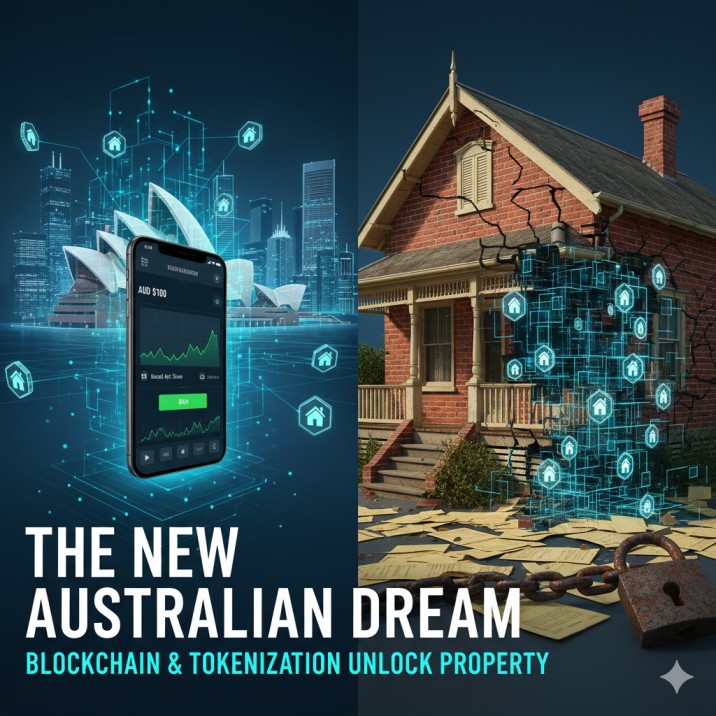
The “Great Australian Dream” of owning a home has, for many, started to feel more like a fantasy. Sky-high property prices, especially in major cities like Sydney and Melbourne, have created a high barrier to entry for Australian property, locking out an entire generation of potential investors and first-home buyers. The traditional real estate market is notoriously slow, expensive, and opaque. We’re still dealing with processes that take months, mountains of paperwork, and a long list of middlemen—from agents to bankers to lawyers—all taking a cut.
But what if there was a way to change all that? What if you could own a piece of a million-dollar apartment in Bondi for just $100? What if you could buy or sell your stake in a commercial building as easily as you trade shares on your phone?
This isn’t a far-off dream. This is what’s happening right now. A powerful wave of technology, led by blockchain and tokenization, is beginning to disrupt the very foundations of the Australian real estate market. This isn’t just a small tweak; it’s a fundamental shift promising to make property investing more accessible, liquid, and transparent than ever before. This article explores in-depth how blockchain and tokenization are disrupting the Australian real estate market, breaking down the complex tech, the game-changing benefits, the very real risks, and what the future of real estate investing in Australia truly looks like.
Why the Australian Property Market is Ready for a Shake-Up
For decades, Australian real estate has been seen as one of the safest and most reliable ways to build wealth. But this reliability has come at a cost. The system is old, inefficient, and fundamentally exclusive. Before we dive into the solution, let’s understand the core problems that blockchain technology is poised to solve.
The High Barrier to Entry for Aussie Home Buyers
The most obvious problem is cost. The median house price in many capital cities requires a deposit that is simply unattainable for the average person. This locks out young people, new investors, and those without existing family wealth. The traditional model is all-or-nothing; you either have the $150,000 deposit, or you’re stuck on the sidelines. This has created a two-tiered system and made the high cost of Australian property a national conversation.
The Problem of Illiquid Real Estate Assets
In finance, “liquidity” refers to how quickly you can sell an asset and get your cash. Real estate is one of the most illiquid assets on the planet. Selling a property involves finding an agent, marketing, open houses, negotiations, legal checks, and finally, a settlement period that can take 30, 60, or even 90 days. These slow property settlement times mean your wealth is “locked up.” You can’t just sell 10% of your house if you need quick cash. This illiquidity in real estate assets is a major drawback for investors who may need to access their capital.
Lack of Transparency and Inefficient Processes
Buying property is a mess of paperwork. It involves multiple parties (buyers, sellers, banks, conveyancers, government registries) who all keep their own separate records. This creates a lack of transparency in property deals and opens the door to errors and even fraud. Think about title fraud, where someone illegally sells a property they don’t own. The entire process is bogged down by manual checks, high property transaction costs Australia, and a reliance on trusted (and expensive) third parties to verify everything.
What are Blockchain and Tokenization in Simple Terms?
To understand the disruption, you first need to grasp the two core technologies driving it. Let’s break them down without the confusing jargon.
Demystifying Blockchain Technology in Real Estate
Forget the complicated code. At its simplest, a blockchain is just a digital ledger, or a record book.
Imagine a Google Doc that an entire group of people can see and edit. But with two special rules:
- You can only add new information; you can never delete or change what’s already there. (This is called “immutability”).
- Everyone in the group has their own identical copy of the doc, and it updates for everyone at the same time. (This is called “decentralization”).
Now, apply this to property. Instead of a single, central land title office (which could be hacked, make an error, or be destroyed), you have a decentralized property registry Australia. Every transaction—every sale, every mortgage, every lease—is recorded as a “block” of data. This block is added to the “chain” and distributed to all participants.
To fake a transaction, a hacker would need to change the record on thousands of computers at the exact same time, making it virtually impossible. This creates immutable property records and provides a single, verifiable source of truth for who owns what.
What is Real Estate Tokenization? (And Why It Matters)
This is where the magic really happens. Tokenization is the process of converting ownership rights in a real asset—like an apartment, an office building, or a plot of land—into a digital “token” that lives on the blockchain.
Think of it thisSame way a company divides its ownership into thousands of shares that you can buy on the stock market. Real estate asset tokenization does the same for a single property.
Let’s say a commercial building in Melbourne is worth $10 million. A real estate asset tokenization platform could represent this building with 10 million digital tokens. Each token is now worth $1 and represents a tiny, direct stake in that building.
Suddenly, you don’t need $10 million to invest. You can buy 100 tokens for $100. This is the fractional ownership of Australian homes and properties made real.
How Smart Contracts Automate Real Estate Transactions
If blockchain is the ledger and tokens are the assets, smart contracts are the engine that makes it all work.
A smart contract is a piece of code on the blockchain that automatically runs when certain conditions are met. It’s like a digital vending machine:
- You (Buyer): Put in $500,000 (Condition 1).
- The Land Title Office (via the blockchain): Confirms the title is clear (Condition 2).
- Vending Machine (Smart Contract): Automatically releases the $500,000 to the seller AND transfers the digital title (token) to you.
No need for a third party to hold money in escrow. No waiting weeks for paperwork to clear. The automating real estate with smart contracts capability means transactions can be faster, cheaper, and more secure. We could even see smart contracts for rental agreements, where rent is automatically paid and bond is automatically released if the property inspection (verified by a ‘digital oracle’) is clear.
The Game-Changer: Fractional Ownership of Australian Property
The single biggest disruption from this technology is fractional ownership. This one concept blows the doors off the traditional real estate market and directly addresses the affordability crisis.
Breaking Down Barriers: How to Invest in Tokenized Real Estate
For the first time, you don’t need a massive bank loan to become a property investor. Fractional ownership of Australian homes allows you to:
- Invest with less: Start with as little as $50 or $100.
- Diversify: Instead of putting a $200,000 deposit on one property, you could put $20,000 into ten different properties across Australia. You could own a piece of a Sydney real estate tokenization project and a Melbourne property blockchain project simultaneously.
- Earn Passive Income: As an owner of tokens, you are entitled to your share of the profits. If the $10 million building we mentioned earlier generates $500,000 in rental income per year, and you own 0.1% of the tokens, you would automatically receive $500 in rental income, likely paid directly to your digital wallet.
This is how to invest in tokenized real estate: you log onto a platform, browse properties, and buy tokens representing the ones you like.
Tokenization vs. REITs in Australia: What’s the Difference?
You might be thinking, “This sounds just like a Real Estate Investment Trust (REIT).” It’s a fair question, but there are crucial differences.
A REIT (Real Estate Investment Trust) is a company that owns and operates a portfolio of properties. When you buy a share in a REIT, you’re buying a share of the company, not the underlying properties. You’re trusting the fund managers to make good decisions.
With tokenization vs REITs in Australia, tokenization offers:
- Direct Ownership: You own a direct, verifiable stake in a specific building. You choose the exact asset you want to invest in.
- Lower Fees: REITs have management fees, administrative costs, and layers of bureaucracy. Tokenization, using smart contracts to automate, aims to cut out many of these middlemen, resulting in lower investment costs property Australia.
- Greater Liquidity: REITs trade on the stock exchange during market hours. Tokenized assets can be traded on digital exchanges 24/7, offering peer-to-peer property trading Australia. This potential for 24/7 real estate trading Australia is a massive leap in liquidity.
Unlocking the Top Benefits of Blockchain in the Property Sector
When you combine fractional ownership, transparent ledgers, and automated contracts, you get a cascade of benefits that could transform the entire industry.
Boosting Liquidity in a Traditionally Stubborn Market
This is the holy grail. As mentioned, real estate is infamously illiquid. Tokenization turns this on its head. By creating a secondary market for property tokens, an owner who needs cash can simply log on and sell their $10,000 stake in an apartment, potentially in minutes, not months. This increased liquidity in real estate assets makes property a much more flexible and attractive asset class.
Drastically Improving Transparency and Security
With blockchain, the entire history of a property—every sale, every lien, every repair (if logged)—can be stored on an unchangeable record. This delivers greater transparency in property transactions.
Imagine doing due diligence on a property and being able to see a perfect, verified digital history. This is how blockchain reduces property fraud. You can’t sell a property you don’t own because the blockchain proves ownership. This creates secure property ownership records that are far superior to our current paper-based systems.
Lowering Costs and Cutting Out the Middlemen
So much of the cost of a property transaction is “friction.” We pay for insurance, escrow services, title checks, and registration fees, all to build trust.
Blockchain is the trust. By using smart contracts, many of these roles can be automated. This disintermediation in real estate (a fancy word for cutting out the middle) could dramatically lower transaction costs. Even the blockchain-based mortgage process Australia is being explored, potentially automating approvals and fund releases, saving time and money for both lenders and borrowers.
Opening the Door to Global Investment in Australian Real Estate
The Australian property market is highly attractive to international investors, but the process is complex and expensive. Tokenization simplifies this. A global access to Australian property market opens up when an investor in London or Singapore can securely buy tokens representing a stake in a Brisbane office building, with the same ease as buying a stock. This could bring a new wave of capital into the market, managed with full transparency and regulatory compliance.
What are the Risks of Tokenized Real Estate in Australia?
It’s not all sunshine and roses. This technology is new, and with great disruption comes great challenges. Being a smart investor means understanding the risks. This is a critical part of fulfilling Google E-E-A-T criteria—being trustworthy and acknowledging the full picture.
The Evolving Australian Regulation on Real Estate Tokens
This is the biggest hurdle. Regulators are still figuring out what these tokens are. Are they a financial product? A security? A new type of property deed?
The legal framework for tokenized property is still being built. Key bodies like the Australian Securities and Investments Commission (ASIC) are closely watching this space. As an investor, you need to know that the rules could change. Strong consumer protection for digital property is essential before this goes mainstream. For up-to-date information, it’s always best to check regulatory guidance directly, such as on the ASIC website.
Smart Contract Security and Technical Hurdles
Smart contracts are powerful, but they are just code. And code can have bugs. A poorly written smart contract could have smart contract security vulnerabilities that hackers could exploit, potentially leading to a loss of funds.
There’s also the technical barrier. Investors need to understand how to use digital wallets to store their tokens securely. If you lose the private keys to your wallet, you could lose access to your assets forever. This is very different from having your name on a paper title deed.
Market Volatility and Adoption Challenges
While one of the goals is liquidity, a new market for real estate token market adoption will be small at first. This can mean high market volatility in tokenized assets. The price of your tokens might swing more wildly than the underlying property value.
Furthermore, the entire ecosystem—from buyers and sellers to agents and lawyers—needs to accept and adopt this technology. This will take time, education, and proven success stories.
The Future of Real Estate Investing in Australia: Web3 and Beyond
We are at the very beginning of this transformation. What we’re seeing now are the first Australian PropTech companies and blockchain projects laying the groundwork.
Real-World Australian Blockchain Property Projects
While many projects are still in pilot stages, we are seeing real-world movement. There are startups focused on creating platforms for tokenization of commercial property, and discussions are happening at the government level about how a blockchain for property titles Australia could work. These early trials are crucial for stress-testing the technology and building a blueprint for the future.
The Impact of Tokenization on Real Estate Agents and Mortgages
Many ask if this means the end of real estate agents. The answer is likely no, but their roles will change. The impact of tokenization on real estate agents will be a shift away from being gatekeepers of information and paperwork, and towards being expert advisors. They will help clients navigate this new digital marketplace, identify good tokenized investments, and provide human-level insights that an algorithm can’t.
We’ll also see a rise in Decentralized Finance (DeFi) for property. Imagine getting a mortgage not from a big bank, but by borrowing directly from a pool of capital supplied by other investors, with the loan terms and repayments all managed by a smart contract. This is the future of PropTech in Australia.
Is This the End of the Australian Property Market as We Know It?
No, it’s not the end. It’s the beginning of a much-needed evolution. The traditional way of buying a house isn’t going to disappear overnight.
But blockchain and tokenization are disrupting the Australian real estate market in a way that can’t be ignored. This technology is a powerful force for democratization. It tackles the market’s biggest problems head-on:
- It lowers the high barrier to entry.
- It solves the problem of illiquid real estate assets.
- It replaces the lack of transparency with verifiable proof.
For the average Aussie, this means the “Great Australian Dream” might no longer be about saving for 20 years for a single backyard. It might be about building a diverse, liquid, and accessible portfolio of properties, one token at a time. The landscape of Web3 and the Australian property market is just being drawn, and for those willing to learn and adapt, it presents an incredible opportunity.
Frequently Asked Questions About Blockchain and Real Estate in Australia
1. Is tokenized real estate legal in Australia?
The Australian regulation on real estate tokens is still developing. Currently, many token offerings are structured as ‘Managed Investment Schemes’ (MIS), which must be licensed by ASIC. It is crucial to only use platforms that are licensed and regulated in Australia.
2. Is this the same as buying property with cryptocurrency?
Not necessarily. Crypto investment in Australian real estate (e.g., buying a house with Bitcoin) is a separate concept about the payment method. Tokenization is about the ownership structure. You will most likely use Australian dollars to buy a property token.
3. What happens if I lose my digital wallet?
This is a major risk of tokenized real estate investment. If you hold your own tokens in a ‘non-custodial’ wallet and lose your private keys (your password), your tokens are likely lost forever. However, many regulated platforms will be ‘custodial’, meaning they manage the wallet and security for you, much like a share trading platform.
4. Can I live in a house I’ve bought tokens in?
No. When you buy tokens in a residential property, you are an investor, not an owner-occupier. You are entitled to a share of the rental income and any capital gains, but you don’t have a right to live there.
5. How does tokenization differ from a property syndicate?
A syndicate is a traditional, offline version of fractional investment. It’s often run by a single manager, has high minimum investments ($50,000+), and is highly illiquid (you’re often locked in for 5-7 years). Tokenization is the digital, low-cost, and liquid version of a syndicate.
6. What are the tax implications of tokenized property?
This is complex and you must seek professional financial advice. Generally, income (from rent) would be treated as investment income, and any gains from selling the token would be subject to Capital Gains Tax (CGT), similar to selling shares or an investment property. The Australian Taxation Office (ATO) is the best source for an official stance.
7. How are tokenized properties valued?
The underlying property is valued just like any other, using licensed appraisers. The token price may fluctuate on a secondary market based on supply and demand, but it will always be anchored to the real-world value and rental yield of the asset.
8. Can a tokenized property be sold in the traditional way?
Yes. The smart contract would have rules for this. For example, if a “traditional” buyer offers to buy 100% of the property, token holders would vote on the sale. If approved, the property is sold, and the proceeds are distributed to all token holders.
9. What are the main benefits of using blockchain for property titles?
The main benefits are security and transparency. A blockchain for property titles Australia would create a single, immutable source of truth, making title fraud almost impossible and streamlining the entire settlement process.
10. How will this affect property management?
It could make it much more efficient. Smart contracts for rental agreements could automate rent collection and expense payments. Maintenance requests and payments to tradespeople could all be logged on the blockchain for a transparent and immutable record.
11. Is tokenized real estate a volatile investment?
The underlying asset (the property) is not typically volatile. However, the token (especially in a new, low-liquidity market) could be. This is a key difference and a risk to be aware of.
12. How do I start investing in tokenized real estate in Australia?
The first step is research and due diligence. Look for Australian-based real estate asset tokenization platforms that are fully licensed by ASIC. Read their product disclosure statements (PDS), understand their fee structure, and never invest more than you can afford to lose. As this is a new space, it’s wise to start small.