When you hear “AI in finance,” what comes to mind? For most people, it’s a helpful chatbot answering a billing question or a simple “robo-advisor” that puts their money into a basic mix of ETFs. These tools are useful, but they are just the tip of the iceberg. They are the Model T, and the industry is now building Formula 1 race cars.
The real revolution, happening right now in the most advanced hedge funds and investment banks, is the rise of autonomous AI agents.
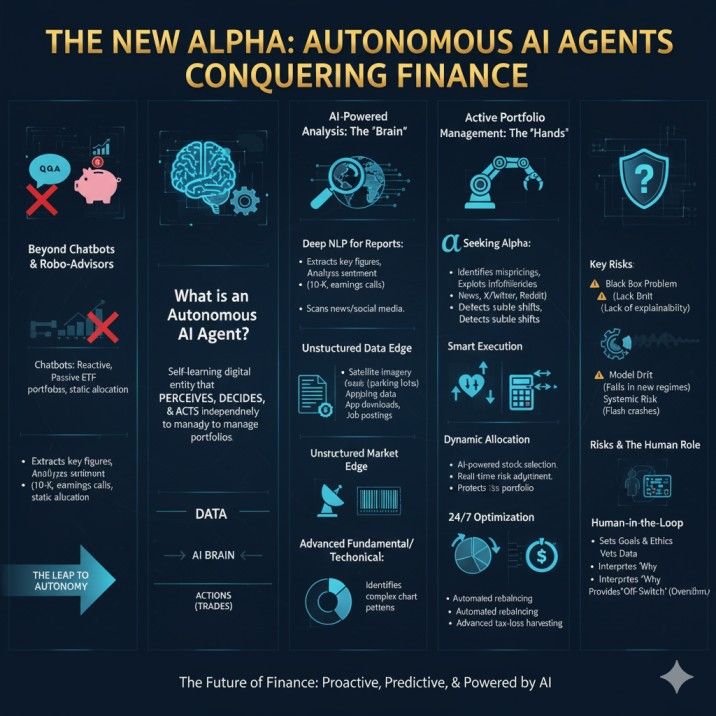
These are not simple, rule-based programs. They are sophisticated, self-learning digital entities designed to perform complex financial analysis and actively manage investment portfolios with minimal human intervention. They are a new class of digital worker, a “junior analyst” that never sleeps, never gets emotional, and can read a million pages of financial reports before you’ve had your morning coffee.
This isn’t just a faster way of doing the old thing. It’s a completely new paradigm. This article is a deep dive into the world of autonomous AI agents. We’ll explore how they are moving beyond chatbots, how they perform deep financial analysis, how they are being used in active portfolio management, and the massive risks and opportunities they present.
The Great Leap: From Simple Rules to True Autonomy
To understand where we’re going, we must first understand where we’ve been. The evolution of AI in finance has had distinct stages, and the leap to autonomous agents is the most significant yet.
What We Thought AI in Finance Was: Chatbots and Robo-Advisors
For the last decade, our interaction with “fintech AI” has been dominated by two tools:
- Chatbots for Customer Service: These are AI in their simplest form. They are driven by Natural Language Processing (NLP) to understand your query (e.g., “What’s my account balance?”) and provide a pre-programmed answer. They are reactive, not proactive.
- Robo-Advisors for Passive Investing: This was the first major step. Robo-advisors use simple algorithms based on Modern Portfolio Theory (MPT). You tell them your age, risk tolerance, and goals, and they place your money in a diversified, low-cost portfolio of ETFs. They passively maintain this allocation, perhaps rebalancing once a quarter. They are a “set it and forget it” tool.
The key limitation? Both are rule-based. They cannot adapt to new information they weren’t programmed to handle. A robo-advisor won’t sell your stocks because it “reads” a worrying trend in a new government report. It just follows its simple rules.
The New Frontier: Defining the Autonomous AI Agent in Finance
An autonomous AI agent is fundamentally different. It is not just a tool; it’s a system.
An autonomous AI agent in finance is a software program that can perceive its environment (the market), make its own decisions based on that data, and take independent actions (like executing trades) to achieve a specific, complex goal (like “maximize returns while keeping risk below X”).
How Autonomous AI Agents Are Different from Robo-Advisors
This is the most critical distinction for investors to understand.FeatureRobo-Advisor (Passive)Autonomous AI Agent (Active)StrategyPassive. Follows a pre-set plan (e.g., 60% stocks, 40% bonds).Active. Creates and adapts its own strategy in real-time.AnalysisMinimal. Based on user questionnaire and broad market data.Deep. Performs real-time fundamental and technical analysis.DataUses basic market prices and user goals.Consumes vast alternative data sets (news, social media, reports).GoalMatch market returns (beta).Beat the market (alpha) and manage complex risk.ActionRebalances to a static target.Proactively makes new trades and allocation decisions.
In short, a robo-advisor is a map. An autonomous AI agent is a self-driving car with a built-in GPS that analyzes traffic, weather, and road closures to find the fastest, safest route on its own.
The “Brain”: How Autonomous AI Agents Perform Advanced Financial Analysis
Before an agent can act, it must think. The “brain” of these agents is a collection of sophisticated machine learning models designed to consume and understand information at a scale and speed no human team could ever match.
Beyond Keywords: AI Agents Reading Financial Reports with NLP
When a company releases its quarterly 10-K or 10-Q report, a human analyst might spend a day reading it. An AI agent can “read” and understand it in seconds.
It’s not just doing a keyword search for “profit.” It uses advanced Natural Language Processing (NLP) to:
- Extract Key Figures: Instantly pull revenue, net income, debt levels, and other metrics, and compare them to all previous reports.
- Analyze Sentiment: Read the “Management’s Discussion and Analysis” section to gauge tone. Is the language optimistic or cautious? Is it more complex than last quarter (a potential red flag for obfuscation)?
- Parse Earnings Calls: AI agents can “listen” to the live earnings call, transcribing the audio and analyzing the sentiment of both the CEO’s prepared remarks and their unscripted answers during the Q&A.
AI for Real-Time Market Sentiment Analysis
The market is driven by fear and greed. AI agents are designed to measure this. They continuously scan millions of data points every minute to build a real-time sentiment score. This includes:
- News articles from thousands of global sources.
- Social media platforms like X (formerly Twitter) and Reddit to see what retail investors are saying.
- Financial blogs and forums.
The agent can detect a subtle shift in sentiment toward a stock or sector, or identify a breaking news story, long before it hits the mainstream and moves the price.
Processing Unstructured and Alternative Data for an Edge
This is where AI truly separates itself from human analysts. Alternative data for financial analysis is any data that isn’t a traditional stock price or financial report.
AI agents are built to find signals in this “unstructured” noise. Examples include:
- Satellite Imagery: An agent can analyze satellite photos of a retailer’s parking lots to predict sales figures before they are announced.
- Shipping Data: It can track container ship movements to gauge global trade volume or a specific company’s supply chain health.
- App Downloads: It can monitor download and usage data for a software company to predict subscription growth.
- Job Postings: A sudden spike or freeze in a company’s job postings can be a powerful leading indicator of its future performance.
No human can gather and process this much data. An AI agent can, and it can build predictive models showing how these data points correlate with future stock prices. Investopedia highlights that this data is increasingly used by hedge funds to find an edge.
AI-Driven Fundamental and Technical Analysis at Scale
Finally, the agent combines all this information to perform classic analysis, but at a superhuman scale.
- AI-Driven Fundamental Analysis: An agent can build thousands of different valuation models (like a Discounted Cash Flow, or DCF) in seconds, testing millions of variable combinations (e.g., “What happens to Apple’s stock price if interest rates rise 0.5% and their supply chain slows by 10%?”).
- AI-Driven Technical Analysis: The agent can identify highly complex, multi-dimensional chart patterns across thousands of stocks simultaneously, finding trading opportunities that are invisible to the human eye.
The “Hands”: AI in Active Portfolio Management
Once the “brain” has formed a thesis, the “hands” of the agent take over. This is the active portfolio management component, where the agent makes and executes financial decisions.
AI Strategies for Beating the Market: The Search for Alpha
In portfolio management, “alpha” is the holy grail. It represents a return on investment that is above the market average. It’s the skill of the manager, not just luck.
Autonomous AI agents are designed specifically to use AI to find alpha. They do this by:
- Identifying Mispricings: By combining fundamental analysis with alternative data, the agent can identify a stock that it believes is “mispriced” (either too cheap or too expensive) by the human-dominated market.
- Exploiting Inefficiencies: The agent can execute trades in milliseconds to capitalize on these small, temporary mispricings before human traders even notice them.
- Factor-Based Investing: An agent can analyze thousands of “factors” (like value, momentum, quality) and build a portfolio that dynamically shifts its exposure to the factors it predicts will perform best in the current market environment.
Intelligent Agents for Algorithmic Trading and Smart Execution
When the agent decides to buy 100,000 shares of a stock, it doesn’t just hit a “buy” button. A large order like that could itself move the market and result in a bad price.
Instead, it uses intelligent execution algorithms. The agent might break the large order into thousands of tiny pieces, executing them across different exchanges over several hours. It monitors the market’s reaction in real-time and will slow down or speed up its trading to minimize its own “market impact” and get the best possible average price.
AI-Powered Stock Selection and Dynamic Asset Allocation Models
This is perhaps the agent’s most powerful function. Based on the client’s goals (e.g., “a 7% annual return with a max 10% drawdown”), the agent builds a complete portfolio.
- AI-Powered Stock Selection: Instead of buying an index fund (like the S&P 500), the agent will build its own index, hand-picking the 50 stocks it believes have the highest probability of outperforming.
- Dynamic Asset Allocation: A robo-advisor might keep you in a 60/40 stock/bond mix no matter what. If an autonomous agent’s analysis shows a high risk of a recession, it might proactively and autonomously sell stocks and move that money into bonds or gold to protect the portfolio. It doesn’t wait for a human to tell it to.
The 24/7 Analyst: How AI Performs Automated Portfolio Rebalancing and Tax Optimization
The agent is always on.
- Automated Rebalancing: The agent doesn’t just rebalance on a calendar. It rebalances opportunistically. If a stock in the portfolio has a massive price spike, the agent can trim the position that same day to lock in profits and redeploy the cash.
- AI Agents for Advanced Tax-Loss Harvesting: This is a huge benefit. At any given moment, the agent knows the tax basis for every single share it holds. It can continuously scan the portfolio for opportunities to sell a losing position, “harvest” the capital loss to offset gains, and immediately reinvest the money into a similar (but not identical) asset to maintain market exposure. This level of tax optimization is impossible to do manually.
The Unseen Risks and Ethical Questions of Autonomous AI
This power is not without significant risk. Handing over financial decisions to an autonomous AI introduces a new set of complex problems that regulators and investors are only beginning to grapple with.
The ‘Black Box’ Problem in AI Financial Models
Many of the most powerful AI models, like deep learning neural networks, suffer from the “black box” problem.
This means that while the model is incredibly accurate at making predictions, its internal logic is so complex that even its human creators can’t fully explain why it made a specific decision.
Why did the AI agent suddenly sell all of its holdings in the tech sector? The answer might be a complex correlation between 500 different data points that no human can understand. This is a massive issue for compliance and trust. If you don’t know why you lost money, how can you fix the model?
What is AI Model Drift in Finance?
AI models are trained on historical data. But what happens when the market enters a new “regime” that looks nothing like the past?
This is called AI model drift. A model trained on a decade of low-interest-rate, low-inflation data may fail spectacularly when faced with a sudden inflationary spike or a global pandemic. The model’s “understanding” of the world is no longer accurate. This is a primary reason why JPMorgan Chase and other major firms emphasize rigorous testing and human oversight.
Cybersecurity Risks of Autonomous Finance AI
What happens if a bad actor hacks your autonomous financial agent?
This isn’t like stealing a credit card number. A hacked agent could be instructed to liquidate your entire portfolio in seconds, wire the money to an offshore account, or even use your portfolio to intentionally manipulate a stock’s price. Securing these agents is a paramount, and incredibly difficult, challenge.
AI Agents and Systemic Market Risk: The ‘Flash Crash’ Scenario
A single AI agent is powerful. What happens when everyone is using them?
This is the nightmare scenario for regulators. If thousands of autonomous agents are all trained on similar data and models, they might all react to a piece of news in the exact same way. This could lead to a massive, self-reinforcing cascade of “sell” orders, triggering a “flash crash” that wipes out market value in minutes, with no humans in the loop to stop it.
The Human Element: Will Autonomous AI Replace Financial Analysts?
The natural question is: Are human financial advisors and portfolio managers doomed?
The answer is “no,” but their job is about to change forever. We are moving from a “human-only” model to a “human-in-the-loop” model.
The Critical Role of Human Oversight for AI Agents
The future is not about letting an AI agent run wild with your money. The future is about human-in-the-loop oversight.
The human manager’s role shifts from doing the analysis to managing the AI. Their new tasks will be:
- Setting the Goals: The human defines the agent’s ultimate objective, its risk parameters, and its ethical boundaries.
- Vetting the Data: The human is responsible for ensuring the data the AI is learning from is clean, accurate, and unbiased.
- Interpreting the “Why”: The human’s job is to challenge the AI’s recommendations and to be the “common sense” filter, especially during new or unusual market events.
- The “Off-Switch”: The human must always have the ability to override the agent or shut it down if it begins to act erratically.
The U.S. Securities and Exchange Commission (SEC) is actively working on rules to ensure that investment firms maintain this crucial human oversight, ensuring AI is used responsibly.
Redefining the Job: From Analyst to AI ‘Manager’
The financial analyst of the future will not be building spreadsheets. They will be a “manager” of a fleet of AI agents. Their skills will be less about financial modeling (the AI will do that) and more about data science, psychology, and risk management.
The Future of Your Wallet: What This Means for You
This technology isn’t just for billion-dollar hedge funds. It is being democratized and will change personal finance forever.
AI Financial Advisor Platforms for Retail Investors
Within the next few years, you will likely be able to hire your own personal AI financial agent.
These AI financial advisor platforms for retail investors will go far beyond what today’s robo-advisors can do. You’ll be able to give your agent complex, personalized goals, such as:
- “Manage my $50,000 portfolio for growth, but automatically set aside 10% of all profits for my tax bill.”
- “Monitor my spending and this basket of stocks, and tell me when I have enough free cash flow to buy more shares.”
- “I want to retire in 2040. Build and actively manage a portfolio that gets me there, and adjust its risk downward as I get closer to the date.”
This is the “democratization of alpha,” giving everyday investors access to strategies that were once the exclusive domain of the ultra-wealthy.
The Future of Your 401(k) and Pension
This technology is already being deployed by the massive institutional investors that manage your 401(k) and pension funds. They are using autonomous agents to manage risk, find new opportunities, and eke out a small performance “edge” that, when scaled over billions of dollars, results in massive gains.
Conclusion: The Proactive, Predictive Future of Finance
We are standing at the threshold of a new era. The move from simple chatbots to autonomous AI agents is as significant as the move from telephone-based trading to internet-based trading.
These agents are turning finance from a reactive field to a proactive and predictive one. They are capable of analyzing the world as a complex, interconnected system and making active decisions in real-time.
The promise is immense: a more efficient market, the democratization of sophisticated financial tools, and the potential for greater returns. But the risks are equally large: the “black box” problem, the potential for systemic crashes, and the complex challenge of human oversight.
The one thing that is certain is that this technology is not a fad. The agents are here, they are learning, and they are about to change the way you think about money forever.
Frequently Asked Questions (FAQ) About Autonomous AI in Finance
1. What is the main difference between an AI agent and a robo-advisor?
A robo-advisor is passive. It follows a simple, pre-set plan you agree to (e.g., a 60/40 stock/bond mix) and just rebalances to that target. An autonomous AI agent is active. It performs its own analysis, creates its own trading strategies, and proactively makes new investment decisions to try and beat the market.
2. What is an autonomous AI agent in finance?
It’s a sophisticated software program that can independently analyze financial markets, make investment decisions, and execute trades to achieve a specific goal (like “maximize returns”) without needing direct human commands for each action.
3. Can AI agents really predict stock prices?
“Predict” is a strong word. AI agents are not “crystal balls.” They do not know the future. Instead, they use machine learning to analyze massive amounts of data to determine the probability of a stock moving in a certain direction. They are designed to make more high-probability “bets” than a human can.
4. How do AI agents perform financial analysis?
They use a combination of machine learning models. Natural Language Processing (NLP) is used to read news, social media, and financial reports. Computer vision can analyze satellite imagery (like parking lots). They combine this with traditional financial data to build predictive models that forecast risk and opportunity.
5. What is active portfolio management with AI?
This is where an AI agent doesn’t just buy an index fund. It actively selects individual stocks or other assets it believes will outperform. It dynamically changes the portfolio’s allocation to different assets based on its real-time analysis of market conditions.
6. What are the biggest risks of AI in portfolio management?
The three biggest risks are:
- The “Black Box” Problem: Not understanding why the AI made a decision.
- Model Drift: The AI’s strategy, trained on past data, fails in a new market event.
- Systemic Risk: Many AI agents reacting the same way at the same time, causing a “flash crash.”
7. Will autonomous AI replace financial analysts and advisors?
It is unlikely to replace them, but it will fundamentally change their jobs. The human’s role will shift from doing the day-to-day analysis to becoming a “manager” of AI agents—setting their goals, validating their data, and providing critical human oversight.
8. What is ‘alternative data’ for financial analysis?
It’s any non-traditional data that can provide an investment edge. This includes things like satellite photos, credit card transaction data, app download statistics, shipping container logs, job postings, and social media sentiment. AI agents are especially good at analyzing this “unstructured” data.
9. How do autonomous systems for financial trading work?
They run on a continuous loop:
- Perceive: Ingest millions of market data points.
- Analyze: Use AI models to find patterns and opportunities.
- Decide: Formulate a trading plan (e.g., “buy 10,000 shares of X”).
- Act: Use smart execution algorithms to make the trades.
- Learn: Analyze the result of the trade and update its own models.
10. What is the ‘black box’ problem in AI financial models?
This refers to complex AI models (like neural networks) where the internal logic is so complicated that humans cannot fully understand how it arrived at its conclusion. This makes it hard to trust, debug, or get regulatory approval for.
11. How can AI agents for retail investors help me?
In the future, you’ll be able to “hire” a personal AI agent to actively manage your money with a level of sophistication previously only available to hedge funds. This includes active stock selection, dynamic risk management, and 24/7 tax optimization.
12. What is AI-driven fundamental analysis?
This is where an AI agent uses machine learning to perform the work of a traditional fundamental analyst. It can read all of a company’s financial reports, analyze its management, and build thousands of valuation models in seconds to determine what it believes the company’s “true” stock value is.
13. Are AI trading agents regulated?
Yes. All investment advisors and trading systems, whether human or AI, fall under the jurisdiction of regulators like the SEC. These bodies are creating new rules to address the unique risks of AI, focusing on transparency, fairness, and ensuring human oversight.
14. What is the difference between AI agents and high-frequency trading (HFT)?
HFT is almost exclusively focused on speed—making thousands of trades in fractions of a second to exploit tiny price differences. Autonomous AI agents are focused on intelligence. They may hold a position for days, weeks, or months, based on a deep, complex analysis of fundamental data, news, and market sentiment.
15. How does AI-powered stock selection work?
An AI agent builds a model that correlates thousands of data points (e.g., revenue growth, debt-to-equity ratio, management sentiment, alternative data) with future stock performance. It then scans the entire market to find the stocks that currently have the highest “score” according to that model.