Ever clicked a link and felt like you could brew a pot of coffee before the page loaded? Or tried to video chat with family, only to have the conversation devolve into a frozen, stuttering mess? For millions of people, especially those in rural and remote areas, this isn’t a joke; it’s the daily reality of a slow, unreliable internet connection. For decades, the solution from the sky—satellite internet—wasn’t much better, often plagued by excruciating lag.
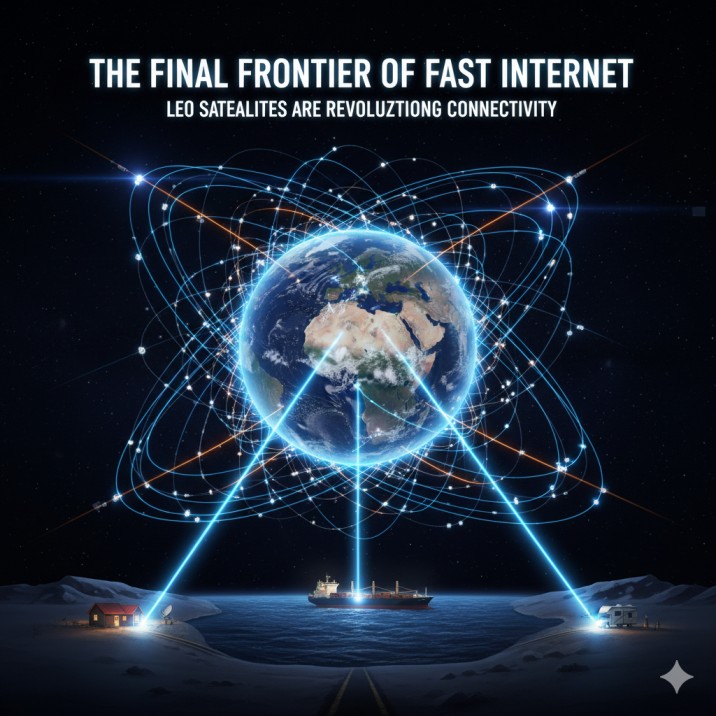
But that’s all changing. A new space race is underway, not for the moon, but for the space just above our heads. This race is deploying thousands of Low Earth Orbit (LEO) satellites that promise to deliver fiber-like speeds to virtually every corner of the globe.
This isn’t just a minor upgrade. It’s a complete paradigm shift. In this guide, we’ll take a deep dive into the science behind the speed of LEO satellites. We’ll explain, in simple terms, the core technologies that make this revolution possible—from latency and bandwidth to massive constellations and laser-guided data streams. Prepare to understand how low earth orbit satellite internet works and why it’s poised to change the world.
The Great Space Race for Internet: Why Altitude Is Everything (LEO vs. GEO)
To understand why LEO is such a game-changer, we first need to look at the old guard: Geostationary (GEO) satellites. For a long time, they were our only option for connecting from the cosmos.
What are Geostationary (GEO) Satellites? The Slow and Steady Workhorse
Imagine a satellite so high up that its orbit perfectly matches the Earth’s rotation. From our perspective on the ground, it appears to hover in a fixed spot in the sky. This is a Geostationary satellite. To achieve this orbital magic, it has to be placed at a very specific altitude: a staggering 35,786 kilometers (about 22,236 miles) above the equator.
This fixed position is fantastic for things like weather forecasting and satellite TV broadcasting, as you can point a dish at it and forget it. However, this massive distance is the Achilles’ heel for internet connectivity. The geostationary satellite altitude and its problems are all about one critical factor: delay.
Introducing Low Earth Orbit (LEO) Satellites: The Need for Speed
Now, imagine bringing that satellite much, much closer to home. LEO satellites orbit the Earth at altitudes between 500 and 2,000 kilometers (about 310 to 1,240 miles). That’s more than 100 times closer than their GEO counterparts.
This proximity is the single most important factor in the difference between LEO and GEO satellites for internet. By being so much closer, LEO satellites can deliver data with a tiny fraction of the delay. The tradeoff is that they are no longer stationary. They zip across the sky at incredible speeds, completing a full orbit of the Earth in as little as 90 minutes. This creates a different set of challenges, but as we’ll see, modern technology has turned this challenge into a strength.
Demystifying the Magic: How LEO Satellites Actually Deliver Low Latency Internet
We keep mentioning “delay” and “latency.” These terms are the heart of the LEO revolution. Let’s break down exactly what they mean and how LEO technology conquers them.
The Physics of Ping: A Simple Explanation of Latency
Have you ever heard gamers complain about “high ping”? They’re talking about latency. Latency, often measured in milliseconds (ms) as “ping time,” is the time it takes for a data packet to travel from your computer to a server and back again. It’s the technical term for lag.
Think of it like this: You shout a question to a friend across a small room. You get a reply almost instantly. That’s low latency. Now, imagine shouting that same question to a friend on the other side of a massive canyon. The time it takes for your voice to travel there and for their reply to travel back is the latency.
For a GEO satellite, your data has to make an epic round trip:
- Your computer to the dish on your roof.
- From your dish up to the satellite (35,786 km).
- From the satellite down to a ground station connected to the internet.
- And then all the way back again.
This journey, even at the speed of light, results in a latency of 600 ms or more. That’s the cause of that awkward pause in video calls and the reason competitive online gaming is impossible on GEO internet. The GEO satellite internet lag explained simply comes down to this unavoidable travel time.
This is precisely how LEO satellites reduce signal delay. With a much shorter round trip of just a few thousand kilometers, LEO systems can achieve latencies as low as 20-40 ms. This is comparable to ground-based connections like cable and is a key reason why is LEO satellite latency so low. This is a performance leap that makes real-time applications like Zoom calls, online gaming, and remote work feel seamless.
Beyond Latency: Understanding Bandwidth in a LEO Context
While latency is about speed of response, bandwidth is about capacity. If latency is the speed limit on a highway, bandwidth is the number of lanes. It determines how much data you can move at once—think streaming a 4K movie or downloading a large file.
One of the key factors affecting satellite internet bandwidth is the focused nature of the signal beam. LEO constellations use a vast number of satellites, each covering a relatively small area on the ground called a “cell.” This allows for the reuse of frequencies and the delivery of more concentrated bandwidth to fewer users within that cell. The result is that LEO systems can provide significant download speeds, often exceeding 100-200 Mbps, which is far better than the LEO satellite internet bandwidth vs cable debate might suggest for many underserved areas.
The Power of Teamwork: How LEO Satellite Constellations Work Together
As we mentioned, a single LEO satellite zips across the sky too quickly to provide a constant connection. The solution is brilliant and ambitious: create a massive, interconnected team of them.
Why One LEO Satellite Isn’t Enough: The Concept of a Constellation
To ensure you always have a connection, you need a new satellite to come into view just as the previous one is flying out of range. This is the core idea behind a satellite constellation. Companies like SpaceX (Starlink), OneWeb, and Amazon (Project Kuiper) are deploying thousands of satellites to form a dense, overlapping mesh network in the sky.
Imagine a continuous celestial relay race. As one satellite moves away, your user terminal (the dish) seamlessly hands off the signal “baton” to the next incoming satellite, all without you ever noticing. This is how do LEO satellite constellations work together to provide uninterrupted service. The Starlink satellite constellation explained for beginners is simply a giant net of satellites ensuring that no matter where you are, one is always overhead, ready to connect you.
The Ground Game: The Critical Role of Ground Stations
The satellites in space are only half of the equation. They need a way to connect to the internet we all use, which is based on a massive network of undersea and underground fiber optic cables. This is what is the role of ground stations for LEO satellites.
Ground stations are facilities on Earth with large antennas that are the bridge between the satellites and the terrestrial internet backbone. Your data travels from your terminal to the satellite, which then relays it down to the nearest ground station. This is how do LEO satellites connect to the internet backbone. The strategic placement of these stations all over the world is crucial for keeping latency low and the entire system running smoothly.
Your Connection to Space: Phased Array Antennas Explained
If the satellites are constantly moving, how does the dish on your roof keep up? The answer lies in one of the most advanced pieces of technology in the system: the user terminal. This isn’t your parents’ old, clunky satellite dish that had to be manually pointed by a technician.
Modern LEO terminals use phased array antennas. Instead of one large dish that physically moves, a phased array antenna is a flat panel containing hundreds of tiny, individual antennas. By making minuscule, electronic adjustments to the signal timing (the “phase”) of each tiny antenna, the system can form and steer a tight beam of data towards a satellite. It can track a satellite moving across the sky and then, in an instant, switch to the next one, all with zero moving parts.
The advantages of electronic steering in antennas are immense: they are faster, more reliable, and can be made much more compact. This beamforming technology in LEO satellites explained is what makes the seamless handoff between satellites possible, giving you a stable and consistent connection.
The Future is Now: Advanced Tech Pushing LEO Satellites Even Further
The innovation doesn’t stop there. The next generation of LEO constellations is incorporating technology that sounds like it’s straight out of science fiction to make the network even faster and more robust.
Cutting Out the Middleman: The Revolution of Inter-Satellite Laser Links
The biggest remaining source of latency in some LEO connections is the “hop” down to a ground station and back up. What if the satellites could just talk to each other directly?
That’s exactly what inter-satellite laser links (ISLLs) do. Many newer LEO satellites are equipped with lasers that allow them to shoot huge amounts of data to their neighboring satellites in the constellation. This is how do satellites talk to each other with lasers, creating a true data network in the vacuum of space.
The benefits of optical inter-satellite communication are incredible.
- Reduced Latency: Data can zig-zag through space, taking the most direct path instead of always needing a ground station. Light travels faster in a vacuum than through fiber optic glass, so for very long-distance connections (e.g., New York to Sydney), routing data through space can actually be faster than using undersea cables.
- Global Coverage: This technology is laser links reducing reliance on ground stations. It means you can get a connection even in the middle of the ocean or in the polar regions, far from any ground station. The satellites can route your traffic across the globe through the space-based network until it reaches a satellite that is within range of a ground station near its final destination. The SpaceX Starlink laser links explained this way show a clear path to truly universal internet access.
Is LEO Satellite Internet the Right Choice for You?
With all this amazing technology, is LEO internet the ultimate solution for everyone? The answer is nuanced.
Who Benefits Most from LEO Satellite Technology?
The primary audience and biggest beneficiaries are those with limited or no access to high-speed terrestrial internet. This includes:
- Rural and Remote Homes: For those stuck with slow DSL, traditional GEO satellite, or no options at all, LEO internet is life-changing. It is undoubtedly the answer to the question, “is LEO satellite internet good for rural areas?”
- Mobile Operations: The transportation, shipping, and aviation industries can now have reliable, high-speed internet on moving vehicles, ships at sea, and airplanes.
- Businesses & Emergency Services: It provides a fantastic option for business continuity, offering a reliable backup internet source that is completely independent of ground-based infrastructure.
Comparing LEO Satellite Internet to Fiber and 5G
It’s important to have realistic expectations. When comparing LEO satellite latency vs fiber optic, fiber still holds the crown. A direct fiber optic connection will almost always offer slightly lower latency and more consistent speeds because it’s a physical, dedicated line.
Similarly, the LEO satellite internet vs 5G performance debate depends on location. In a dense urban area with strong 5G coverage, your mobile connection might be faster. However, 5G’s reach is limited, and its performance can degrade with distance from the tower.
LEO internet’s unique value proposition is its reach. It provides very good, low-latency performance almost anywhere on the planet with a clear view of the sky. For a vast portion of the world’s geography, it’s not just the best option—it’s the only option.
Conclusion: A New Era of Global Connectivity
The science behind LEO satellites is a symphony of incredible innovations. By moving satellites closer to Earth, the crippling latency of the past has been solved. By launching thousands into interconnected constellations, they provide constant, reliable coverage. And through advanced technologies like self-pointing phased array antennas and space-based laser links, the system is becoming smarter, faster, and more resilient every day.
We are at the very beginning of a new era of global connectivity. The digital divide that has left so many behind is finally being bridged, not by cables laid in the ground, but by a meticulously engineered web of light and data in the sky. The future of the internet is not just fast; it’s everywhere.
Frequently Asked Questions (FAQ)
1. Can I use LEO satellite internet for competitive online gaming?
Absolutely. This is one of the biggest advantages over older satellite technology. With latency often between 20-50ms, the gaming experience on LEO internet is comparable to cable or fiber, making it an excellent solution for gamers in rural areas where the impact of latency on online gaming was previously a major issue.
2. How does bad weather like rain or snow affect LEO satellite internet?
Like any satellite service, very heavy rain, snow, or hail can temporarily interfere with the signal, an effect known as “rain fade.” However, because the LEO signal is much stronger due to the satellite’s proximity, the impact is generally less severe and shorter-lived than with GEO satellite systems. Most user terminals also have a built-in heating element to melt snow and ice.
3. What is the installation process for a LEO satellite internet terminal?
Most LEO services, like Starlink, are designed for user-friendly self-installation. The kit typically comes with the terminal (dish), a mount, and a cable. The basic process involves placing the terminal in a location with a clear, unobstructed view of the sky and then plugging it in. The terminal automatically orients itself to connect with the constellation. For more information, you can explore resources from the Federal Communications Commission (FCC) on satellite service.
4. Is LEO satellite bandwidth shared with other users?
Yes, like most internet services (including cable and 5G), the bandwidth in a specific geographic “cell” is shared among the users within it. During peak usage times in a densely populated area, speeds may be slightly lower. However, constellation operators are constantly launching more satellites to increase capacity and manage network performance.
5. What are the major LEO satellite constellations currently in operation or development?
The most well-known is SpaceX’s Starlink. Other major players include OneWeb, which also has a large constellation in orbit, and Amazon’s Project Kuiper, which is in its deployment phase. There are also several other companies planning constellations for various purposes.
6. How does LEO satellite internet compare in cost to other services?
The cost of LEO satellite internet service involves an upfront hardware fee for the user terminal and a monthly subscription fee. This monthly fee is often competitive with or slightly higher than mid-to-high-tier cable or fiber plans, but it is significantly more affordable than many specialized remote connectivity solutions of the past.
7. Do LEO satellites contribute to “space junk”?
This is a significant concern for the industry. Modern LEO constellations are designed with end-of-life plans. Satellites are built to use their remaining fuel to de-orbit at the end of their service life, causing them to burn up completely in Earth’s atmosphere to prevent them from becoming orbital debris. You can learn more about orbital mechanics from agencies like NASA.
8. What is the difference between LEO, MEO, and GEO orbits?
LEO (Low Earth Orbit) is closest to Earth (under 2,000 km). MEO (Medium Earth Orbit) is in the middle, around 2,000 to 35,786 km, often used for GPS. GEO (Geostationary Earth Orbit) is the highest, at 35,786 km, where satellites match Earth’s rotation.
9. Can I use LEO internet on a moving vehicle like an RV or a boat?
Yes! Many providers now offer specific hardware and service plans designed for in-motion use on RVs, boats, and other vehicles. These systems are robustly designed to maintain a connection while on the move, making them ideal for digital nomads and the maritime industry.
10. Are there any health concerns related to the radio frequencies used by LEO satellites?
LEO satellite systems operate within the same frequency bands and power levels that have been used safely by other satellite and terrestrial communication systems for decades. They are regulated by international bodies like the ITU and national agencies like the FCC to ensure they operate well within established safety limits for radiofrequency exposure.
11. How do inter-satellite laser links handle aiming and connection?
The aiming systems are incredibly precise. Satellites use a combination of GPS data and sophisticated optical tracking systems to locate and lock onto another satellite hundreds or thousands of kilometers away. The system must account for the blistering speed of both satellites to maintain a perfect laser connection. This represents a major leap in what is possible, as detailed in research by organizations like the European Space Agency (ESA).
12. What is the future of LEO satellite technology?
The future is focused on expansion and enhancement. This includes launching next-generation satellites with even more capacity, improving inter-satellite laser links to create a faster global mesh network, shrinking the size and cost of user terminals, and providing direct-to-cellphone connectivity from space.