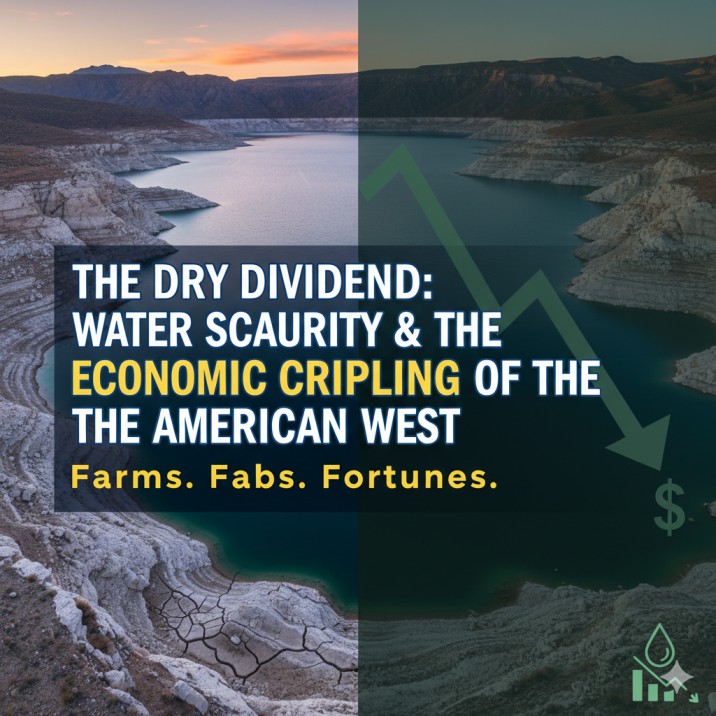
When you see the stark, white “bathtub ring” around Lake Mead, it’s easy to think of it as an environmental story. It’s a powerful symbol of a changing climate, a megadrought gripping the American West. But look closer. That receding waterline isn’t just a measure of water; it’s a measure of economic risk. For decades, the explosive growth of the West was built on the promise of abundant, cheap water. That promise is now broken.
The economic consequences of water scarcity in the American West are no longer a distant forecast—they are a present-day reality hitting the bottom line of businesses, big and small. This isn’t just about dusty fields and endangered fish. It’s about the very foundation of the region’s multi-trillion-dollar economy.
This analysis moves beyond the environmental headlines to focus squarely on the business impact of the western US drought. We’ll explore how this crisis is fundamentally reshaping key industries, from the farms that feed the nation to the tech giants powering our digital world and the real estate markets that house millions. Understanding these financial shockwaves is the first step for any business leader, investor, or resident looking to navigate the arid future of the American West.
The Ripple Effect: How a Megadrought Threatens America’s Economic Engine
Water is the lifeblood of any economy. It grows our food, cools our data centers, manufactures our technology, and sustains our cities. When that lifeblood runs low, every part of the economic body feels the strain. The current megadrought, the worst in over 1,200 years, is creating an economic crisis with far-reaching implications.
Beyond Dry Riverbeds: The True Financial Cost of Water Scarcity
The financial cost of the western megadrought is measured in billions. A single drought year can shave points off a state’s GDP. According to a study from the University of California, Davis, the 2021 drought alone cost California’s agricultural sector an estimated $1.7 billion and nearly 15,000 jobs. But the direct costs are just the beginning. The indirect costs ripple outwards, affecting everything from energy production at hydropower dams to the tourism dollars lost at shrinking recreational lakes. These are the economic risks of water shortages that businesses are now forced to confront.
The Colorado River Crisis: An Economic Lifeline Running Dry
At the heart of this economic story is the Colorado River. This single river system supports a $1.4 trillion annual economy—equivalent to the world’s 10th largest country—and provides water to 40 million people across seven states. Now, with key reservoirs like Lake Mead and Lake Powell at historically low levels, the federal government has been forced to implement unprecedented water cuts.
The business impact of Colorado River water cuts is a direct threat to industries in Arizona, Nevada, and California. Farmers are losing their allocations, cities are implementing strict conservation measures, and industries are being told to prepare for a future with far less water. As you can see from the data provided by the U.S. Bureau of Reclamation, the situation is critical and requires immediate economic adaptation.
Agriculture on the Brink: The Impact on America’s Breadbasket
No sector is more exposed to the immediate economic impact of water scarcity than agriculture. The American West, particularly California’s Central Valley, is the fruit and vegetable basket for the entire nation. Now, that basket is becoming lighter.
How Water Shortages are Reshaping Farming in California and Arizona
Across the West, farmers are making painful choices. Faced with zero-percent water allocations from state and federal projects, many are forced to fallow, or leave unplanted, hundreds of thousands of acres of productive farmland. The economic impact of drought on California agriculture is visible in these barren fields.
Farmers who can still access water are facing skyrocketing costs to pump it from rapidly depleting groundwater aquifers. This leads to tough decisions:
- Crop Switching: Many are abandoning thirsty, lower-value crops like cotton or alfalfa in favor of higher-value, more water-efficient crops like pistachios.
- Technology Investment: There is a rush to invest in hyper-efficient irrigation technology, like drip systems and soil moisture sensors.
- Land Sales: Some multi-generational farming families, facing insurmountable financial losses due to water cuts, are being forced to sell their land altogether.
The Rising Cost of Food Production and Its Effect on Consumers
The problems on the farm don’t stay on the farm. How water scarcity affects food supply chains is a question every American consumer is now facing at the grocery store. When it costs more to grow crops in the West, that cost is passed on. The impact of drought on grocery prices is seen in more expensive lettuce, tomatoes, berries, and nuts. This food price inflation is a direct economic consequence of the water crisis.
Is High-Value Crop Farming Sustainable in the Arid West?
A fierce economic debate is raging over water-intensive, high-value export crops. The water usage of almond farming in California, for example, has become a flashpoint. While almonds are a profitable crop that supports thousands of jobs, they require a significant amount of water. Similarly, the economic viability of growing alfalfa in the Arizona desert—a thirsty crop often exported to feed livestock overseas—is being called into question when cities like Phoenix are facing their own water shortages. These are the difficult economic trade-offs that define the new reality of the West.
The Thirsty Tech Boom: Water Scarcity Challenges for Data Centers and Manufacturing
The American West isn’t just farms and fields; it’s also a global hub for the technology industry. From the massive data centers that power the cloud to the sophisticated fabrication plants that make semiconductor chips, the tech boom was built on the same assumption of abundant resources as agriculture. That assumption is now being tested.
Why Data Centers in Arizona and Nevada Face an Uncertain Future
Do you know how data centers cool themselves in the desert? The answer, surprisingly, is with massive amounts of water. Servers generate immense heat, and in arid climates, evaporative cooling—which uses water—is one of the most efficient methods. A single large data center can use millions of gallons of water per day, as much as a small city.
This creates significant water scarcity challenges for tech data centers. As communities in places like Phoenix and Las Vegas are asked to conserve, the optics and logistics of allocating huge volumes of water to tech companies are becoming difficult. Tech giants are now facing:
- Rising Operational Costs: The price of water is increasing, directly impacting their bottom line.
- Regulatory Scrutiny: Cities are beginning to question and even deny permits for new data center projects based on their water usage.
- Reputational Risk: Companies are facing public backlash for being perceived as resource hogs in a time of crisis.
The Semiconductor Squeeze: Water Risks for Chip Manufacturing in the West
The challenge is even more acute for the semiconductor industry. The push to bring chip manufacturing back to the U.S. has led to massive investments in new fabrication plants (“fabs”) in states like Arizona. However, making a computer chip is an incredibly water-intensive process, requiring millions of gallons of ultrapure water.
The water risk for semiconductor manufacturing in Arizona is a major concern for this critical industry. A disruption in the water supply could halt production, sending shockwaves through global supply chains. This impact of water scarcity on US chip production highlights the hidden vulnerabilities in our most advanced industries.
Real Estate and Development: A Looming Water-Based Housing Crisis?
For decades, the story of the West has been one of growth—new suburbs, new golf courses, and new residents flocking to the Sun Belt. But can you build a future on a foundation of dwindling water?
The Effect of Water Shortages on Real Estate Values in the Southwest
The question “are water rights affecting property values in Nevada and Arizona?” is no longer hypothetical. In some rural areas, properties without secure, long-term water rights are already seeing their values decline. In urban areas, the impact of water scarcity on real estate prices in Phoenix is more complex. While prices haven’t collapsed, a “water risk premium” is beginning to emerge. Buyers are becoming more sophisticated, asking tough questions about the long-term water security of a community before they invest.
How Water Moratoriums are Halting New Development Projects
The most dramatic impact is the rise of development moratoriums. Several fast-growing communities in states like Arizona and Utah have already put a pause on issuing new building permits because they cannot guarantee a 100-year water supply, a requirement in some states. The water moratoriums and their effect on construction are a hard stop to growth. This creates a cascade of economic problems, from lost construction jobs to worsening housing affordability as supply is artificially constrained. The challenges of urban growth in water-scarce cities are forcing a complete rethinking of how and where we build.
The Path Forward: Business Strategies for a Water-Scarce Future
The economic outlook is challenging, but it is not hopeless. The crisis is also a powerful catalyst for innovation and adaptation. Businesses that recognize the new reality and act proactively can not only mitigate risk but also find a competitive advantage.
Investing in Innovation: Water Recycling and Desalination Solutions
Necessity is the mother of invention, and the water crisis is spurring a boom in water technology. There is massive business investment in water conservation technology, including:
- Advanced Water Recycling: Cities and industries are investing in “direct potable reuse” systems that can turn wastewater into pure drinking water, creating a reliable, drought-proof local supply.
- Desalination: While historically expensive, the economic feasibility of desalination for western states like California is improving. New technologies are making it more efficient to turn ocean water into fresh water.
- Smart Water Grids: Just like the smart energy grid, technology can help us better monitor and manage water use, detecting leaks and optimizing distribution in real-time.
Corporate Water Stewardship as a Competitive Advantage
In this new environment, corporate strategies for managing water risk are becoming a standard part of business planning. Companies like Microsoft, Intel, and Google are investing millions to become “water positive,” meaning they replenish more water than they consume in the regions where they operate.
The importance of water stewardship for businesses goes beyond simple conservation. It involves a holistic assessment of a company’s entire water footprint, from its direct operations to its supply chain. As detailed by organizations like the World Resources Institute (WRI), companies that lead in water stewardship are seen as lower-risk investments and are more resilient to the inevitable shocks of a drier future.
Conclusion: An Economic Reckoning for the American West
The water crisis in the American West is, at its core, an economic reckoning. The era of assuming limitless water is over. The long-term economic outlook for the American West now depends entirely on how effectively its leaders, businesses, and residents can adapt to a future defined by scarcity.
The challenges are immense, impacting our most foundational industries. But the path forward involves embracing the same spirit of innovation and resilience that built the West in the first place. Building a resilient economy in a drier future requires us to finally value water not as a cheap commodity, but as the precious and finite resource that it truly is. For businesses, this means that proactive water management is no longer just an environmental goal; it is an absolute economic necessity for survival and success.
Frequently Asked Questions (FAQ)
1. Which industries are most affected by water scarcity in the West?
The three most directly affected industries are agriculture, due to its massive water consumption for irrigation; the technology sector, specifically data centers and semiconductor manufacturing which require vast amounts of water for cooling and production; and real estate/construction, which faces moratoriums on new development.
2. How much does the agricultural sector lose financially during a severe drought?
Financial losses can be in the billions. For example, recent droughts in California have led to direct economic losses to the agricultural sector exceeding $1.5 billion in a single year, not including the downstream costs of job losses and impacts on related industries.
3. Are cities in the American West actually at risk of running out of water?
While a major metropolitan area like Phoenix or Las Vegas is unlikely to see taps run completely dry due to extensive planning and diverse water portfolios, they face a future of significantly higher water costs, strict permanent conservation measures, and hard limits on future growth.
4. How are tech companies like Google and Microsoft responding to water challenges?
Leading tech companies are investing heavily in water stewardship. They are building on-site water recycling plants, funding water restoration projects in local watersheds, and pioneering new air-cooling technologies to reduce their data centers’ dependence on water.
5. Can desalination solve the West’s water problems?
Desalination can be part of the solution for coastal cities like San Diego and Los Angeles, but it is not a silver bullet. It is energy-intensive, expensive, and creates environmental challenges with the disposal of brine. It is not a viable solution for inland states.
6. What is a “water risk assessment” for a business?
A water risk assessment is a comprehensive analysis of how a company’s operations, supply chain, and financial stability could be affected by water scarcity. It examines physical risks (not enough water), regulatory risks (new conservation laws), and reputational risks (public perception of water use).
7. How do water rights in the West complicate the economic situation?
The West operates on a complex “first in time, first in right” system, where senior water rights holders (often agricultural districts) get their full water allocation before junior rights holders (often cities and new developments) get any. This creates enormous economic and legal conflicts during shortages.
8. What is the single biggest opportunity for water conservation in the West?
While urban conservation is important, the single biggest opportunity lies in agriculture, which uses approximately 80% of the water in many western states. A modest increase in irrigation efficiency across the sector could save more water than is used by all the region’s cities combined.
9. Will the federal government bail out states affected by the Colorado River crisis?
The federal government is already playing a major role by investing billions through legislation like the Inflation Reduction Act to fund conservation, improve infrastructure, and compensate water users for voluntarily reducing their consumption. However, it is a support role; the primary responsibility for adaptation lies with the states.
10. How does the drying of Utah’s Great Salt Lake create economic problems?
The drying of the Great Salt Lake poses a multi-billion dollar economic threat. It could devastate the state’s brine shrimp industry ($60 million/year), harm the mineral extraction industry ($1.3 billion/year), and expose the Salt Lake City area to toxic dust storms that could deter tourism and new business investment.
11. Are investors starting to consider water risk when evaluating companies?
Yes, absolutely. ESG (Environmental, Social, and Governance) investors are increasingly scrutinizing companies’ water management plans. A company located in a water-stressed region with no credible water strategy is now seen as a higher-risk, less attractive investment.
12. What are the most promising innovative water solutions for businesses in arid regions?
The most promising solutions include atmospheric water generation (pulling water from the air), advanced leak detection AI for water systems, satellite-based irrigation monitoring for farms, and developing industrial processes that require significantly less water from the outset.