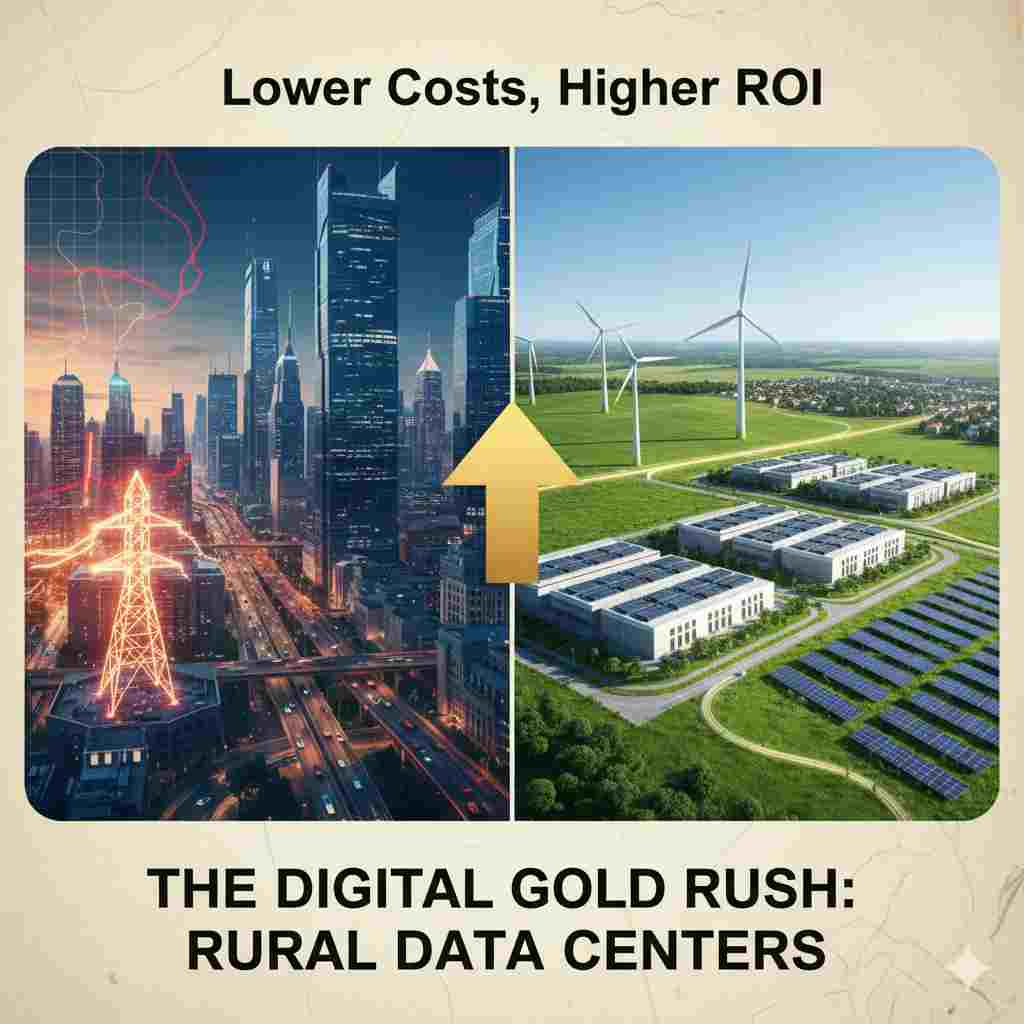
When you think of the “cloud,” you might picture something weightless and ethereal. The reality is that the cloud lives on the ground, inside massive, power-hungry industrial buildings called data centers. For decades, these digital fortresses have clustered around a few major urban hubs like Northern Virginia, Silicon Valley, and Chicago. But that’s changing. These tech meccas are becoming victims of their own success—land is scarce, power grids are strained, and construction costs are skyrocketing.
A quiet revolution is now underway, moving the physical heart of the internet to a surprising new location: rural America. Savvy investors and tech giants are looking past the city lights and discovering that the future of digital infrastructure may lie amidst sprawling fields and small towns. This isn’t just a trend; it’s a strategic economic shift driven by compelling financial incentives.
This in-depth analysis explores the powerful investment potential of building data centers in rural America. We will break down the financial case, examine the critical site selection factors that drive profitability, and reveal how this digital gold rush offers a rare opportunity for both high-return investments and the revitalization of the American heartland.
The Urban Squeeze: Why Are Data Centers Moving to Rural Areas?
The migration of data centers away from traditional hubs isn’t happening by chance. It’s a direct response to a growing set of economic and logistical pressures that are making urban development unsustainable for the massive scale that modern data demands.
A Cost Comparison of Urban vs. Rural Data Center Land Prices
The most straightforward driver is the staggering cost of land. In a place like Loudoun County, Virginia—often called “Data Center Alley”—an acre of land suitable for development can cost millions of dollars. The land acquisition cost alone can be a massive barrier to entry and a significant drag on a project’s profitability.
Now, compare that to many rural counties across the Midwest or Southeast, where an acre of land can be purchased for a tiny fraction of that price. For a hyperscale data center project, which can require a campus of 100 acres or more, the savings are not just significant; they are game-changing. This cost differential in land prices fundamentally alters the financial modeling of a project, allowing for larger, more scalable facilities and dramatically improving the potential return on investment (ROI).
The Growing Problem of Power Grid Constraints in Major Tech hubs
Data centers are unbelievably thirsty for electricity. A single large data center can consume as much power as a small city. In established urban markets, the electrical grids are reaching their limits. Utility companies in places like Northern Virginia have already warned that they may not be able to meet the projected power demands for new data center projects in the near future.
This creates a massive bottleneck. A developer can have land and funding, but without a guaranteed, multi-megawatt power connection, the project is dead on arrival. Rural areas, by contrast, often have more available capacity on their electrical grids. Many are located near major power generation sources, including a growing number of wind and solar farms, offering a more stable and accessible power supply.
Navigating Zoning Regulations and Community Opposition in Crowded Cities
Building a large industrial facility in a densely populated area is a complex and often contentious process. Developers face lengthy zoning battles, strict environmental reviews, and frequent opposition from local communities concerned about noise, resource consumption, and the aesthetic impact of these massive, windowless buildings. These delays add uncertainty and significant “soft costs” to a project.
Rural communities, on the other hand, often welcome the economic development that data centers bring. Local governments are typically more accommodating, with streamlined permitting processes and a desire to attract new investment. This creates a more predictable and faster path from groundbreaking to operation, which is critical for meeting market demand.
The Financial Case for Rural Data Center Development
The decision to move rural is rooted in a powerful financial equation. Cheaper land is just the beginning. The ongoing operational costs are where rural locations truly shine, creating a compelling long-term investment thesis.
How Lower Electricity Costs in Rural Regions Boost Profitability
Over the 10-20 year lifespan of a data center, electricity will be the single largest operating expense, far exceeding the initial cost of land. According to the U.S. Energy Information Administration (EIA), electricity rates can vary dramatically from state to state. Industrial electricity rates in many rural states are often significantly lower than in the coastal urban centers.
A difference of even one or two cents per kilowatt-hour can translate into millions of dollars in savings annually for a large facility. This direct, recurring cost advantage flows straight to the bottom line, making the profitability of rural data centers substantially higher over the long term.
The Significant Advantage of Cheaper Land for Hyperscale Data Center Projects
As mentioned, the low cost of land is a major upfront benefit. But it’s not just about the initial purchase price. The availability of large, contiguous parcels of land allows for the development of massive, campus-style data center parks. This enables a “build-as-you-grow” strategy, where companies can secure a large footprint upfront and build out new phases as demand increases. This long-term scalability is a huge strategic advantage that is nearly impossible to achieve in land-constrained urban markets.
A Look at State Tax Incentives for Data Center Construction in Rural States
Recognizing the immense economic impact of these facilities, many states have rolled out the red carpet with aggressive tax incentive packages. These programs are a powerful tool for boosting investment returns. Common incentives include:
- Sales and Use Tax Exemptions: Abatements on the multi-million dollar servers, racks, and cooling equipment that fill the data center.
- Property Tax Abatements: Long-term reductions or waivers of property taxes, which can be substantial on a facility valued at hundreds of millions of dollars.
- Corporate Income Tax Credits: Credits tied to job creation and the total amount of capital invested.
States like Iowa, Wyoming, Nebraska, and Alabama have used these data center tax incentive programs to successfully attract massive projects from companies like Google, Meta, and Microsoft.
Long-Term ROI Analysis of Rural Hyperscale Data Centers
When you combine all these factors—lower land costs, reduced power expenses, and generous tax incentives—the long-term ROI analysis for rural data centers becomes incredibly compelling. The lower capital expenditure (CapEx) on land and the significantly lower operating expenditure (OpEx) on power and taxes create a financial model that is far more resilient and profitable than its urban counterpart. This allows investors to achieve better returns while taking on less risk associated with market saturation and grid instability.
Key Site Selection Criteria for Profitable Rural Data Centers
While the financial incentives are strong, not just any rural plot will do. Choosing the right location is a highly technical process that balances costs with critical infrastructure requirements.
The Critical Importance of Access to Renewable Energy Sources
Modern data center tenants, especially the large cloud providers, are under immense pressure to meet sustainability goals. They are actively seeking locations where they can power their facilities with 100% renewable energy. This has made proximity to wind farms in the Midwest, solar installations in the Southeast, and hydroelectric power in the Northwest a top-tier site selection criterion. A location with direct access to abundant, cheap, renewable power is no longer a “nice to have”—it’s a “must have” for attracting a blue-chip tenant.
Overcoming Fiber Optic Connectivity Challenges in Rural Locations
The one major advantage urban centers have historically held is connectivity. Data centers are useless without high-speed, low-latency fiber optic connections to the rest of the world. While this has been a barrier for rural areas in the past, it’s changing rapidly.
Long-haul fiber optic cables already crisscross the country, often passing through rural areas. The key is finding a site with close proximity to these major backbones to minimize the cost of building the “last mile” connection. As new fiber routes are built to support this rural migration, connectivity is becoming less of a hurdle and more of a strategic planning factor.
Analyzing Water Access for Data Center Cooling Systems
Data centers generate an immense amount of heat, and cooling is a critical operational component. While some modern designs use air cooling, many of the most efficient systems, particularly for high-density computing, rely on water for evaporative cooling. Therefore, a sustainable and affordable water source is a key consideration. Site selectors must analyze local water availability, utility costs, and any potential environmental regulations related to water usage.
Assessing the Local Skilled Workforce and Training Opportunities
While highly automated, data centers still require a skilled workforce of technicians and engineers to operate and maintain them. A potential challenge in some rural areas is the availability of this talent. Successful rural data center projects often involve partnering with local community colleges and technical schools to create workforce development programs. These programs train local residents for the high-paying, stable jobs the facility will create, ensuring a sustainable talent pipeline for the company and creating valuable career paths for the community.
Beyond the Bottom Line: The Impact of Data Centers on Rural Economic Development
The benefits of a rural data center extend far beyond the investors’ balance sheets. For the small towns and counties that host them, these projects can be transformative economic engines.
How Do Data Centers Benefit Rural Communities Through Tax Revenue?
A single data center can instantly become the largest taxpayer in a rural county. The massive investment in buildings and equipment creates a huge new property tax base. This influx of tax revenue for rural communities can be used to fund schools, improve roads, and support essential public services, fundamentally improving the quality of life for all residents.
Data Center Job Creation and Its Effect on Local Economies
The construction phase of a data center brings hundreds of well-paying construction jobs to an area for 1-2 years. Once operational, the facility will employ dozens of full-time technicians, security staff, and managers in high-paying, stable careers. These are exactly the kinds of 21st-century jobs that many rural communities are eager to attract.
The Ripple Effect on Local Infrastructure and Small Businesses
The arrival of a data center often spurs broader infrastructure improvements. Utility companies may upgrade the local power grid, and telecom providers might extend fiber networks, benefiting the entire community. Furthermore, the new employees and construction workers spend money at local restaurants, stores, and hotels, creating a positive ripple effect that supports local small businesses.
Frequently Asked Questions (FAQ)
1. What is the main financial reason for building data centers in rural areas?
The two primary financial drivers are dramatically cheaper land, which lowers initial construction costs, and significantly lower industrial electricity rates, which reduces the largest ongoing operational expense.
2. Is investing in rural data center real estate a good idea in 2025?
Many analysts believe it’s a very strong investment. The demand for data is growing exponentially, while urban markets are becoming constrained. This supply/demand imbalance makes rural data center development a key growth area in digital infrastructure.
3. How do data centers get fast internet in the countryside?
They are strategically located near major long-haul fiber optic cables that already run through rural parts of the country. While a final connection needs to be built, they tap into these existing internet backbones.
4. What states offer the best tax incentives for data centers?
States like Iowa, Wyoming, Nebraska, Ohio, and Alabama are known for having very aggressive and attractive tax incentive packages, including long-term sales and property tax abatements.
5. What are the biggest challenges of building a data center in a rural location?
The main challenges can include ensuring robust fiber optic connectivity, securing a skilled local workforce, and confirming adequate access to power and water utilities.
6. How much do data centers help the local economy in rural towns?
They provide a massive boost by becoming the largest taxpayer, creating high-paying permanent jobs, employing hundreds during construction, and spurring secondary economic activity for local small businesses.
7. Why is access to renewable energy so important for new data centers?
Large tech companies, the primary tenants for these facilities, have corporate sustainability mandates to power their operations with 100% renewable energy. Access to wind, solar, or hydro power is often a non-negotiable requirement.
8. What is a “hyperscale” data center and why are they suited for rural areas?
A hyperscale data center is a massive facility designed to support the needs of a single large tenant, like Google or Amazon Web Services. Their enormous size (requiring 100+ acres) makes them perfectly suited for rural locations where large, affordable parcels of land are available.
9. Does a rural data center use a lot of local water?
Some cooling systems do use significant amounts of water. This is a critical part of the site selection process, and developers must ensure the local water supply can support the facility without negatively impacting the community or environment.
10. What is the long-term ROI potential for a rural data center investment?
The long-term ROI is considered excellent. The combination of lower capital costs (land) and lower operating costs (power, taxes) leads to higher profit margins and more stable returns compared to developing in expensive, saturated urban markets.
11. Are there enough skilled workers in rural America for these high-tech jobs?
This can be a challenge, but it is often addressed through partnerships between the data center company and local community colleges to create specialized training programs, building a local talent pipeline.
12. What is “edge computing” and how does it relate to rural data centers?
Edge computing involves placing smaller data centers closer to end-users to reduce latency. As more applications require real-time processing, we will see a rise in “edge” data centers in smaller towns and rural areas, creating another layer of investment opportunity.