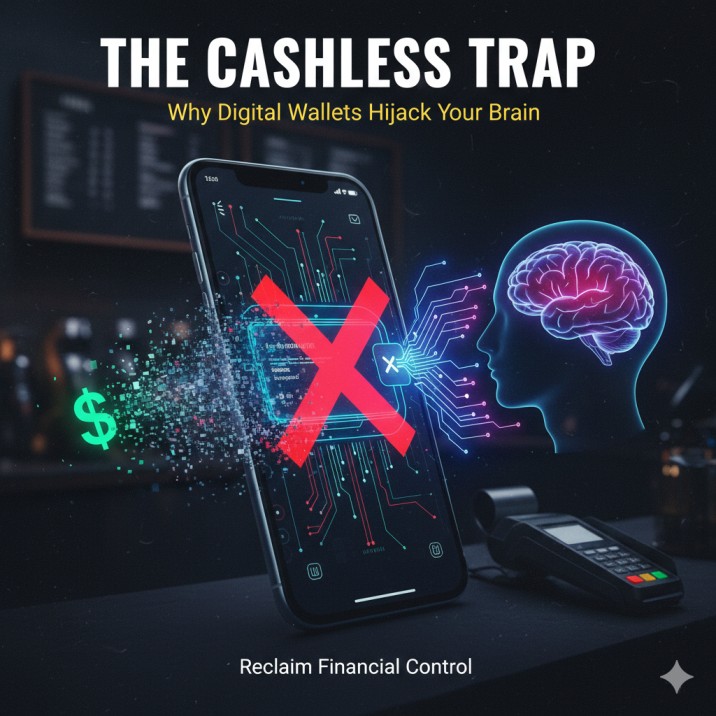
We’ve all been there. You’re at a coffee shop, and the total is $5.75. You pull out your phone, double-click the side button, and tap. The transaction is over before you’ve even put your phone back in your pocket. It was effortless. Painless. And that’s exactly the problem.
A week later, you check your bank account and feel a jolt of surprise. Where did all the money go? It trickled away in a series of those same silent, invisible transactions.
This phenomenon isn’t a failure of your willpower. It’s a carefully designed feature of our modern financial world. It’s called the “Cashless Effect,” and it’s the powerful psychological tendency for people to spend more money when they aren’t using physical cash. Your digital wallet—whether it’s Apple Pay, Google Pay, or a saved card on Amazon—is a powerful tool of convenience, but it’s also a neurological trick that is hijacking your brain and encouraging you to overspend.
This post isn’t about shaming you for using digital payments. It’s about pulling back the curtain on the deep psychology of digital spending. We will explore the specific brain hacks that digital wallets use against you, identify the modern traps that amplify the problem, and give you advanced, actionable strategies to take back control of your finances in a digital-first world.
Understanding the “Cashless Effect”: Why Digital Money Feels Less Real
To understand why you spend so much more with a tap of your phone, we first need to understand why spending physical cash stops you. The answer lies in a simple psychological principle.
The Core Concept: The “Pain of Paying” and How Digital Wallets Remove It
Spending money is supposed to hurt, at least a little. Behavioral economists call this the “pain of paying.”
When you have a $50 bill and you have to hand it over to a cashier, your brain processes this as a tangible loss. You physically see your money disappear. You feel its absence. This friction—this small moment of psychological pain—acts as a natural brake. It forces you to ask, “Is this purchase really worth giving up this $50 bill?”
Digital wallets are designed to systematically destroy this pain.
The abstraction of money is the first step. When your money is just a string of numbers on a screen, it doesn’t feel like your money. It’s just data. Tapping your phone or clicking “Buy Now” has the same physical feel whether you’re spending $5 or $500. There is no friction, no sense of loss, and therefore, no “pain of paying.”
This separation of the pleasure of buying from the pain of paying is the central trick. You get the instant reward of the purchase, while the consequence—the depletion of your funds—is delayed and hidden.
How Your Brain Gets Tricked: The Key Cognitive Biases at Play
Your brain uses mental shortcuts, or cognitive biases, to make decisions. Digital payment systems are masterfully designed to exploit these biases.
- Abstraction Bias: As mentioned, digital money is abstract. It’s hard for our brains, which evolved to handle tangible goods, to assign a real value to pixels on a screen. The difference between a balance of $1,200 and $1,150 is just a few changed numbers. The difference between having twelve $100 bills and eleven is a physical, noticeable gap in your wallet.
- Frictionless Spending: The goal of “fintech” (financial technology) is to make transactions as “seamless” and “frictionless” as possible. That “one-click checkout” or “tap-to-pay” feature isn’t just for your convenience; it’s to remove any moment of hesitation. The less time you have to think between the impulse to buy and the act of buying, the more likely you are to complete the purchase.
- Salience (Out of Sight, Out of Mind): When you use cash, you have a limited, visible supply. You can literally see how much money you have left for the week. With a digital wallet linked to a credit card or a large bank account, that limit is effectively invisible. The “out of sight, out of mind” nature of your total funds means you’re always spending from what feels like an infinite pool.
Your Brain on “Tap-to-Pay”: The Neuroscience of Instant Gratification
What’s happening inside your head on a chemical level is just as important as the psychology. The design of digital payments isn’t just bypassing your rational brain; it’s activating your brain’s most primitive reward centers.
The Dopamine Hit: How One-Click Purchases Create a Reward Loop
When you buy something you want, your brain releases a small amount of dopamine, the “feel-good” neurotransmitter. This is the same chemical involved in pleasure, reward, and, unfortunately, addiction.
In a normal transaction, the “pain of paying” with cash would counteract this dopamine rush, keeping your behavior in balance. But digital payments break this system.
Because the payment is frictionless and instant, you get the dopamine hit from the purchase (the reward) without any of the associated psychological pain (the consequence). The one-click checkout button essentially becomes a “dopamine” button. This creates a powerful behavioral loop: you feel an impulse, you click, you get a reward. This makes it incredibly difficult to stop and is why impulse buying with one-click checkout is a major source of consumer debt.
How Marketing and Apps Use Gamification to Encourage Spending
Modern financial and shopping apps are designed like video games to keep you engaged and spending. This is called “gamification.”
Think about it:
- You get “points” for purchases.
- You “unlock” new tiers of rewards.
- You get celebratory animations when you use your card.
- You get push notifications: “You’ve earned a new badge!”
These elements aren’t just for fun. They are behavioral nudges that reinforce the spending-reward loop. They tap into your brain’s desire for achievement and small, frequent rewards, all while distracting you from the real financial consequences of your actions.
The Modern Traps: How Technology Amplifies the Cashless Effect
Digital wallets like Apple Pay and Google Pay are just the tip of the iceberg. The entire modern economy is building an ecosystem designed to separate you from your money with as little thought as possible.
The Dangers of “Buy Now, Pay Later” (BNPL) Services
Services like Afterpay, Klarna, and Affirm represent the ultimate evolution of the cashless effect. They have successfully decoupled the pleasure of buying from the pain of paying entirely.
With BNPL, you don’t even pay a portion of the price upfront (or only a small one). You get the full dopamine reward of the purchase immediately while pushing the financial consequence weeks or months into the future.
This is psychologically dangerous. It tricks your brain into thinking an item is “cheaper” than it is. A $200 jacket doesn’t feel like $200; it feels like “four easy payments of $50.” The problem with buy now pay later services is that these small payments from multiple purchases begin to stack up. This “payment stacking” is how millions fall into a debt cycle, where their entire paycheck is already spent on paying for things they bought months ago.
One-Click Checkouts and In-App Purchases: The Impulse Buy Accelerators
Amazon patented its “1-Click” button for a reason: it knew that the single greatest barrier to a sale was the checkout process. By saving your payment and shipping info, it removed the last chance you had to review your cart and change your mind.
The same is true for in-app purchases and mobile games. The dangers of in-app purchases lie in their “micro” size. Spending $1.99 on a game doesn’t feel like a real purchase. But those micro-transactions are designed to be repeated, and they add up to macro problems.
The Silent Drain: Subscription Creep and Automated Payments
Finally, we have the “set it and forget it” trap. Automated payments and subscriptions are the ultimate form of “out of sight, out of mind” spending.
You sign up for a $14.99/month streaming service. Your brain doesn’t process this as $180 per year. It just processes the small, painless charge. Subscription creep is what happens when you accumulate five, six, or even ten of these small, automated payments.
Because you never have to “approve” the purchase each month, you never re-evaluate its worth. It becomes part of your financial background noise, silently draining your account whether you use the service or not.
How to Stop Overspending with Digital Wallets: A Practical Guide to Reclaiming Control
Reading this, you might feel discouraged. It can seem like the entire system is rigged against you. But it’s not. The key to beating the cashless effect is to use the same psychology, but in reverse. You must intentionally re-introduce friction and visibility into your financial life.
Strategies to Combat the Cashless Effect and Build Mindful Spending Habits
This isn’t about cutting up your credit cards or deleting Apple Pay. It’s about using them mindfully. Here are practical strategies you can start today.
Strategy 1: Re-Introduce “Financial Friction” into Your Digital Life
The goal is to give your rational brain a fighting chance to catch up with your impulse brain.
- Turn Off One-Click and “Express” Checkouts: Go into your Amazon, Shopify, and other favorite shopping accounts and disable one-click ordering. Force yourself to manually enter your shipping and credit card information for every purchase. That 30-second delay is often all you need to ask, “Do I really need this?”
- Delete Saved Cards from Browsers and Apps: Don’t let your phone or web browser “helpfully” remember your credit card. The act of getting up, finding your wallet, and typing in the 16 digits is a powerful form of physical friction.
- Log Out of Shopping Apps: Stay logged out of non-essential shopping apps by default. This forces you to log in before you can even browse, adding a simple barrier that stops mindless “window shopping” that turns into real spending.
- Use Two-Factor Authentication (2FA) for Purchases: If your bank allows it, set up transaction alerts or approvals that require a second step. This can be a text message code or a tap in your banking app.
Strategy 2: Make the Invisible Visible – The Power of Tracking
You can’t manage what you don’t measure. The abstraction of digital money is your enemy, so you must make it concrete.
- Use a Proactive Budgeting App: Don’t just use an app that tracks spending after the fact. Use one that plans spending before it happens. Tools like YNAB (You Need A Budget) force you to give every single dollar a “job” before you spend it. When you’re at the coffee shop, you have to check your “Coffee” budget category first.
- Turn on Every Single Transaction Alert: Go into your banking app and credit card settings and turn on push notifications or text alerts for all transactions. Yes, even $1.00. This makes your spending “salient” (visible) again. Every tap should be followed by a buzz in your pocket, a real-time reminder that money has just left your account.
- Perform a Daily “Money Minute”: You don’t need to spend an hour a week balancing a checkbook. Just take 60 seconds every morning. Open your banking app and look at your balance and the transactions from the previous day. This tiny, consistent habit keeps you connected to the reality of your cash flow.
Strategy 3: The “Digital Envelope System” – A Modern Fix for an Old Problem
The old-school cash envelope system—where you put cash for “Groceries,” “Gas,” and “Fun” into separate envelopes—was effective because it was visual and finite. You can replicate this digitally.
- Create Digital “Pots” or “Vaults”: Many modern online banks (like Ally, SoFi, or Monzo) allow you to create separate “pockets,” “pots,” or “vaults” within your main account. When you get paid, immediately move your budgeted amounts into these digital envelopes. When you buy groceries, you pay from the “Groceries” pot. When it’s empty, it’s empty.
- Use Separate Bank Accounts: For an even stronger barrier, open 2-3 free online checking accounts. One is your “Bills” account (where automated payments come out). One is your “Spending” account (for food, gas, fun). And one is your “Savings” account. You only put your weekly “spending” money into the spending account, and you only carry the debit card for that account in your digital wallet.
Strategy 4: Implement “Pause” Rules for Digital Purchases
To combat the instant gratification of the dopamine loop, you need to create a forced delay.
- The 24-Hour Rule: For any non-essential purchase over a set amount (say, $50), you must wait 24 hours before buying it. Add it to your cart, but then close the tab. If you still want it and it fits the budget 24 hours later, you can buy it. You will be shocked at how often the “need” for it completely vanishes.
- The “Add to Cart, Don’t Check Out” Rule: Treat your online shopping cart like a “wish list,” not a “to-buy” list. Let items sit there for a week. This “cooling off” period separates the thrill of the hunt from the act of spending.
- Unsubscribe from Marketing Emails: This is a simple but powerful act of friction. Go into your inbox and unsubscribe from every “deal” and “sale” email. This removes the trigger before it can even start an impulse.
Building Long-Term Financial Health in a Digital-First World
Controlling your digital spending isn’t just about tips and tricks; it’s about shifting your entire mindset around money. A cashless society requires a new kind of financial literacy.
Financial Literacy for the Digital Age: Thinking Beyond Old Rules
Old financial advice was built for a world of cash and checkbooks. Financial literacy for the digital age means accepting that the environment is actively working against your self-control.
This new literacy means:
- Understanding that convenience is not free. The “cost” of one-click convenience is often overspending and debt.
- Treating your attention as a financial asset. Protecting it from marketing emails and push notifications is a core financial skill.
- Prioritizing systems over willpower. Don’t just “try harder” to spend less. Build systems (like alerts, budgets, and friction) that make it easier to spend less. For more on this, the Consumer Financial Protection Bureau offers great resources on building spending plans.
Teaching Kids About Digital Money and its Dangers
This is perhaps the most critical part. We are raising the first generation of “cashless natives” who may never know the “pain of paying” with physical money. It is our job to teach them.
When you’re teaching kids about digital money, you must make the abstract concrete.
- Show them the money: When they use a gift card, show them the balance before and after the purchase.
- Use a prepaid debit card: Give them an allowance on a prepaid card (like Greenlight or GoHenry) with a fixed limit. This teaches them the “digital envelope” concept from day one.
- Talk about it: When you tap your phone to pay, explain what’s happening. “I just tapped the phone, which told the bank to send $5 of our family’s money to the store. That $5 is now gone.”
Conclusion: You Are Still in Control
The “Cashless Effect” is real, and it is a powerful psychological force. Digital wallets, BNPL, and one-click checkouts are brilliantly designed to make you spend more money by removing friction and pain. They trick your brain, exploit your cognitive biases, and activate your dopamine loops.
But they are not unbeatable.
Knowledge is your first line of defense. By simply understanding why you overspend with digital wallets, you’ve already taken the first step. The second step is action.
Your goal is not to go back to a cash-only life; it’s to move forward into the digital world with your eyes wide open. By intentionally re-introducing friction, making your spending visible, and building mindful systems, you can break the spell. You can enjoy the convenience of digital payments without falling into the trap. You are, and always will be, the one in control.
Frequently Asked Questions (FAQ)
1. Why do I spend so much more with Apple Pay or Google Pay than with my physical credit card?
Even a physical card has some friction. You have to open your wallet, take it out, and dip or swipe it. A digital wallet removes even this tiny delay. It’s a “tap-and-go” motion that is so fast and abstract, your brain barely registers it as a financial transaction, making it the most frictionless spending method available.
2. Is the “Cashless Effect” a real, scientifically-proven concept?
Yes. Numerous studies on consumer behavior and psychology have shown that people are willing to spend significantly more (sometimes up to 80% more) when using cards or digital payments compared to cash. This is tied directly to the “pain of paying” concept.
3. What is the single best way to stop impulse shopping online?
The single best way is to create a 24-hour “cooling off” period. When you feel the impulse, add the item to your cart and close the browser tab. If you still want it 24 hours later, you can then check to see if it’s in your budget. This simple delay short-circuits the dopamine-fueled impulse loop.
4. How can I control my spending on “Buy Now, Pay Later” (BNPL) services?
The best way is to avoid them for non-essential purchases. If you must use them, treat the total cost as the “price.” Before you click, ask yourself, “Do I have the full $200 for this in my bank account right now?” If the answer is no, you can’t afford it. Also, try to limit yourself to only one BNPL plan at a time.
5. What is the best way to track all my digital spending and subscriptions?
A zero-based budgeting app (like YNAB) or a tracking app (like Mint or PocketGuard) is essential. These apps sync with your accounts and automatically categorize transactions, showing you exactly where your money is going. Many can also identify and list all your recurring subscriptions so you can cancel the ones you don’t use.
6. How can I make my digital money “feel real” again?
The best way is to use the “digital envelope system” combined with real-time alerts. By creating separate “pots” or accounts for “Groceries,” “Fun,” etc., you create digital scarcity. When your “Fun” pot is empty, you feel the same scarcity you would if your physical envelope were empty.
7. Is it safer to use a debit card or a credit card in my digital wallet?
From a spending perspective, a debit card is “safer” because you can only spend money you actually have. However, from a fraud protection perspective, a credit card is almost always safer. A good compromise is to use a credit card in your digital wallet, but pay the balance off in full every single week, not every month.
8. What is “subscription creep” and how do I fight it?
Subscription creep is the slow accumulation of monthly automated payments that you forget about. To fight it, set a calendar reminder for every 3-6 months to do a “subscription audit.” Go through your bank statements, list every recurring charge, and ask yourself, “Did I get my money’s worth from this last month?” Be ruthless and cancel what you don’t use.
9. How do I teach my kids about the dangers of digital money?
Start with a physical, clear piggy bank so they can see money accumulating. When you graduate them to an allowance, use a prepaid kids’ debit card that has a fixed limit and an app that you can both review together. This shows them that digital money is finite and has real-world consequences.
10. What is “financial friction” and why do I want it?
Financial friction is any small obstacle or delay between the impulse to buy and the purchase itself. Examples include having to type in your card number, logging into an account, or waiting 24 hours. You want this friction because it gives your logical brain time to wake up and decide if the purchase is a good idea, rather than letting your impulse brain make all the decisions.
11. Do digital wallets make it easier to get into debt?
Yes, because they make it easier to spend money you don’t have, especially when linked to a credit card. The frictionless, painless nature of “tap-to-pay” can lead you to make many small, unthinking purchases that add up, maxing out your credit card much faster than if you were paying with cash.
12. My partner and I both overspend with our digital wallets. How can we get on the same page?
The key is visibility and shared goals. Sit down together and use a budgeting app that you can both share. Create your “digital envelopes” or budget categories together. This way, you’re not blaming each other, but working together as a team against the “cashless effect.” Setting up shared alerts for any spending over $20 can also help keep you both accountable.