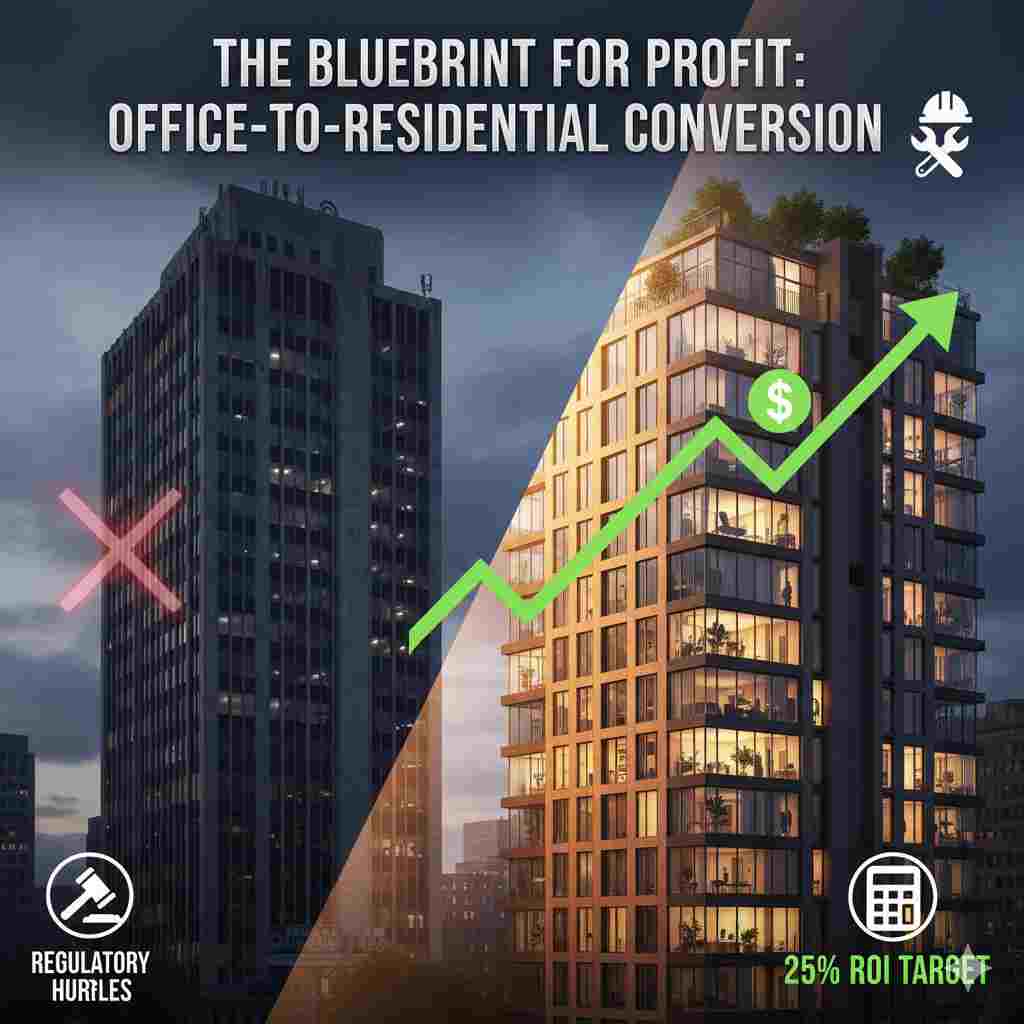
Walk through the downtown core of any major American city, and you’ll see them: gleaming office towers with floors of dark windows, silent monuments to a pre-pandemic work culture. As hybrid and remote work becomes permanent, these buildings face an existential crisis, leading to record-high vacancy rates and plummeting property values. At the same time, a severe housing shortage is pushing rents to unattainable levels for millions.
This collision of two crises has created one of the most compelling and complex opportunities in modern real estate: the adaptive reuse of empty office buildings into residential apartments. For developers and investors, this is more than just a construction project; it’s a high-stakes puzzle. The potential rewards are enormous—transforming a depreciating asset into a highly profitable, in-demand residential building while helping to revitalize city centers. But the path is filled with immense financial, architectural, and regulatory challenges.
This in-depth guide will explore the real-world profitability of commercial real estate conversion. We will dissect the costs, navigate the biggest regulatory hurdles, and provide a clear framework for calculating the potential ROI, offering a comprehensive blueprint for anyone looking to capitalize on this transformative trend in urban development.
The Golden Opportunity: Why Consider Converting Empty Office Buildings Now?
The push for office-to-residential conversions isn’t just a clever idea; it’s a market-driven necessity. Several powerful economic and social forces are aligning to make this a uniquely timely and potentially lucrative strategy.
Analyzing the Post-Pandemic Impact on Commercial Office Space Demand
The shift to remote and hybrid work is not a temporary blip. It’s a fundamental restructuring of how and where white-collar work gets done. Companies are downsizing their office footprints, leaving a glut of vacant space, particularly in older, less desirable buildings. According to major real-estate services firm CBRE, office vacancy rates in many major U.S. cities have climbed to 30-year highs.
This has created a “flight to quality,” where companies move to brand-new, amenity-rich buildings, leaving older Class B and Class C properties with few leasing prospects. For the owners of these buildings, the choice is stark: face declining rents and eventual obsolescence, or find a new purpose for their asset. This market pressure is the primary catalyst driving the conversion trend.
How Office-to-Residential Conversions Can Help Solve the Urban Housing Crisis
Simultaneously, virtually every major city is grappling with a critical lack of housing. The supply of new apartments has not kept pace with demand, leading to soaring rental costs and a “missing middle” housing gap.
Office-to-residential conversions offer a powerful solution. They create new housing units directly within urban cores, often in prime locations with existing access to public transit, jobs, and amenities. This is a more sustainable approach than urban sprawl, as it utilizes existing structures and infrastructure. For cities, supporting these projects is a strategic way to increase housing supply, create more vibrant 24/7 neighborhoods, and stabilize the commercial property tax base.
The Investment Case for Adaptive Reuse in Commercial Real Estate
For an investor, the financial thesis is compelling. You are acquiring an underperforming or distressed asset (an empty office building) at a potentially significant discount. Through a strategic capital investment, you can transform it into a high-performing, cash-flowing asset (a fully leased apartment building) that meets a clear and urgent market demand.
While new construction faces soaring land and material costs, adaptive reuse can sometimes offer a more cost-effective and faster path to market. Furthermore, the finished product—often featuring unique architectural details, high ceilings, and large windows—can be highly attractive to renters, allowing for premium rental rates.
The Anatomy of a Conversion: A Detailed Cost Analysis
While the opportunity is clear, the execution is incredibly complex. The biggest mistake an investor can make is underestimating the true cost of transforming a building designed for commerce into a place people call home. The budget goes far beyond cosmetic changes.
A Construction Cost Breakdown for Office Building Adaptive Reuse
The “hard costs” of construction are the most significant expense. This isn’t a simple renovation; it’s a gut renovation and a complete mechanical, electrical, and plumbing (MEP) overhaul. Key line items in your financial model for estimating project expenses will include:
- Interior Demolition: Tearing out everything back to the structural columns—cubicles, conference rooms, dropped ceilings, and old wiring.
- Framing and Drywall: Building out the individual apartment units, including bedrooms, bathrooms, and closets.
- Kitchens and Bathrooms: The most expensive areas per square foot, requiring cabinetry, countertops, appliances, and fixtures for dozens or hundreds of units.
- Flooring, Paint, and Finishes: Costs for the final finishes across the entire residential space.
The Hidden Costs of Plumbing and Electrical System Overhauls
This is where many conversion budgets get broken. An office building’s infrastructure is fundamentally different from a residential one’s.
- Plumbing: Office buildings typically have a central plumbing core with bathrooms in one location per floor. A residential building needs “wet stacks” (supply and drain lines) running to every single apartment for kitchens and multiple bathrooms. This requires extensive concrete cutting on every floor to run new pipes, a costly and complex process.
- Electrical: Similarly, an office building is wired for overhead lighting and cubicle power. It needs to be completely rewired to provide individual meters and breaker panels for each apartment, with outlets and wiring sufficient for modern residential loads (appliances, entertainment systems, etc.).
- HVAC: Centralized office HVAC systems designed for large, open floors must be replaced with individual heat pump or VRF systems for each apartment, allowing for personal climate control.
Factoring in Facade and Window Replacement for Residential Living
Many office buildings, particularly those from the mid-20th century, have floor-to-ceiling glass facades. While great for office views, they are often single-pane and highly inefficient for residential energy codes. They also may not have operable windows, which are a requirement or strong preference for residential living.
A full facade and window replacement is often necessary to improve energy efficiency, provide better sound insulation, and allow for fresh air. This is a multi-million dollar expense that must be factored into the initial pro forma.
The Profit Equation: How to Calculate the ROI on an Office-to-Apartment Conversion Project
With a clear picture of the costs, you can begin to model the potential profitability. Calculating the return on investment (ROI) is a multi-step process that hinges on realistic projections of income and the final value of the asset.
Projecting Rental Income and Occupancy Rates for New Residential Units
The first step is a thorough market analysis. What are the current rental rates per square foot for comparable new-construction apartments in the target neighborhood? You’ll need to project rents for different unit types (studios, one-bedrooms, two-bedrooms) based on their size and features.
You also need to project a stabilized occupancy rate. While demand may be high, a 95-97% occupancy rate is a standard assumption, accounting for normal turnover. Total annual rental income minus a vacancy allowance gives you your Gross Potential Income.
How to Determine the After-Conversion Value of the Property
Once the project is complete and the building is leased up (stabilized), it has a new market value as a residential asset. This is typically determined using the “cap rate” method. The cap rate (capitalization rate) is the expected rate of return on a real estate investment property.
Value = Net Operating Income (NOI) / Cap Rate
- Net Operating Income (NOI): This is your gross rental income minus all operating expenses (property management, insurance, taxes, maintenance, utilities).
- Cap Rate: This is determined by the market. You would look at the cap rates at which similar, newly stabilized apartment buildings have recently sold in the area. For example, if the market cap rate is 5%, and your project’s NOI is $2 million, its after-conversion value would be $40 million ($2M / 0.05).
A Step-by-Step Guide to Calculating Your Potential Return on Investment
Now you can put it all together.
- Calculate Total Project Cost: Acquisition Price + Hard Construction Costs + Soft Costs (architects, permits, financing, etc.).
- Calculate Profit: After-Conversion Value – Total Project Cost.
- Calculate ROI: (Profit / Total Project Cost) x 100.
For example, if your total project cost is $32 million and the after-conversion value is $40 million, your profit is $8 million. The ROI would be ($8M / $32M) x 100 = 25%. This is often expressed as a “development spread”—the difference between the final cap rate (5% in our example) and the “yield on cost” (NOI / Total Cost = $2M / $32M = 6.25%). The 1.25% (or 125 basis points) spread represents your profit margin.
Navigating the Maze: The Biggest Regulatory Hurdles for Developers
A perfect financial model can be completely derailed by regulatory roadblocks. Navigating city hall is one of the most challenging aspects of any conversion project.
Understanding Zoning Laws for Commercial-to-Residential Redevelopment
The first hurdle is zoning. A building located in a zone designated purely for commercial use cannot legally house residents. A developer must apply for a “zoning variance” or a “rezoning” of the property. This can be a long, expensive, and politically fraught process involving public hearings and community input. Cities that are serious about encouraging conversions are creating “as-of-right” conversion zones, which streamline or eliminate this step, providing much-needed certainty for developers.
The Challenge of Meeting Residential Building Codes and Light/Air Requirements
Building codes for residential properties are much stricter than for offices, particularly concerning life safety, light, and air.
- Egress: You need more fire stairs, and they must be positioned correctly to serve apartment layouts.
- Light and Air: A common rule is that a legal bedroom must have a window. This is the Achilles’ heel for office buildings with very deep floor plates (large distances from the window-line to the building core). It can result in unusable, dark space in the middle of the building, making the layout inefficient and unprofitable.
Leveraging Tax Incentives and Credits for Historic Office Building Redevelopment
For older buildings, one of the most powerful tools to make a project financially viable is the Federal Historic Tax Credit program. If a building is a certified historic structure, developers can receive a tax credit equal to 20% of the qualified rehabilitation expenses. As detailed by the National Park Service, this program can provide millions of dollars in equity to a project, often making the difference between a feasible and an unfeasible deal. Many states also offer parallel historic tax credit programs.
Frequently Asked Questions (FAQ)
1. Is converting office buildings to apartments a profitable venture?
Yes, it can be highly profitable, with developers often targeting an ROI of 20-30%. However, it carries significant risks, and profitability depends heavily on the acquisition price, construction costs, and the local rental market.
2. What are the biggest construction challenges in an office conversion?
The biggest challenges are the complete overhaul of the plumbing and electrical systems to serve individual apartment units and dealing with the building’s facade and window systems to meet residential energy and living standards.
3. How much does it cost to convert an office building to residential units?
Costs vary widely by location and the building’s condition, but they can range from $200 to over $500 per square foot. A full cost analysis is the most critical step in a feasibility study.
4. What makes an office building a good candidate for conversion?
Ideal candidates are typically older Class B or C buildings with smaller floor plates (less than 15,000 sq. ft.), a good window-to-floor area ratio, and a location in a neighborhood with strong residential demand and amenities.
5. How do developers finance office-to-residential conversion projects?
Financing is typically done through construction loans from banks or private debt funds. These loans are often more complex than for new construction and require a developer with a strong track record. Tax credits can also be a key part of the financing package.
6. What are the main regulatory hurdles developers face?
The primary hurdles are navigating restrictive zoning laws that prohibit residential use in commercial districts and redesigning the building to meet the much stricter residential building codes for things like light, air, and fire safety.
7. How do deep office floor plates impact conversion feasibility?
Very deep floor plates are a major problem because they create a large amount of interior space far from any windows. Since legal bedrooms require windows, this space is difficult to monetize, making the residential layout inefficient and often financially unviable.
8. Do office conversions actually help with the housing affordability crisis?
They help by increasing the overall housing supply, which can ease upward pressure on rents over time. However, due to high construction costs, the new units are typically market-rate or luxury, not affordable housing, unless public subsidies are involved.
9. What are the tax incentives available for adaptive reuse projects?
The most significant is the 20% Federal Historic Tax Credit for rehabilitating certified historic buildings. Many states and cities also offer property tax abatements (tax freezes) and other local incentives to encourage these projects.
10. What is the average timeline for an office-to-residential conversion?
From acquisition to a fully leased building, the process can take 3 to 5 years. This includes time for design, navigating the complex permitting and zoning process, 18-24 months of construction, and the final lease-up period.
11. Why are Class B and C office buildings better for conversion than Class A?
Class A buildings are newer, have higher occupancy rates, and are too expensive to acquire for a financially viable conversion. Older, partially vacant Class B and C buildings can be acquired at a lower cost basis, which is essential for making the project’s numbers work.
12. How does the ROI on a conversion compare to building a new apartment complex?
The target ROI is often similar. Conversions can be faster and avoid land acquisition costs, but they carry more risk due to unforeseen conditions within the existing structure. New construction is more predictable but can be more expensive and take longer to get approved.