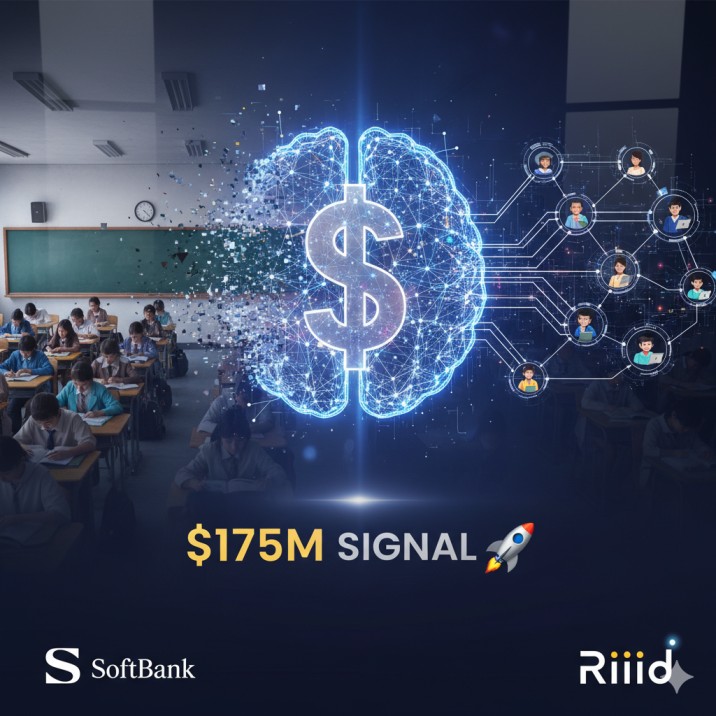
In the world of high-stakes venture capital, few names carry the weight of SoftBank’s Vision Fund. When they invest, the world takes notice. So, when SoftBank Vision Fund 2 led a massive $175 million funding round for a relatively unknown South Korean EdTech company named Riiid, it wasn’t just another transaction. It was a clear and powerful signal: the future of education has arrived, and it is powered by artificial intelligence.
This isn’t just about a new study app or a digital textbook. This monumental investment goes to the very heart of how we learn, how we measure knowledge, and how we unlock human potential. It challenges a century-old educational model and poses a critical question: What did SoftBank see in Riiid’s AI technology that made them bet so big on the future of AI in educational assessment?
The answer lies in a revolutionary approach that promises to make learning deeply personal, incredibly efficient, and universally accessible. Let’s decode this landmark investment and explore how Riiid’s AI-driven platform is set to permanently reshape the global education landscape.
The Fundamental Flaw: Why Our Current Educational System Is Breaking
Before we can appreciate the solution Riiid offers, we must first understand the deep-rooted problems it aims to solve. For decades, the dominant model of education has been a “one-size-fits-all” approach. Imagine a classroom with thirty students, each with unique strengths, weaknesses, and learning speeds. Yet, they are often taught the same material, at the same pace, from the same textbook.
The Limitations of Standardized Testing and Learning
This system creates significant challenges in traditional classroom settings. A teacher, no matter how dedicated, simply cannot provide continuous, one-on-one attention to every student. As a result, some students get bored while others fall behind, creating knowledge gaps that widen over time.
The primary tool for measuring success in this model is the standardized test. While useful for broad comparisons, these tests often measure a student’s ability to memorize and recall information on a single day, rather than their true understanding or problem-solving skills. They fail to provide real-time, actionable feedback that can guide a student’s learning journey. This leads to inefficiencies in learning models, where teaching is geared toward “the middle” of the class, and personalization is a luxury few can afford.
A New Protagonist Appears: What Exactly is the Riiid AI Tutor?
This is where Riiid enters the story. Founded in South Korea, a country known for its hyper-competitive academic environment, Riiid (pronounced ‘rid’) set out to solve this personalization puzzle. Riiid is not just another EdTech company; it is an AI research and development firm that has created a powerful AI-powered tutor.
At its core, Riiid provides a personalized learning experience through its various applications, most notably Santa for the TOEIC (Test of English for International Communication). Instead of giving every student the same practice questions, Riiid’s AI analyzes each user’s performance in real time to create a completely unique and adaptive study plan.
The goal is simple but profound: to maximize learning efficiency by focusing a student’s time and effort on exactly what they need to learn next. This deep learning for personalized education moves away from the static, one-way flow of information and creates a dynamic, interactive learning partner for every user.
Under the Hood: How Does Riiid’s Adaptive Learning Algorithm Actually Work?
The magic behind Riiid isn’t just about having a large bank of questions. It’s about the sophisticated AI engine that powers the entire experience. This engine is built on two core technological pillars: knowledge tracing and predictive analytics.
Understanding AI Knowledge Tracing Technology
Think of “knowledge tracing” as the AI’s ability to create a detailed, real-time map of a student’s brain. As a student answers questions, the AI isn’t just tracking right or wrong answers. It’s analyzing patterns to understand which concepts the student has mastered and which ones are still shaky. This proprietary algorithm, developed from over 300 million data points, can determine the probability that a student will answer the next question correctly. This goes far beyond simple scoring; it’s a deep diagnostic of a student’s knowledge state.
The Power of Predictive Analytics for Student Success
Once the AI has this “knowledge map,” it uses predictive analytics to chart the most efficient path forward. It identifies the precise question or concept that will be most beneficial for the student to tackle next—one that is challenging enough to promote growth but not so difficult that it causes frustration. This is the essence of how adaptive learning algorithms work. The system constantly adjusts the difficulty and topic of the questions, ensuring the student is always operating in their optimal learning zone.
The result? Students using Riiid’s platform have shown remarkable improvements in their scores in significantly less time compared to traditional study methods. It’s a testament to the power of AI to deliver a truly one-on-one tutoring experience at scale.
The SoftBank Vision: Why a Global Investment Giant Placed a $175M Bet
SoftBank’s Vision Fund doesn’t invest in trends; it invests in revolutions. Their investment in Riiid was a calculated move based on a clear vision of the future, driven by several key factors.
The Massive Market Potential for AI EdTech Solutions
First and foremost is the sheer size of the opportunity. The global education and corporate training market is worth trillions of dollars, yet it has been one of the slowest sectors to embrace digital transformation. As detailed by market analysts, investors see a massive, underserved market ripe for disruption. SoftBank recognized that the first company to successfully scale a truly effective AI-powered learning solution would not just capture a piece of this market but define it for generations to come.
A Scalable Technology with Global Applications
Second, Riiid’s core AI engine is highly scalable and sector-agnostic. While it proved its effectiveness in the English-language test prep market, the underlying technology can be applied to virtually any subject or skill. From K-12 math and science to professional certifications and corporate training, Riiid’s AI can be adapted to create personalized learning paths for anyone, anywhere. This versatility is a key element of the SoftBank Vision Fund 2 strategy, which prioritizes AI platforms with the potential for exponential, global growth.
Proven Efficacy and a Data-Driven Moat
Finally, Riiid had something many startups lack: proof. The company had already demonstrated significant, measurable score improvements for its users. Furthermore, its AI model becomes smarter and more accurate with every question answered. This creates a powerful data network effect—the more users it has, the better the AI becomes, which in turn attracts more users. This data-driven “moat” makes it incredibly difficult for competitors to catch up, a quality highly valued by long-term investors like SoftBank.
Beyond the Classroom: The Broader Implications of AI in Student Assessment
The excitement surrounding Riiid and similar technologies extends far beyond helping students pass exams. The applications of AI beyond the classroom are vast and have the potential to democratize opportunity on a global scale.
Transforming Corporate Training and Lifelong Learning
Imagine a corporate training program that adapts to each employee’s existing skills, quickly closing knowledge gaps and preparing them for new roles. AI platforms can make upskilling and reskilling more efficient and effective, helping workforces adapt to the rapid pace of technological change. This is a crucial tool for the future of work.
Reducing the Educational Equity Gap with Technology
Perhaps the most inspiring implication is the potential to close educational divides. Access to high-quality, one-on-one tutoring has historically been a privilege of the wealthy. AI can democratize this resource, offering a world-class personalized tutor to any student with a smartphone. This can provide critical support for students in underserved communities, helping to level the academic playing field and unlock talent that might otherwise have been overlooked.
Addressing the Big Question: How AI Can Support Teachers, Not Replace Them
A common fear surrounding the rise of AI in education is that technology will make human teachers obsolete. However, this narrative misunderstands the true role of AI in the classroom. The goal is not to replace educators but to empower them with superpowers.
Think of AI as the ultimate teaching assistant. While the AI handles the personalized drill-and-practice, knowledge assessment, and progress tracking, it frees up the teacher to focus on what humans do best: mentoring, inspiring critical thinking, fostering creativity, and providing emotional support. Research from leading institutions like Stanford University’s Graduate School of Education highlights this collaborative future. In an AI-driven classroom, teachers can transition from being a “sage on the stage” to a “guide on the side,” using rich data insights from the AI to provide targeted, meaningful interventions for their students.
The Road Ahead: Navigating the Ethical Implications of AI in Education
As with any powerful technology, the rise of AI in education comes with significant responsibilities and challenges that must be addressed proactively.
Data Privacy Concerns in EdTech
AI learning platforms collect vast amounts of data on student performance, learning habits, and even emotional states. Ensuring this sensitive data is protected, used ethically, and kept secure from breaches is paramount. Clear regulations and transparent policies are needed to build and maintain trust among students, parents, and educators.
The Dangers of Algorithmic Bias in Educational AI
AI models are trained on data, and if that data reflects existing societal biases, the AI can perpetuate or even amplify them. It is crucial to ensure that educational algorithms are fair and equitable, and do not disadvantage students based on their socioeconomic background, race, or gender. Organizations like the AI Now Institute are doing critical work in this area, advocating for accountability and transparency in AI systems.
Bridging the Digital Divide
For AI education to be truly democratizing, we must address the digital divide. Students without reliable internet access or suitable devices will be left behind. Solving this requires a concerted effort from governments, companies, and non-profits to ensure equitable access to the technological infrastructure required for 21st-century learning.
Conclusion: The Dawn of a Truly Personalized Learning Era
SoftBank’s $175 million investment in Riiid was more than just a financial transaction; it was a watershed moment for the education industry. It validated the immense potential of artificial intelligence to dismantle the outdated, one-size-fits-all model of learning and usher in an era of true personalization.
Riiid’s technology shows us a future where every learner has a dedicated, intelligent partner guiding them on their unique educational journey. It’s a future where teachers are empowered with data-driven insights to become more effective mentors. And it’s a future where educational opportunity is not limited by geography or wealth, but is accessible to all. The road ahead has its challenges, but the destination—a smarter, more equitable, and more efficient way to learn—is a future worth investing in.
Frequently Asked Questions (FAQ)
1. What is Riiid and what does its main product do?
Riiid is an AI-powered education technology company based in South Korea. Its flagship product is an AI tutor that provides personalized learning plans for students. By analyzing a user’s answers in real-time, its adaptive learning technology identifies knowledge gaps and provides the optimal questions and materials to maximize study efficiency, particularly for standardized test preparation like the TOEIC.
2. Why was SoftBank’s $175M investment in Riiid so significant?
The investment was significant because it represented a major endorsement from one of the world’s largest technology investors in the power of AI to revolutionize education. It signaled a shift in the market towards highly personalized, data-driven learning solutions and validated Riiid’s technology as a leader in the global EdTech space.
3. How is AI in educational assessment different from traditional testing?
Traditional testing typically provides a single score at a single point in time, offering little insight into why a student struggled. AI-powered assessment, like Riiid’s, is a continuous, diagnostic process. It tracks a student’s knowledge state in real-time, predicts future performance, and provides immediate, actionable feedback to guide their learning path.
4. What is adaptive learning technology and how does it benefit students?
Adaptive learning technology is a method that uses AI algorithms to adjust the educational material presented to a student based on their performance. The benefit is immense efficiency; students don’t waste time on concepts they’ve already mastered and get targeted practice on areas where they are weak, leading to faster and more effective learning.
5. Will AI-powered learning platforms like Riiid replace human teachers?
No, the goal is not for AI to replace teachers but to augment their capabilities. AI can handle personalized practice and assessment at scale, freeing up teachers to focus on higher-level skills like critical thinking, collaboration, and mentorship. It acts as a powerful assistant, providing teachers with detailed data to better support their students.
6. What are the main ethical considerations for using AI in student education?
The main ethical concerns include data privacy (protecting sensitive student information), algorithmic bias (ensuring the AI doesn’t discriminate against certain groups of students), and the digital divide (ensuring all students have access to the necessary technology to benefit from these tools).
7. Can Riiid’s AI technology be used for subjects other than English tests?
Yes. Riiid’s core AI engine is designed to be highly versatile and applicable to almost any subject that can be broken down into concepts and questions. This includes mathematics, science, history, and even corporate compliance training or professional certifications.
8. What is “knowledge tracing” and why is it important for AI tutors?
Knowledge tracing is an advanced AI technique that models a student’s understanding of different concepts over time. It’s important because it allows the AI tutor to go beyond simple right/wrong scoring and build a dynamic map of a student’s knowledge, enabling it to accurately predict performance and recommend the most effective next step.
9. How does investment in EdTech companies like Riiid help solve educational inequality?
By making high-quality, personalized tutoring scalable and affordable, AI EdTech platforms can provide powerful learning tools to students who lack access to expensive human tutors. This can help level the playing field, giving every student, regardless of their socioeconomic background, the support they need to succeed.
10. What makes South Korea a good incubator for a company like Riiid?
South Korea has a highly competitive and technologically advanced education market. The intense focus on standardized testing and academic achievement created the perfect environment for a company like Riiid to develop and prove the effectiveness of an AI solution designed to make studying more efficient.
11. What is the future outlook for the AI in the EdTech market?
The market is poised for explosive growth. We can expect to see more AI integration across all levels of education, from K-12 to university and corporate learning. The focus will continue to shift from simple digital content to truly interactive and adaptive platforms that personalize the entire learning experience.
12. How can schools and institutions start implementing AI in their curriculum?
Schools can start by piloting adaptive learning platforms for specific subjects, providing teachers with professional development on how to use data from these tools to inform their instruction. Starting with supplemental programs for test prep or homework help is a common and effective way to begin integrating AI into the broader curriculum.