There’s an invisible war being waged every second of every day within the global financial system. It’s a conflict fought not with soldiers, but with spreadsheets; not with tanks, but with transactions. The enemy is financial crime—a sprawling, sophisticated network of money launderers, terrorist financiers, and fraudsters. And the cost of this war is staggering. By some estimates, the amount of money laundered globally in one year is 2-5% of global GDP, which translates to a multi-trillion-dollar problem.
For decades, the financial industry’s primary defense has been a set of rules and regulations known as Anti-Money Laundering (AML) compliance. Banks and financial institutions spend billions annually on armies of compliance officers who manually sift through mountains of data, chasing down suspicious activities. Yet, despite this colossal effort, the results are deeply concerning. The United Nations estimates that less than 1% of illicit financial flows are ever seized.
The old way of doing things is broken. It’s expensive, wildly inefficient, and criminals are constantly evolving their tactics to stay one step ahead. But a new technological revolution is underway, poised to turn the tide. This is the era of RegTech (Regulatory Technology), and its most potent weapon is Artificial Intelligence (AI).
This is the story of how RegTech is using AI to fight the massive and growing cost of AML and financial crime, transforming the battle from a manual, reactive slog into an intelligent, proactive, and data-driven campaign.
Understanding the $1 Trillion Problem: Why Traditional AML Compliance is Failing
To grasp the significance of the AI revolution, we first have to understand the deep-seated flaws in the traditional approach to AML. For years, the system has been built on a foundation of rule-based transaction monitoring.
Imagine a bank setting a rule: “Flag any cash deposit over $10,000.” On the surface, this seems logical. But sophisticated criminals are not so simple. They will structure their deposits, making 11 separate deposits of $9,500 to fly under the radar—a technique known as “structuring.” The old system, bound by its rigid rules, often misses this completely.
This leads to the two core failures of legacy AML systems:
- A Tsunami of False Positives: Because the rules are so broad, they generate an overwhelming number of alerts for perfectly legitimate transactions. A customer receiving a large inheritance or selling a house might trigger an alert. The result? Compliance teams spend up to 95% of their time investigating these false positives in AML alerts, chasing ghosts while the real criminals slip through the cracks. The high cost of manual AML transaction monitoring is driven almost entirely by this inefficiency.
- Inability to Detect Sophisticated Networks: Traditional systems look at transactions in isolation. They can’t see the bigger picture. Modern money laundering is not a single transaction; it’s a complex web of shell corporations, offshore accounts, and mule networks designed to obscure the money trail. A rule-based system is like a police officer staring at a single brick, unable to see the entire criminal headquarters it’s a part of.
The financial and operational burden is immense. Banks face crippling fines for compliance failures, with penalties running into the billions. The challenges in traditional AML compliance have created a system that is both a massive cost center and largely ineffective, a perfect storm for disruption.
What is RegTech and Why is it the Future of Financial Regulation?
Into this environment of high costs and low efficiency steps RegTech. Simply put, RegTech is the application of new technology to solve regulatory and compliance challenges more effectively and efficiently. It’s not about replacing the rules; it’s about providing smarter, faster, and cheaper ways to adhere to them.
While FinTech focuses on disrupting customer-facing financial services (like payments or lending), RegTech focuses on the back office—the engine room of the financial industry where compliance, risk management, and reporting take place.
How RegTech is transforming AML processes is by shifting the paradigm from a manual, human-centric model to an automated, data-centric one. Instead of hiring more people to review more alerts, RegTech solutions use technology to produce fewer, better alerts, allowing human experts to focus their skills on genuine, high-risk cases. The benefits of RegTech solutions for banks are not just incremental improvements; they represent a fundamental change in how compliance is managed.
The Power Couple: How AI and Machine Learning are Supercharging AML Efforts
If RegTech is the vehicle for change, then Artificial Intelligence (AI) and its subfield, Machine Learning (ML), are the high-performance engine. AI provides the “brains” that legacy systems so desperately lack. Instead of being told what to look for, AI learns what to look for.
Here’s how AI in AML compliance software is being deployed to tackle the core challenges of financial crime.
1. AI for Smarter Transaction Monitoring and Anomaly Detection
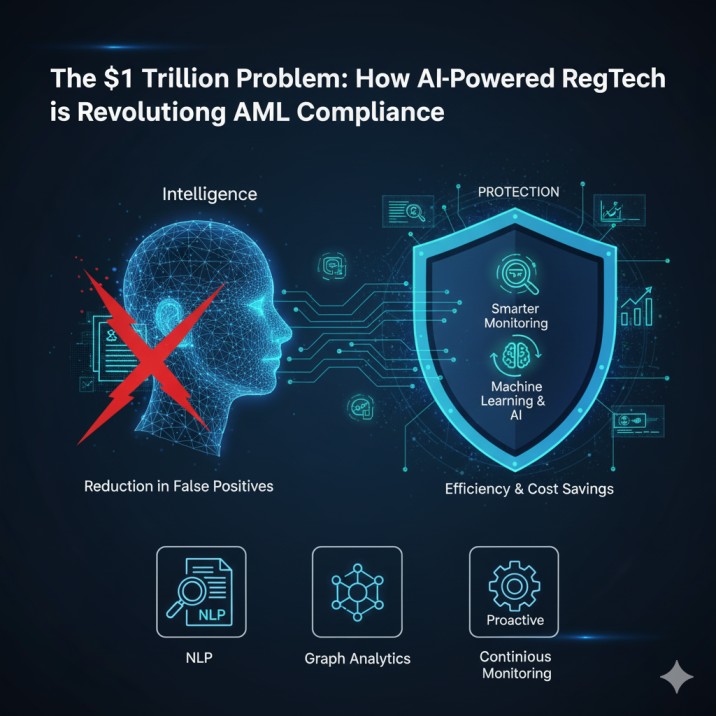
This is the most immediate and impactful application. Instead of rigid rules, machine learning algorithms for anomaly detection in financial transactions are used to establish a baseline of normal behavior for every single customer. The AI model learns a customer’s unique financial fingerprint: when they bank, where they send money, how much they typically transact.
When a transaction deviates significantly from this established pattern, it’s flagged for review. This could be a small business owner who suddenly starts wiring money to a high-risk country or a student who inexplicably receives a series of large, structured payments.
The impact is profound. AI can analyze hundreds of variables for every transaction in real-time, something no human team could ever do. This leads to a dramatic reduction of false positives in AML alerts using machine learning—often by over 70-80%. This allows investigators to stop searching for needles in a haystack and start examining a small, highly curated pile of needles.
2. Natural Language Processing (NLP) for Enhanced Due Diligence
AML compliance isn’t just about transactions; it’s about knowing your customer. The Know Your Customer (KYC) and Customer Due Diligence (CDD) processes are critical for assessing risk when a new customer comes on board. Traditionally, this involves manual background checks and searching for “adverse media”—news reports or public records linking a person to financial crime, terrorism, or political corruption.
This is where Natural Language Processing (NLP), a branch of AI that understands human language, becomes a game-changer. AI-powered adverse media screening for KYC uses NLP to scan and comprehend millions of data sources—news articles, legal documents, social media, and regulatory watchlists—in seconds.
It can understand context, differentiate between people with the same name (e.g., John Smith the banker vs. John Smith the convicted fraudster), and even analyze sentiment to gauge the severity of the information. This automation of customer onboarding with NLP not only makes the process faster and more accurate but also ensures ongoing monitoring, alerting the bank if a customer’s risk profile changes over time.
3. Network Analysis and Graph Analytics to Uncover Hidden Criminal Networks
This is where AI truly starts to think like a detective. As mentioned, criminals operate in networks. Using graph analytics to detect money laundering schemes is an AI technique that visualizes financial data as a network of nodes (people, accounts, companies) and edges (transactions).
This allows the AI to see the “shape” of financial crime. It can identify a group of seemingly unrelated accounts that all send money to a single, central shell corporation. It can spot mule networks where money is rapidly passed through dozens of accounts to blur its origin. These are patterns that are virtually impossible to detect when looking at individual transactions in a spreadsheet. This is a powerful AI-based approach for identifying money laundering patterns.
4. Predictive Analytics for Proactive Risk Management
The final piece of the puzzle is moving from a reactive to a proactive stance. Predictive analytics for AML risk assessment uses historical data to forecast future risks. An AI model can analyze trends to identify which types of customers or transactions are most likely to become problematic in the future.
This allows a financial institution to dynamically adjust its controls. For instance, if the AI detects a new money laundering typology emerging in a certain region, it can automatically tighten the monitoring parameters for transactions originating from that area. This ability to anticipate and adapt is crucial in the fight against constantly evolving criminal tactics.
From Theory to Practice: The Tangible Benefits of AI-Powered RegTech in AML
The adoption of these technologies isn’t just a theoretical exercise. Financial institutions that have embraced AI-powered RegTech are seeing transformative results.
- Drastic Reduction in False Positives: The impact here cannot be overstated. By focusing investigators’ time on high-quality alerts, institutions are improving their detection rates while simultaneously lowering operational costs. It’s a classic case of working smarter, not harder.
- Increased Efficiency and Significant Cost Savings: Automation of manual tasks, from transaction monitoring to KYC checks, frees up valuable human resources. The ROI of implementing AI in AML compliance is realized not only through reduced headcount but also through the avoidance of massive regulatory fines.
- Enhanced Detection of Sophisticated Crimes: AI-powered tools are consistently proving their ability to uncover complex, multi-layered criminal activities that would have gone unnoticed by legacy systems. They are finding the “unknown unknowns.”
- Future-Proofing Compliance: Criminals adapt. Regulations change. An AI system is not static; it is designed to learn and evolve. This makes it a far more sustainable and scalable solution for enterprise AML compliance than a rigid, rule-based engine that needs to be manually updated for every new threat.
For more on the real-world application and benefits, reports from major consulting firms like PwC provide deep insights into the state of financial crime and the technologies being used to combat it.
Navigating the Challenges: What Banks Need to Know Before Adopting AI for AML
Despite the immense promise, the transition to an AI-driven compliance model is not without its hurdles. Institutions must navigate several key challenges.
- Data Quality and Availability: AI models are hungry for data, and their performance is entirely dependent on the quality of that data. Banks often struggle with data that is siloed across different departments, incomplete, or inconsistent. A successful AI implementation begins with a robust data governance strategy.
- The “Black Box” Problem and Explainable AI (XAI): Early-stage machine learning models were often “black boxes,” meaning they could produce an answer, but it was impossible to understand how they reached that conclusion. This is a non-starter for regulators, who need to know why a bank made a certain decision. The field of Explainable AI (XAI) in financial compliance is now critical, focusing on developing models that can provide clear, human-understandable reasoning for their outputs.
- Regulatory Acceptance and Scrutiny: Regulators are cautiously optimistic about AI but are also rightly concerned about its risks. Financial institutions must engage in open dialogue with regulators, demonstrating that their AI models are fair, transparent, and effective. The path to regulatory approval for AI-based AML systems requires careful validation and documentation.
- Integration with Legacy Systems: Most large banks are built on decades-old technology infrastructure. Integrating cutting-edge AI platforms with these legacy systems can be a complex and expensive undertaking.
Organizations like the Financial Action Task Force (FATF), the global money laundering and terrorist financing watchdog, are actively exploring the role of new technologies and providing guidance to help the industry navigate these challenges.
Frequently Asked Questions (FAQ)
1. What is the difference between RegTech and FinTech?
FinTech (Financial Technology) is a broad term for any technology that improves or automates financial services for consumers or businesses (e.g., mobile payments, robo-advisors). RegTech is a subset of FinTech that focuses specifically on technologies that help companies comply with regulations more effectively.
2. How exactly does AI reduce false positives in AML?
AI reduces false positives by learning the unique, normal behavior of each customer. Instead of a blunt rule like “flag all transactions over $10,000,” AI understands that a $15,000 transaction might be normal for a large corporation but highly unusual for a student. It only flags deviations from the established norm, resulting in fewer, more accurate alerts.
3. Is RegTech expensive to implement for smaller institutions?
While initial costs can be a factor, many RegTech solutions are now delivered through a cloud-based Software-as-a-Service (SaaS) model. This lowers the barrier to entry, allowing smaller banks and credit unions to access powerful AI tools without a massive upfront investment in hardware and infrastructure.
4. What are some of the best AI tools for AML compliance?
The market is home to many innovative companies. Leading solutions often come from specialized RegTech vendors like ComplyAdvantage, Feedzai, and NICE Actimize, as well as larger tech players. These tools typically offer a suite of AI-powered services, including transaction monitoring, KYC/CDD automation, and sanctions screening.
5. Can AI completely replace human compliance officers?
No. The goal of AI in AML is not to replace humans but to augment them. AI is brilliant at processing vast amounts of data and identifying subtle patterns, but it lacks the contextual understanding and investigative intuition of a human expert. The future is a “human-in-the-loop” model, where AI handles the heavy lifting of data analysis, freeing up human officers to perform high-value investigation and decision-making.
6. How does AI help with the Know Your Customer (KYC) process?
AI automates the most time-consuming parts of KYC. It uses Natural Language Processing (NLP) to instantly screen for adverse media, checks against global sanctions lists, and can even use biometric technology to verify customer identities during digital onboarding, making the process faster and more secure.
7. What is a Suspicious Activity Report (SAR), and how does AI help?
A SAR is a document that financial institutions must file with authorities (like FinCEN in the US) when they suspect a transaction may be related to criminal activity. AI helps by automating the creation of the narrative for the SAR, pulling together all the relevant customer and transaction data to make the filing process quicker and more comprehensive for investigators.
8. How is AI being used to fight cryptocurrency money laundering?
AI is crucial for crypto compliance. Specialized blockchain analytics tools use AI to trace the flow of cryptocurrencies across the blockchain, identify transactions linked to illicit activities (like darknet markets or ransomware), and assess the risk profile of different crypto wallets and exchanges.
9. What is “explainable AI” (XAI), and why is it important for AML?
Explainable AI (XAI) refers to AI models that can provide clear reasoning for their decisions. This is vital in AML because if a bank’s AI model flags a customer, regulators will demand to know why. XAI provides that audit trail, making the AI less of a “black box” and more of a transparent, trustworthy tool.
10. Do I need a data scientist team to use AI for AML?
Not necessarily. Many modern RegTech platforms are designed to be user-friendly for compliance professionals, not just data scientists. They provide intuitive dashboards and require minimal coding, although having data expertise in-house is certainly beneficial for customization and model validation.
11. How does AI handle new and evolving money laundering techniques?
This is one of AI’s biggest strengths. Because machine learning models are designed to learn from new data, they can adapt and identify new, emerging patterns of criminal behavior much faster than a static, rule-based system that would require manual reprogramming.
12. What are the ethical considerations of using AI in AML?
A key ethical concern is the potential for algorithmic bias. If an AI model is trained on biased historical data, it could unfairly target certain demographic groups. It is crucial for institutions to actively audit their models for fairness and ensure their AI systems are making equitable decisions.
13. What is SupTech, and how does it relate to RegTech?
SupTech (Supervisory Technology) is when regulatory bodies themselves use technology to improve their oversight capabilities. It’s the other side of the RegTech coin. In the future, regulators will use SupTech to analyze the data submitted by banks’ RegTech systems, creating a more efficient and data-driven supervisory environment. The Bank for International Settlements (BIS) is a key institution driving research in this area.
14. Can AI predict financial crime before it happens?
Yes, to an extent. Predictive analytics models can identify customers or patterns of behavior that have a high probability of being linked to financial crime in the future. This allows banks to take proactive measures, such as applying enhanced monitoring or limiting services, to mitigate the risk before a crime is even committed.
15. Is my personal data safe when banks use AI for AML?
Data security and privacy are paramount. Banks are bound by strict data protection regulations like GDPR. Furthermore, new AI techniques like federated learning are emerging that allow models to be trained on data from multiple banks without the banks ever having to share the underlying sensitive customer data with each other.
Conclusion: Winning the War on Financial Crime with Intelligent Technology
The trillion-dollar problem of financial crime is a drain on the global economy and a threat to societal stability. The traditional methods of fighting it are no longer sufficient. We cannot win a 21st-century war with 20th-century tools.
The emergence of AI-powered RegTech marks a true inflection point. By moving from a reactive, rule-based approach to a proactive, intelligence-driven one, we can finally begin to turn the tide. This technology empowers financial institutions to be more efficient, more effective, and more insightful in their fight against illicit finance.
The road ahead will involve challenges of implementation, regulation, and ethics, but the path is clear. Embracing this technological shift is not just an option for staying competitive; it is an imperative for creating a safer, more transparent, and more secure global financial system. As reported by leading financial news outlets like the Wall Street Journal, the investment in this technology is not just about compliance—it’s about the future integrity of finance itself.