(Disclaimer: This blog post is for informational and educational purposes only. It is not financial or investment advice. All investing involves risk, including the possible loss of principal. Please conduct your own research and consult with a qualified financial advisor before making any investment decisions.)
Welcome to your first step toward building wealth. If you’re reading this, you’re probably feeling a mix of excitement and confusion. You hear stories of people making money in the stock market, and you see headlines about Bitcoin every day. But where do you even begin? The world of investing in 2026 can feel like a private club with a secret language.
I get it. When I started, I was overwhelmed by terms like “ETFs,” “blockchains,” and “diversification.” It felt safer to just leave my money in a savings account. But the truth is, the biggest risk to your long-term financial health isn’t just losing money—it’s losing buying power to inflation.
This guide is designed to change that. We’re going to break down everything. This isn’t a get-rich-quick scheme. This is a step-by-step guide on how to start investing in 2026 for beginners, focusing on the two biggest players: stocks and crypto. We’ll cover building a portfolio, understanding risk, and using simple platforms like Robinhood and Coinbase.
Let’s build your financial future, one simple step at a time.
The 2026 Investor’s Mindset (Before You Spend a Dollar)
Before you download an app or buy a single share, the most important investment you can make is in your mindset.
Why Start Investing in 2026? Beyond the Hype
First, let’s ask: is 2026 a good year to start investing?
Yes. The best time to start investing was 20 years ago. The second-best time is today. The reason isn’t about “timing the market”; it’s about time in the market.
The goal of investing is to put your money to work. Instead of you working for every dollar, your dollars start working for you. This happens through a powerful force called understanding compound interest in investing.
In simple terms: You invest $100. It earns 10% ($10). Next year, you don’t just earn 10% on your original $100; you earn it on $110. Your earnings start making their own earnings. Over 20 or 30 years, this effect can turn small, consistent investments into significant wealth. Leaving your money in a savings account (where it might earn 1% or less) while inflation runs at 3% or more means you are effectively losing buying power every year.
Setting Your Investing Goals for 2026
You wouldn’t get in a car without a destination. Don’t invest without a goal. Your goals will define your entire strategy.
- Short-Term Goals (1-3 years): Saving for a vacation, a new car, or an emergency fund. Spoiler: Money for these goals should not be in stocks or crypto. It should be in a high-yield savings account, safe from market swings.
- Mid-Term Goals (3-10 years): Saving for a house down payment or a wedding.
- Long-Term Goals (10+ years): Retirement, your kids’ college education, or general wealth-building.
This is where investing shines. The stock market, despite its daily ups and downs, has historically gone up over any 10-year period. How to create an investment plan starts with writing down your goals and your timeline. For 99% of beginners, the goal is long-term growth.
Investing vs. Trading: A Critical Difference for Beginners
This is the most important concept to grasp.
- Investing is buying assets (like stocks or crypto) with the belief that their value will grow over a long time. You are buying a piece of a company’s future or a stake in a new technology. This is a passive investing strategy for beginners and the one we focus on.
- Trading is buying and selling assets frequently (daily, weekly) to profit from short-term price swings. It’s a high-stress, high-risk, full-time job.
Beginners who try to be traders often get burned. They buy high (when everyone is excited) and sell low (when the market panics). As an investor, you do the opposite. You buy consistently, hold for the long term, and ignore the daily “noise.”
The First Step: How to Assess Investment Risk for Beginners
Before you can build a portfolio, you must understand your own stomach.
What is Your Investment Risk Tolerance? (The Most Important Question)
Your risk tolerance is your emotional and financial ability to handle a drop in your investments without panic-selling.
An investment risk assessment questionnaire for beginners would ask things like:
- How old are you? (Younger investors can take more risks).
- What is your income stability?
- How much do you have in emergency savings? (You must have 3-6 months of living expenses saved before you invest).
- How would you feel if your portfolio dropped 20% in a month?
- (A) I’d sell everything. (Low tolerance)
- (B) I’d be nervous but hold. (Medium tolerance)
- (C) I’d buy more. (High tolerance)
Be honest with yourself. This answer will determine your asset allocation.
Understanding High-Risk vs. Low-Risk Investments
All investments have risk, but the risk is not equal.
- Lower-Risk: Government bonds, high-yield savings accounts, Certificates of Deposit (CDs). These are “safe” but offer very low growth, often not even beating inflation.
- Medium-Risk: Index funds (like an S\&P 500 ETF), blue-chip dividend stocks. These are diversified and represent the broad market.
- High-Risk: Individual growth stocks, “meme stocks,” most cryptocurrencies. These have the potential for massive gains but also the potential to go to zero.
Your job as a beginner is to build a foundation on medium-risk assets and only sprinkle in high-risk assets, if at all.
Building Your Foundation: Investing in Stocks 101
For most beginners, the stock market will be the core of their portfolio. When you buy a stock, you are buying a tiny piece of ownership in a real business.
How to Buy Your First Stock in 2026: A Simple Guide
Here are the simple steps to start investing with little money:
- Choose a Broker: This is the company that gives you access to the stock market. For beginners, an app like Robinhood, Fidelity, or Charles Schwab is a great choice.
- Open Your Account: You’ll need to provide personal information like your Social Security number and bank account details. This is a standard legal requirement.
- Fund Your Account: Transfer money from your bank. You can start with any amount. Many platforms now support investing in fractional shares for beginners, meaning you can buy $5 worth of a $500 stock.
- Pick Your Investment: This is the big one. (Hint: Don’t start with individual stocks).
- Buy: You’ll place an order. A “market order” buys at the current price, while a “limit order” lets you set a price you’re willing to pay. For beginners, a market order is fine.
That’s it. You’re an investor.
Individual Stocks vs. Funds (ETFs & Index Funds)
A new investor trying to pick the “next Amazon” is gambling. Instead, you can buy the entire market.
- Individual Stock: Buying one share of Tesla. If Tesla has a bad year, you lose money.
- Fund (ETF or Mutual Fund): Buying one share of a “basket” that holds hundreds or thousands of stocks.
What are ETFs (exchange-traded funds) for beginners? They are the best invention for new investors. An ETF is a fund that trades on the stock market just like a regular stock.
The most famous type is an index fund. An index fund simply copies a market index. For example, by investing in S\&P 500 for beginners, you are buying one fund (like VOO or SPY) that holds small pieces of the 500 largest companies in the U.S. (Apple, Microsoft, Amazon, etc.).
This gives you instant diversification. You are no longer betting on one company; you are betting on the long-term success of the entire U.S. economy.
Growth Stocks vs. Value Stocks: What New Investors Should Know
You’ll hear these terms a lot.
- Growth Stocks: Companies growing sales and earnings faster than average (e.g., tech companies). They rarely pay dividends; they reinvest all their money to grow bigger.
- Value Stocks: Companies that seem “cheap” compared to their earnings or assets (e.g., older banks, consumer goods companies). They often pay dividend stocks for beginners, which are regular cash payments to shareholders.
A good index fund holds a mix of both.
The Power of Dollar-Cost Averaging (DCA) in Stocks
This is your secret weapon against volatility and how to avoid emotional investing.
Don’t try to “time the market.” Instead, set up an automatic investment. Decide to invest $100 on the 1st of every month, no matter what.
- When the market is high, your $100 buys fewer shares.
- When the market is low, your $100 buys more shares.
Over time, this strategy lowers your average cost per share and takes all the emotion out of it. It’s the single best strategy for 99% of investors.
The New Frontier: A Beginner’s Guide to Buying Crypto
Now for the wild side. Cryptocurrency is a new, exciting, and extremely risky asset class.
How to Start Investing in Cryptocurrency in 2026
Crypto is not the stock market. You aren’t buying ownership in a company. You are buying a digital asset that lives on a blockchain, technology for investors to understand at a basic level. A blockchain is a public, unchangeable digital ledger.
The risks of investing in cryptocurrency in 2026 are significantly higher than in stocks. Prices can swing 30% or more in a single day. Regulations are still evolving. But the potential rewards are also higher, which is why it attracts so much attention.
Rule #1: Never invest more in crypto than you are perfectly willing to lose. For most beginners, this should be a very small part of your total portfolio (e.To 1% to 5%).
Bitcoin, Ethereum, and Altcoins: What’s the Difference?
- Bitcoin (BTC): The original. A beginner’s guide to buying Bitcoin 2026 starts here. Think of it as “digital gold”—a store of value that is scarce and secure.
- Ethereum (ETH): The second biggest. Think of it as a “decentralized computer.” People can build applications on its blockchain. This is how to buy Ethereum for beginners if you believe in the future of blockchain technology itself (like DeFi and NFTs).
- Altcoins and Meme Coins: Everything else. This ranges from serious projects to outright scams or jokes (like Dogecoin). This is the highest risk category. Beginners should be extremely cautious.
How to Store Cryptocurrency Safely: Hot Wallets vs. Cold Wallets
This is critical. When you buy a stock, your ownership is registered with a broker. When you buy crypto, you are responsible for securing it.
- On an Exchange (like Coinbase): This is the easiest way. Coinbase holds your crypto for you. It’s convenient but means you are trusting their security. This is a type of hot wallet (connected to the internet).
- A “Cold Wallet”: This is a physical device, like a USB drive (from brands like Ledger or Trezor), that stores your crypto offline. This is the safest way to buy crypto for the long term, as it can’t be hacked remotely.
If you own more than a few hundred dollars, learning what is a crypto wallet (hot vs. cold) and getting a cold wallet is essential.
Managing the Extreme Risk of Crypto
The same principles from stocks apply but are even more important here.
- Dollar-Cost Averaging (DCA): Use what is dollar-cost averaging in crypto to your advantage. Set up a recurring buy (e.g., $10 of Bitcoin every Friday) to smooth out the insane volatility.
- Don’t Panic: You will see your investment drop 50%. It’s normal in this market. If you believe in the long-term technology, you must be prepared to hold through what to do when the crypto market crashes.
Choosing Your Tools: Platforms Like Robinhood and Coinbase
To buy stocks and crypto, you need an “on-ramp.” These are the best investment apps for stocks and crypto in 2026 for beginners.
Robinhood for Beginners 2026 Review: Pros and Cons
Robinhood is famous for its simple, game-like interface and “commission-free” trading.
- Pros: Extremely easy to use, great for learning. It pioneered investing in fractional shares for beginners, letting you buy tiny pieces of expensive stocks. You can buy both stocks and some major cryptos in one app.
- Cons: The “game-like” design can encourage over-trading. Its customer support and educational tools aren’t as strong as traditional brokers. When asking is Robinhood safe for beginners, the answer is yes; it’s a regulated broker-dealer, and your cash/securities are insured (up to certain limits).
Coinbase for Beginners 2026 Review: Your Crypto Gateway
Coinbase is the “Robinhood” of the crypto world. It’s often the very first platform new users buy crypto on.
- Pros: Incredibly simple interface. How to buy crypto on Coinbase is a 3-click process. It is a publicly traded U.S. company, giving it a high level of trust and security. Their “Learn and Earn” feature even gives you free crypto for watching short videos.
- Cons: The fees can be high, especially for small, direct purchases. The “simple” Coinbase app has high fees; the “Advanced” trading platform has lower fees but is more complex. Is Coinbase safe for beginners? Yes, it’s considered one of the safest and most regulated exchanges in the world.
Understanding Fees: Robinhood vs. Coinbase
- Robinhood: Trading stocks and ETFs is commission-free. They make money in other ways (like “payment for order flow”). For crypto, they charge a spread (a small difference between the buy and sell price).
- Coinbase: Fees are higher. You’ll pay a spread and a transaction fee, which can add up.
Many people use a traditional broker (like Fidelity) for stocks and an exchange (like Coinbase) for crypto. However, alternatives to Robinhood and Coinbase in 2026 include platforms like Kraken (for crypto) or Public and Webull (for stocks).
How to Build Your First Investment Portfolio in 2026
Okay, let’s put it all together.
How to Build an Investment Portfolio from Scratch in 2026
Building a diversified portfolio with $1000 (or even $100) is easier than ever. A “portfolio” is just the collection of all your investments.
Your goal is not to pick winners. Your goal is to build a “team” of assets that don’t all move in the same direction. This is the importance of diversification in investing.
The Core Principle: Diversification and Asset Allocation
Asset allocation is simply deciding how to slice your investment “pie.” This is the single biggest factor in your portfolio’s performance.
This is your beginner guide to asset allocation:
- Stocks (Equities): The engine for growth.
- Bonds (Fixed Income): The “brakes” for stability. Bonds (loans to governments or corporations) usually go up when stocks go down, smoothing out your ride.
- Cash: Your emergency fund, kept separate.
- Alternatives: A tiny slice for things like crypto or real estate.
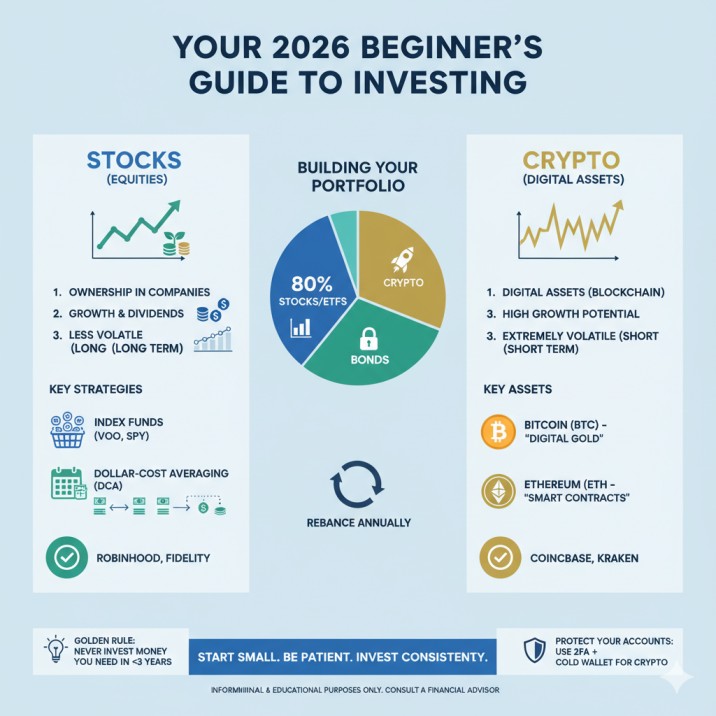
A common rule for your stock/bond mix is “110 minus your age.” If you are 30, you’d have 80% in stocks and 20% in bonds.
What Percentage Should I Invest in Stocks vs. Crypto?
This is the big question for 2026. Given crypto’s extreme risk, it should be treated as a part of your “alternatives” slice, or a small piece of your “stocks” slice.
A sample beginner portfolio (this is not advice, just an example) for a 30-year-old with moderate risk tolerance might look like this:
- 80% in Stocks:
- Example: 60% in a U.S. Total Stock Market Index Fund (like VTI).
- Example: 20% in an International Stock Market Index Fund (like VXUS).
- 15% in Bonds:
- Example: 15% in a Total Bond Market Index Fund (like BND).
- 5% in Alternatives:
- Example: 5% in Cryptocurrency (e.g., Bitcoin and Ethereum).
This portfolio gives you exposure to thousands of companies worldwide, the stability of bonds, and a small, exciting stake in the new crypto-asset class. This is how you create a diversified investment portfolio 2026.
How to Rebalance Your Investment Portfolio (And Why It Matters)
Let’s say after a great year, your crypto slice has grown from 5% to 15% of your portfolio, and your stocks have shrunk.
You are now taking on more risk than you originally planned.
How to rebalance your investment portfolio means selling some of the “winner” (crypto) and using the profit to buy more of the “loser” (stocks/bonds) to get back to your original 80/15/5 target.
This forces you to “sell high and buy low” and is a key part of long-term portfolio management for beginners. You should check your portfolio and rebalance it once or twice a year.
Avoiding Common Pitfalls (Our Experience)
I’ve seen so many new investors stumble. Here are the common investing mistakes beginners make in 2026 and how to avoid them.
- Mistake 1: FOMO (Fear of Missing Out). You see a stock or coin “mooning” and you buy at the absolute top, right before it crashes. Solution: Stick to your DCA plan.
- Mistake 2: Panic Selling. The market crashes, and you sell everything at a loss to “stop the bleeding.” Solution: Remember your long-term goal. Crashes are temporary; a 10-year holding period is your shield.
- Mistake 3: Investing Money You Need. You invest your rent money, hoping to double it. Solution: Only invest money you will not need for at least 3-5 years.
- Mistake 4: Not Doing Any Research. You buy a stock because a celebrity tweeted about it.
How to Research Stocks and Crypto Before Buying
You don’t need a finance degree.
- For Stocks: What is fundamental analysis for beginners? It’s asking simple questions: What does this company actually do? Is it profitable? Does it have a lot of debt? Does it have a strong brand? You can find this info on Yahoo Finance.
- For Crypto: Read the “whitepaper.” What problem does this crypto solve? Who is the team behind it? How many coins are there (is it scarce like Bitcoin)? Is it already being used?
Understanding the Tax Implications of Investing
You must pay taxes on your realized gains.
- If you buy a stock and hold it for a year, then sell it for a profit, you pay “long-term capital gains” tax, which is a lower rate.
- If you buy and sell within one year, you pay “short-term capital gains,” which is taxed at your regular income tax rate (much higher).
This is another reason to be a long-term investor, not a trader. The tax implications of investing in crypto 2026 are the same as for stocks. The IRS treats it as property. Keep good records. This is not tax advice, so please consult a professional. For official information, you can always refer to government resources like the IRS website on capital gains.
Conclusion: Your Investing Journey Starts Now
You’ve just completed a crash course on investing in 2026.
You’ve learned more than 90% of new investors ever will. You know the difference between investing and trading. You know how to manage risk, the power of diversification, and why index funds are a beginner’s best friend. You understand the basics of stocks and crypto, and you know how to use platforms like Robinhood and Coinbase.
The most important step is the next one. Not to invest all your money, but to continue your financial literacy for beginner investors. Read a book. Listen to a podcast.
Start small. How to invest $100 for beginners is a great first step. Open an account, put $100 into an S\&P 500 index fund, and set up a $10 weekly contribution. Then, let it sit.
The journey to building wealth is not a sprint; it’s a marathon. You’ve taken the first step. Congratulations.
Frequently Asked Questions About Starting to Invest in 2026
1. How much money do I need to start investing in stocks?
You can start with as little as $1. Thanks to fractional shares, you can buy a small piece of any stock or ETF. The amount isn’t as important as the habit of investing consistently.
2. What is the safest investment for a beginner?
The “safest” investments (like high-yield savings accounts) won’t grow your money. The best blend of safety and growth for a beginner is typically a broad-market index fund, like an S\&P 500 ETF or a Total Stock Market ETF. It provides massive diversification, which protects you from any single company failing.
3. What is a bear market vs. a bull market?
A bull market is a period when stock prices are generally rising. A bear market is a period when prices are falling (typically by 20% or more). As a long-term investor, you will live through both. Bear markets are scary, but they are also the best opportunities to buy assets “on sale.”
4. Can I invest in stocks and crypto in my IRA?
You can (and should) invest in stocks, ETFs, and mutual funds through an IRA (Individual Retirement Account) like a Roth IRA vs. traditional IRA. These accounts offer huge tax advantages. It is possible to invest in crypto in some specialized IRAs, but it’s more complex and not recommended for beginners. For more on tax-advantaged accounts, check reliable financial education sources like Investopedia’s guides.
5. What are market orders vs. limit orders?
A market order buys or sells an asset at the best available current price. It’s fast and simple. A limit order lets you set a specific price. For example, “Buy 1 share of XYZ only if the price drops to $50.” For beginners buying long-term index funds, a market order is perfectly fine.
6. What is the single biggest mistake new investors make?
Checking their portfolio every day. This will drive you crazy and cause you to make emotional decisions (panic-selling or fomo-buying). Set up your automatic investments and check your portfolio once a month, or even once a quarter.
7. How do I protect my investment accounts from hackers?
This is a key part of how to protect your investment accounts. Use a unique, strong password and, most importantly, enable Two-Factor Authentication (2FA) on all your accounts (Robinhood, Coinbase, etc.). For crypto, the ultimate protection is a cold wallet.
8. What is a financial advisor, and do I need one?
A financial advisor is a professional who helps you create a financial plan. Most beginners don’t need one. A simple strategy of buying index funds (a “three-fund portfolio”) is something you can easily manage yourself. You might consider an advisor when your finances get more complex (you have a house, kids, and a large portfolio).
9. What are NFTs, and should I invest in them in 2026?
NFTs (Non-Fungible Tokens) are unique digital assets on a blockchain, often representing art or collectibles. For a beginner, they should be considered speculative collecting, not investing. The risk is extremely high, and you should only use money you are fully prepared to lose. Focus on your foundation (index funds) first.
10. What is dollar-cost averaging in crypto?
It’s the same as in stocks. Instead of trying to “buy the dip,” you commit to buying a small, fixed amount of crypto (like $20 of Bitcoin) every single week, regardless of the price. This averages out your cost over time and is the most sensible way for a beginner to how to start investing in cryptocurrency 2026. Platforms like Coinbase have features to set this up automatically.
11. How to read stock charts for beginners?
Honestly, you don’t need to. “Technical analysis” (reading charts to predict future prices) is for traders. As a long-term investor, you care about the company’s long-term health (its fundamentals) and the broad market’s growth, not the squiggly lines on a 1-day chart.
12. What to do when the stock market crashes?
If you have a proper emergency fund, your bills are paid, and your timeline is long-term, the answer is: nothing. Don’t sell. If you have extra cash, a crash is a fantastic time to buy more, as you are getting your favorite index funds at a major discount. Stick to your plan.