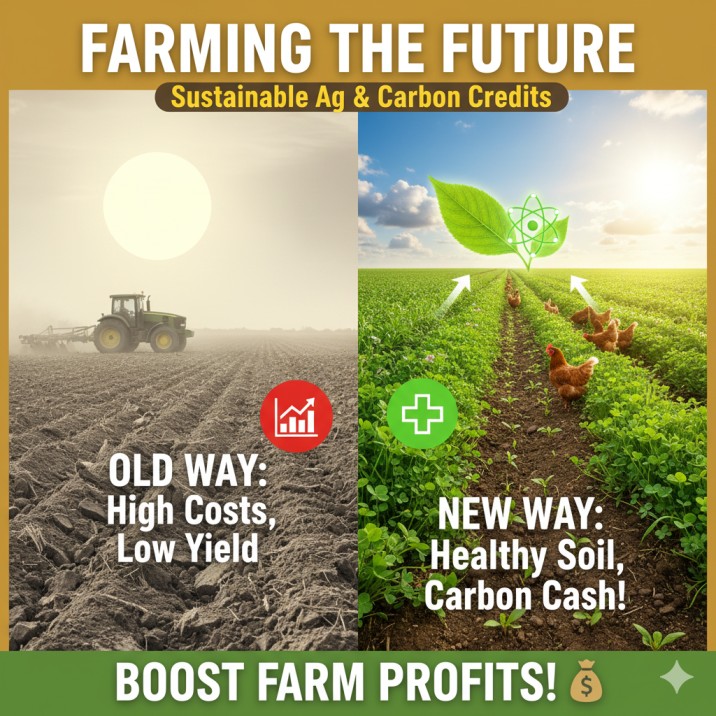
The life of a farmer has always been a delicate dance with economics and the environment. For generations, the goal was simple: maximize yield. But today, the ground is shifting—both literally and financially. Rising input costs, unpredictable weather, and degrading soil health are challenging the old ways. What if you could not only make your land more resilient and productive but also open up an entirely new revenue stream just by farming smarter?
This isn’t a far-off dream. It’s the new reality of sustainable agriculture. Farmers across the country are discovering that practices designed to heal the land are also healing their bottom line. The secret weapon in this economic revolution is something you can’t even see: carbon. By adopting “carbon farming” techniques, you can turn your soil into a valuable asset, generating income through the burgeoning carbon credit market.
This guide is for you—the forward-thinking farmer. We’ll break down the economics of sustainable agriculture and carbon farming credits, showing you the financial incentives available and how to transform your sustainable practices into a profitable enterprise.
Why Sustainable Agriculture is Now an Economic Imperative
For decades, conventional farming has relied on a model of intensive tillage and chemical inputs. While it produced high yields, it often came at a hidden cost to the farm’s most valuable asset: its soil. This approach is becoming less and less sustainable, both for the environment and for your wallet.
Understanding the Hidden Costs of Conventional Farming
Think about your annual budget. How much is spent on synthetic fertilizers, pesticides, and fuel for tillage? These costs are not just line items; they are symptoms of a system that is fighting against nature. Degraded soil loses its natural ability to hold water and cycle nutrients, forcing you to spend more money to do the job the soil used to do for free. This is where the long-term profitability of sustainable agriculture really begins to shine. By rebuilding soil health, you cut down on these expensive inputs year after year.
The Core Sustainable Farming Practices That Pay Dividends
Sustainable agriculture isn’t about one single change; it’s a system of practices that work together to create a healthier, more resilient farm ecosystem. The most impactful and financially rewarding practices include:
- No-Till or Reduced-Till Farming: By not disturbing the soil, you prevent carbon from being released into the atmosphere, reduce erosion, and drastically cut fuel and labor costs. The economic benefits of no-till farming are among the most immediate a farmer can see.
- Cover Cropping: Planting crops like clover or rye during the off-season protects the soil from erosion, suppresses weeds (reducing herbicide costs), and adds valuable organic matter and nutrients back into the ground. The financial benefits of cover crops for soil health compound over time.
- Rotational Grazing: Moving livestock between pastures allows the land to recover, leading to healthier forage, reduced feed costs, and more even manure distribution, which acts as a natural fertilizer. This practice has significant carbon sequestration potential in grazing systems.
These aren’t just “green” ideas; they are powerful business decisions that improve your land’s value and reduce your operational expenses.
Carbon Farming 101: Turning Your Soil into a Financial Asset
So, how do these sustainable practices translate into a direct paycheck? The answer lies in the concept of carbon farming.
What Exactly is Carbon Farming and How Does it Generate Revenue?
At its core, carbon farming is the practice of using agricultural methods to capture and store atmospheric carbon dioxide in the soil and vegetation. Plants naturally absorb CO₂ through photosynthesis. Sustainable practices like no-till and cover cropping supercharge this process, pulling more carbon out of the air and locking it away in the soil in a stable form called soil organic carbon.
This stored carbon has real monetary value. Companies and governments looking to offset their own emissions will pay farmers for these verified carbon removals. Each metric ton of CO₂ stored is equivalent to one agricultural carbon credit. You are essentially selling a measurable environmental service, creating an entirely new income source for farmers from carbon sequestration.
The Step-by-Step Process for Farmers to Sell Carbon Credits
Getting started might seem complex, but the pathway is becoming clearer every year. Most farmers work with a carbon program developer who handles the technical side of things. Here’s a simplified look at the journey:
- Choose a Partner and Establish a Baseline: You’ll select a reputable carbon program. They will help you establish your farm’s current carbon baseline by collecting soil samples and analyzing your historical management data. This is the starting point from which all new carbon storage will be measured.
- Adopt New Sustainable Practices: You’ll implement one or more new qualifying practices, such as transitioning a field from conventional tillage to no-till or planting cover crops for the first time. The key is “additionality”—you are paid for new carbon captured as a result of these changes.
- Measurement, Reporting, and Verification (MRV): This is a critical step. Over a set period, data is collected through soil sampling and modeling to quantify the amount of carbon you’ve stored. This data is then audited by an independent third party. The importance of third-party carbon verification cannot be overstated, as it ensures the integrity and value of your credits.
- Sell Your Credits: Once verified, your carbon credits are issued and can be sold on the voluntary carbon market for agriculture. Your program partner typically facilitates this sale and you receive the payment, transforming your sustainable efforts into tangible profit.
The Financials: A Deep Dive into the Economics of Carbon Credits
This is the question every farmer asks: Is it worth it? Let’s break down the numbers and the market to understand the ROI of regenerative agriculture practices.
How Much are Agricultural Carbon Credits Worth in 2025?
The price of agricultural carbon credits is dynamic and depends on several factors, including the verification standard used, the permanence of the storage, and overall market demand. As of late 2025, prices on the voluntary market for high-quality, verified soil carbon credits typically range from $20 to over $40 per metric ton of CO₂.
It’s important to remember that demand is growing rapidly as more corporations make net-zero commitments. This increasing demand is expected to put upward pressure on prices, making now an excellent time to get involved. The future market trends for farm-based carbon offsets look incredibly promising.
Calculating the Potential Return on Investment for Your Farm
Let’s run a hypothetical scenario.
- Farm Size: 1,000 acres of corn and soybeans.
- New Practice: Transition from conventional tillage to no-till and add a cereal rye cover crop.
- Sequestration Rate: A conservative estimate is that this change can sequester 0.5 metric tons of CO₂ per acre per year.
- Carbon Price: We’ll use a moderate price of $30 per credit (per ton).
Annual Carbon Revenue Calculation:
- 1,000 acres × 0.5 tons/acre = 500 tons of CO₂ sequestered.
- 500 tons × $30/ton = $15,000 in new annual revenue from carbon credits.
But that’s only half the story. The economic analysis of cover cropping and no-till farming reveals significant cost savings as well:
- Fuel Savings (No-Till): Eliminating tillage passes can save $15-$25 per acre in fuel and labor. (1,000 acres x $20 = $20,000 saved).
- Fertilizer Reduction: Improved soil health can reduce the need for synthetic nitrogen over time, saving another $10-$30 per acre. (1,000 acres x $15 = $15,000 saved).
Total Annual Financial Impact:
- $15,000 (Carbon Revenue) + $20,000 (Fuel/Labor Savings) + $15,000 (Fertilizer Savings) = $50,000 positive impact on the farm’s bottom line.
This carbon farming profitability calculator for farmers shows how the benefits stack, making the transition a powerful financial decision.
Navigating the Voluntary Carbon Market for Agriculture
The market where most agricultural credits are sold is the voluntary market. This is where companies voluntarily purchase credits to meet their sustainability goals. When choosing a program, look for partners who are transparent about their fees, use rigorous and scientifically-backed soil carbon measurement techniques for farmers, and have a strong track record of selling credits to reputable buyers. Exploring the best carbon credit programs for farmers involves due diligence, but finding the right partner is key to maximizing your returns.
Beyond Carbon Credits: Additional Financial Incentives
While carbon credits are an exciting new revenue stream, the economic benefits of going sustainable don’t stop there.
Unlocking Government Grants and Subsidies for Sustainable Practices
Governments recognize the public benefits of healthy soil and clean water. As a result, there are numerous government incentives for sustainable farming. In the United States, the USDA’s Natural Resources Conservation Service (NRCS) offers significant financial assistance through programs like:
- Environmental Quality Incentives Program (EQIP): Provides financial and technical assistance to help producers implement conservation practices.
- Conservation Stewardship Program (CSP): Rewards farmers for maintaining a high level of conservation on their land and for adopting additional practices.
You can learn more about these powerful programs directly from the USDA NRCS website. These programs can help offset any initial costs of starting carbon farming and accelerate your transition.
How Improved Soil Health Directly Boosts Your Bottom Line
The economic benefits of healthy soil are profound. Healthy soil rich in organic matter acts like a sponge, dramatically improving water infiltration and retention. This means your fields become more resilient to both drought and flooding. Better water availability during dry spells can directly translate to higher, more stable yields, protecting your income in an increasingly unpredictable climate. As mentioned earlier, healthy soil also cycles nutrients more efficiently, meaning you spend less on buying and applying commercial fertilizers.
Accessing Premium Markets for Sustainably Grown Products
Consumers are more interested than ever in where their food comes from and how it’s grown. This has created market advantages of sustainable agriculture. Many food companies are now willing to pay a premium for crops grown using regenerative or sustainable methods. By certifying your farm or working with specific buyers, you can tap into these premium markets, adding another layer of profitability on top of your cost savings and carbon credit revenue.
Overcoming Hurdles: Challenges and Considerations in Carbon Farming
Transitioning to a new system is not without its challenges. It’s crucial to go in with a clear understanding of the commitment required.
Understanding the Upfront Costs and Long-Term Commitment
While sustainable practices lead to long-term savings, there can be upfront costs. You might need to invest in new equipment like a no-till drill or purchase cover crop seeds. Furthermore, there can be a learning curve. Yields may dip slightly in the first year or two of transition as the soil biology adjusts. This is why viewing it as a long-term investment is critical. The challenges in transitioning to sustainable agriculture are real, but they are manageable with proper planning and support from programs like EQIP.
The Importance of Accurate Measurement, Reporting, and Verification (MRV)
The credibility of the entire carbon market rests on robust MRV. Buyers need to trust that the carbon credit they are purchasing represents a real, permanent, and additional ton of CO₂ removed from the atmosphere. This is why working with a program that uses high-quality soil carbon measurement and verification protocols is non-negotiable. Reputable programs partner with trusted registries like Verra or the Climate Action Reserve to ensure every credit is real and can withstand scrutiny. This rigor, backed by institutions like the Soil Health Institute, is what gives your carbon credits their value.
The Future is Fertile for Profitable, Sustainable Farming
The message is clear: The future of farming profitability is intrinsically linked to sustainability. The days of viewing environmental stewardship and financial success as opposing forces are over. Sustainable agriculture offers a pathway to lower costs, more resilient land, and diversified income streams.
Carbon farming credits are at the heart of this new economic model, providing a direct financial reward for the vital environmental service you provide by storing carbon in your soil. It’s a system where everyone wins—the farmer, the environment, and society. By taking the first steps today—researching programs, analyzing your operation, and talking to other farmers—you can position your farm not just to survive, but to thrive for generations to come.
Frequently Asked Questions (FAQ)
1. Is carbon farming actually profitable for small farms?
Absolutely. While larger farms may generate more total credits, the per-acre revenue and cost savings are the same. Many carbon programs are now specifically designed with flexible contract terms to make them accessible and profitable for small to mid-sized family farms.
2. How long does it take to get paid for agricultural carbon credits?
The timeline can vary. Generally, after enrolling and implementing a practice change, the verification and payment cycle is about 12-18 months for the first issuance. Subsequent payments are often on an annual cycle after that.
3. What are the biggest risks involved in selling carbon credits?
The primary risks include price volatility in the market and “permanence.” If you plow a field that was in no-till for 5 years, the stored carbon is released, and you may have to repay the credits. Choosing a program with fair and clear contract terms is essential to mitigate these risks.
4. Can I get paid for sustainable practices I am already doing?
This is a tricky area. Most carbon programs require “additionality,” meaning you get paid for new changes. However, some emerging programs and government incentives (like CSP) are designed to reward farmers who have already been long-term stewards of the land.
5. How do companies measure the carbon in my soil?
Measurement is typically done through a combination of physical soil sampling and advanced biogeochemical modeling. A baseline is established with initial soil samples, and then models use data on your practices, weather, and soil type to quantify changes over time, with periodic resampling for validation.
6. Do I have to sign a long-term contract to participate in a carbon program?
Yes, most contracts range from 5 to 20 years. This is because carbon storage is a long-term process, and credit buyers need assurance that the carbon will remain stored. Be sure to fully understand the length and terms of any contract before signing.
7. What happens if I have a bad year with a drought or flood?
Reputable carbon programs understand the realities of farming. Their models account for natural weather variability. A single bad year will not typically disqualify you, as they are measuring the trend of carbon storage over the long term. Your contract should have clear clauses for “acts of God.”
8. Who are the main buyers of agricultural carbon credits?
The primary buyers are large corporations in sectors like technology, transportation, and finance that have made public commitments to reduce their carbon footprint and achieve “net-zero” emissions. They use high-quality credits from sources like agriculture to offset emissions they cannot eliminate from their operations.
9. Can organic farms also sell carbon credits?
Yes! In fact, many organic practices (like composting and complex cover cropping) are excellent for building soil carbon. Organic farms can absolutely participate in carbon markets, adding another valuable revenue stream to their operation.
10. How much does it cost me to enroll in a carbon farming program?
Most leading carbon programs have zero upfront costs for the farmer. The program developer covers the costs of soil sampling, verification, and credit marketing. They then take a percentage of the final credit sale as their fee.
11. What is the difference between the voluntary and compliance carbon markets?
The compliance market (like California’s Cap-and-Trade) is government-regulated and mandatory for certain industries. The voluntary market, where most agricultural credits are sold, consists of buyers (companies, individuals) who choose to purchase offsets to meet their own goals. A key standard setter in the voluntary market is Verra, which manages the Verified Carbon Standard (VCS).
12. Where can I find a list of reputable carbon credit programs for farmers?
There isn’t a single official list, but a good starting point is to contact organizations like the Soil Health Institute, the American Farmland Trust, or your local university extension office. They often have resources and can provide guidance on reputable programs operating in your region.