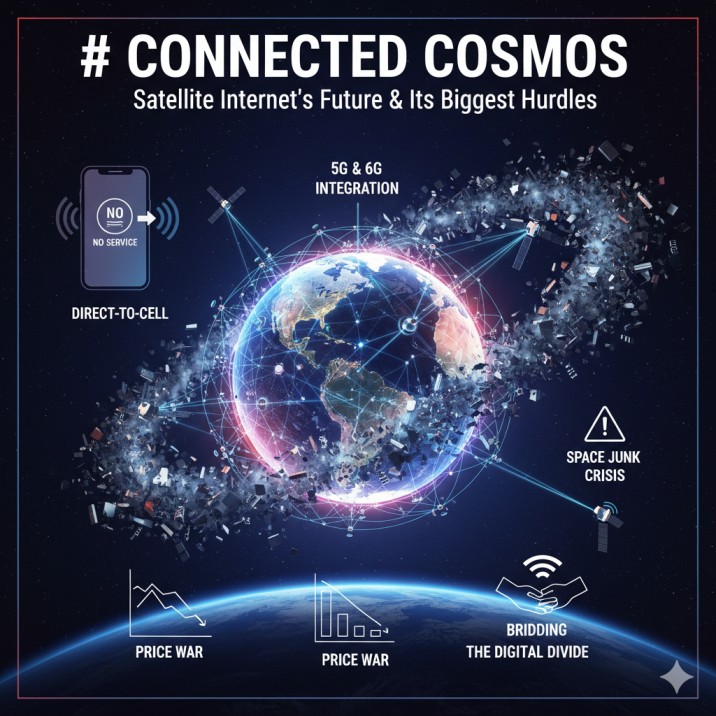
We are living in the golden age of satellite internet. The launch of massive Low Earth Orbit (LEO) constellations has shattered old perceptions of laggy, unreliable connections from space. Companies like Starlink have demonstrated that high-speed, low-latency internet can be beamed to remote cabins, ships at sea, and underserved communities around the world. It’s a monumental achievement.
But this is just the beginning.
The current revolution is merely the foundation for a much more integrated and ambitious future. So, what’s next for satellite internet? The road ahead is paved with groundbreaking trends that could redefine global connectivity, but it’s also fraught with serious challenges that we must navigate responsibly.
This deep dive explores the future of satellite internet technology, from its seamless integration with 5G and 6G networks to the looming crisis of orbital debris. We’ll examine the complex regulatory hurdles and analyze how fierce competition will ultimately impact the price you pay. This is the roadmap to true global coverage.
The Seamless Sky: How Satellite Internet Will Integrate with 5G and 6G Networks
The future isn’t about choosing between your cell phone plan and a satellite connection; it’s about them working together in perfect harmony. The next great leap is the creation of a single, unified network that blends terrestrial and space-based systems.
What is a Hybrid Network and Why Does It Matter?
Imagine your phone seamlessly switching from a 5G tower in the city to a satellite overhead the moment you drive into a rural valley, without the call ever dropping. This is the core promise of a hybrid network. In technical terms, this concept is known as Non-Terrestrial Networks (NTN), and it’s a key component of the 5G-Advanced and 6G standards.
The hybrid satellite and terrestrial network benefits are immense:
- Total Coverage: It eliminates dead zones, providing resilient connectivity everywhere.
- Network Resilience: If terrestrial networks (cell towers, fiber lines) go down during a natural disaster, satellites can provide an immediate communications backbone for emergency services.
- Load Balancing: During periods of heavy congestion in a city, network traffic can be offloaded to satellites to ensure smooth performance for everyone. The satellite backhaul for 5G mobile networks will become a crucial tool for carriers looking to expand capacity without building more towers.
This integration is the next logical step in our quest for always-on connectivity, creating a network that is truly greater than the sum of its parts.
Direct-to-Cell: The End of “No Service” Dead Zones?
Perhaps the most exciting short-term trend is direct-to-cell satellite communication. So, what is satellite to phone technology? It’s a system that allows standard, off-the-shelf smartphones to connect directly to a satellite for basic services, bypassing the need for a special terminal or dish.
You’ve already seen the first generation of this with Apple’s Emergency SOS via satellite. The direct to cell satellite communication future is far more ambitious. Companies are developing LEO satellites with massive, advanced antennas that can effectively act as cell towers in the sky.
Initially, this will provide text messaging, and eventually voice and low-speed data, to any area that currently has zero cellular coverage. This is a game-changer for hikers, boaters, people living in extremely remote areas, and anyone who has ever been stranded with a “No Service” message on their screen. It represents a fundamental safety and connectivity net for the entire planet.
The Role of LEO Satellites in Future 6G Networks
If 5G is about integrating satellites, 6G is about being born from them. The vision for 6G is a three-dimensional network that fully incorporates satellites, high-altitude drones, and terrestrial systems into one intelligent fabric. The satellite internet and 6G network explained simply is a move from satellites as a “backup” to satellites as a core, indispensable component.
In a 6G world, LEO constellations won’t just transmit data; they will be part of a global sensing system, providing high-resolution Earth observation, precise positioning, and real-time data for AI-driven systems that manage everything from autonomous shipping routes to smart agriculture. The role of LEO satellites in 6G networks is to provide the ubiquitous, low-latency data streams that will power the next generation of technology.
A Crowded Cosmos: The Growing Challenge of Orbital Debris and Space Sustainability
While we build this incredible network in the sky, we face a monumental risk: polluting our orbital environment to the point of no return. The very constellations that connect us could create a cage of debris around our planet.
The Problem with Space Junk from Satellites Explained
Orbital debris, or “space junk,” is any man-made object in orbit that no longer serves a useful purpose. This includes everything from defunct satellites and spent rocket stages to tiny flecks of paint. The danger isn’t the object itself, but its velocity—traveling at over 28,000 km/h (17,500 mph), even a small screw has the destructive energy of a hand grenade.
The primary fear is a cascading chain reaction known as the Kessler syndrome. The Kessler syndrome and LEO constellations risk is that a single collision could generate a cloud of new debris, which in turn increases the probability of more collisions, creating even more debris. If triggered, this could render certain orbits unusable for centuries, trapping us on Earth. The long term challenges for satellite internet are not just on the ground but in ensuring the orbital highways remain clear.
The Fight for Dark Skies: Impact of Satellite Constellations on Astronomy
Another unintended consequence is the growing light pollution from Starlink satellites explained by astronomers worldwide. Just after sunset and before sunrise, these thousands of satellites catch the sun’s rays and can appear as bright, moving streaks in the night sky.
This poses a serious threat to ground-based astronomy. These streaks can saturate the sensitive detectors of large telescopes, ruining observations and hindering our ability to study the universe, track asteroids, and make new discoveries. While companies are experimenting with darker paint and new orientations to mitigate this, the impact of satellite constellations on astronomy remains a point of significant tension between commercial progress and scientific discovery.
Deorbiting Strategies and the Future of Space Sustainability
The solution to a crowded space is responsible management. The concept of space sustainability and satellite mega constellations going hand-in-hand is now a primary focus. Modern regulations in many countries now mandate that satellites must have a reliable plan to be deorbited within 5 to 25 years of their mission ending.
These deorbiting strategies for old satellites include:
- Passive Deorbit: Using leftover fuel to push the satellite into a lower orbit where atmospheric drag will naturally cause it to burn up.
- Active Deorbit: Including systems like tethers or small sails that increase drag to speed up atmospheric reentry.
Furthermore, a new industry is emerging around Active Debris Removal (ADR). Companies are developing concepts for “space tugs” that could capture and deorbit large, dangerous pieces of existing debris. Knowing how are companies cleaning up space debris will be a key part of ensuring the long-term viability of our orbital environment.
Navigating the Red Tape: Global Regulatory Hurdles for Satellite Internet
Technology is only one part of the equation. Deploying a truly global internet service requires navigating a labyrinth of international laws, regulations, and politics.
The Battle for the Airwaves: Who Manages Spectrum Allocation?
Satellites communicate using radio waves, and the range of available frequencies (the “spectrum”) is a finite, precious resource. To prevent services from interfering with each other, the spectrum allocation for satellite communication is carefully managed by the International Telecommunication Union (ITU), a specialized agency of the United Nations.
Companies must apply to the ITU and national regulators to secure the rights to use specific frequency bands. This is a long, complex, and highly competitive process. The future of satellite internet regulation will involve intense negotiations as more and more constellations vie for their slice of the electromagnetic pie. For more information on this process, you can visit the ITU’s official page on radio regulations.
Landing Rights and Geopolitical Issues with Satellite Internet
Even with the right spectrum, a company can’t just offer service anywhere it wants. It needs permission from each individual country, a process known as securing “landing rights.” This presents major geopolitical issues with satellite internet.
Some governments may be hesitant to allow a foreign-controlled internet service to operate within their borders, fearing a loss of control over the flow of information. This raises the question of how countries can block satellite internet, either through regulatory denial or more active measures like signal jamming. The regulatory challenges for global satellite internet are as much about politics and national security as they are about technology.
Who Owns Space? The Murky Waters of International Space Law
The foundational law of space is the 1967 Outer Space Treaty, which states that space is the province of all humankind and cannot be claimed by any single nation. However, this treaty was written decades before the idea of private companies launching tens of thousands of commercial satellites.
The existing international space law for satellite constellations is vague on issues like traffic management, liability for collisions, and the environmental impact of mega-constellations. The world is in desperate need of an updated legal framework to govern this new era of intense commercial activity in orbit, a challenge being tackled by organizations like the United Nations Office for Outer Space Affairs (UNOOSA).
The Price War in Orbit: How Competition is Shaping Affordability
For the end-user, one of the most important questions is simple: what will it cost? The good news is that an unprecedented level of competition is set to drive innovation up and prices down.
Starlink vs. Kuiper vs. OneWeb: The New Space Race Heats Up
For a while, Starlink was the only major LEO player offering direct-to-consumer service. That is changing rapidly. The Starlink vs Kuiper vs OneWeb competition is becoming a three-way race, with Amazon’s Project Kuiper preparing for a massive deployment and OneWeb focusing on enterprise and government markets. Dozens of other companies are also entering the fray.
This impact of new players in satellite internet market is classic economics in action. More competition forces providers to:
- Offer better performance and higher speeds.
- Develop smaller, cheaper, and more efficient user terminals.
- Introduce more flexible and competitive pricing plans.
What Will the Future Cost of Satellite Internet Service Be?
While it’s unlikely we will see satellite internet for $10 a month anytime soon, the trend is clearly towards greater affordability. We can expect to see several key developments in the future cost of satellite internet service:
- Lower Hardware Costs: As manufacturing scales up, the upfront cost of the user terminal will continue to fall.
- Tiered Pricing: Expect a wider range of monthly plans, from basic-use tiers for a lower price to premium, high-speed plans for power users.
- Regional Pricing: Companies will likely adjust prices to be more competitive in different markets and developing nations.
The satellite internet price drop predictions all point in one direction: it is satellite internet becoming more affordable, and that trend will accelerate as the skies get more crowded.
The Quest for Accessibility: Bridging the Digital Divide
Ultimately, the grand promise of satellite internet is to bring billions of people online for the first time. Connecting the unconnected with LEO satellites is a mission that goes beyond convenience; it’s about providing access to education, healthcare, and economic opportunities.
Achieving this requires more than just technology; it requires affordable access. We are likely to see an increase in public-private partnerships and government subsidies for satellite internet access, similar to programs that have helped expand terrestrial broadband. Finding ways how to get affordable satellite internet for rural areas and developing countries is the final and most important hurdle on the road to universal internet access.
Conclusion: A Shared Future in a Shared Sky
The future of satellite internet is a brilliant tapestry of seamless integration, unprecedented capability, and true global reach. The lines between terrestrial and satellite networks will blur, creating a single, resilient system that keeps us connected anywhere on Earth.
However, this bright future is conditional. It depends on our ability to act as responsible stewards of the orbital environment. We must solve the challenge of space debris, navigate complex regulations with international cooperation, and ensure that the benefits of this technology are accessible to all, not just a privileged few. The quest for a connected planet is also a test of our foresight and our ability to manage the final frontier for the good of all humankind.
Frequently Asked Questions (FAQ)
1. Will satellite internet eventually be faster than fiber?
For most mainstream users, fiber will likely remain the gold standard for raw speed and lowest latency due to its physical connection. However, the future of satellite internet technology includes massive increases in capacity. For intercontinental data transfers, routing data through laser links in the vacuum of space could one day be faster than sending it through undersea fiber optic cables.
2. What is being done to make satellites less bright for astronomers?
Companies are actively working on solutions. SpaceX, for example, has implemented a dielectric mirror film on its newer satellites to reflect less sunlight back to Earth and has oriented them to fly in a way that minimizes reflections. This is an ongoing area of research and collaboration between satellite operators and the scientific community.
3. Can a foreign country shoot down another country’s internet satellite?
Technically, several countries have demonstrated anti-satellite (ASAT) weapon capabilities. However, doing so would be an extreme act of aggression with massive geopolitical consequences. It would also create a catastrophic amount of orbital debris, potentially harming the aggressor’s own satellites. It is considered a “red line” that has not yet been crossed in conflict.
4. How will direct-to-cell satellite service affect my current mobile plan?
Initially, it will act as a supplement, not a replacement. You can expect it to be offered as a feature or an add-on to your existing plan, designed to provide a safety net for emergency communications or basic messaging when you are outside of normal cellular coverage.
5. What happens if two satellites are on a collision course?
All major satellite operators have sophisticated tracking and maneuvering capabilities. They constantly monitor their satellites and the orbital environment. If a high-risk collision is predicted, they will use onboard thrusters to perform an avoidance maneuver, slightly altering the satellite’s orbit to ensure a safe passage.
6. Are there health risks from the thousands of new satellites overhead?
No. Satellite internet systems operate using radio frequencies at power levels that are well within the strict safety limits established by international regulatory bodies like the ITU and national agencies like the FCC. The signals reaching the ground are extremely weak and pose no known health risks.
7. How long does a modern LEO satellite last in orbit?
Most LEO satellites are designed for a service life of about 5 to 7 years. After this, they are designed to execute a deorbit maneuver to burn up harmlessly in the atmosphere, making way for newer, more advanced replacement satellites.
8. Will satellite internet work during a power outage?
The satellite terminal itself requires power. If you have it connected to a backup power source like a generator, a battery pack (like a UPS), or a solar power system, your internet service will continue to work even if the local power grid is down, as the satellites and ground stations have their own redundant power systems.
9. What are the ethical considerations of satellite internet?
The main ethical debates revolve around the “digital divide” (ensuring affordability for developing nations), the environmental impact (space debris and light pollution), and data privacy (how user data is handled by a global provider). There are also concerns about information control and censorship in authoritarian regimes.
10. How secure is the data I send over a satellite internet connection?
All modern satellite internet systems use strong, end-to-end encryption for all user traffic. This means your data is encrypted from your user terminal, through the satellite, to the ground station. It is a secure communication method comparable to other modern internet services.
11. What is the biggest hurdle to achieving true global coverage?
While technology is advancing rapidly, the biggest hurdles are regulatory and political. Gaining the legal permission (landing rights) to operate in every country, particularly those with restrictive information policies, is the most complex part of the puzzle on the road to universal internet access.
12. How does the environmental impact of satellite launches compare to the benefit?
This is a complex and debated topic. Each rocket launch does have a carbon footprint. Proponents argue that the global benefit of connecting millions of people to education, healthcare, and economic opportunity—as well as enabling more efficient global logistics and climate monitoring—far outweighs the launch impact, especially as launch providers move towards reusable rockets and cleaner fuels.