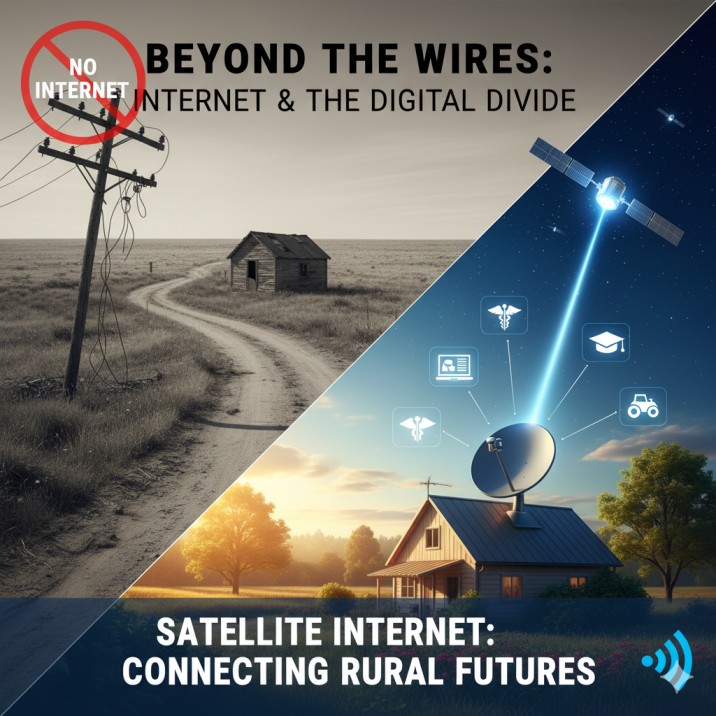
Imagine trying to run a business, attend a university lecture, or even have a simple video call with family, but your internet connection constantly buffers, drops, or simply doesn’t exist. For tens of millions of people living in rural and remote areas, this isn’t a hypothetical scenario; it’s a daily reality. This gap between the connected and the disconnected is known as the digital divide, a vast chasm that limits opportunity and stifles growth. But a powerful solution is beaming down from the heavens. Satellite internet is no longer a slow, last-resort option. It has become a revolutionary force, bridging the digital divide by providing the only viable high-speed option in places where fiber optic cables and cellular towers may never reach.
This isn’t just about faster streaming or social media. It’s about the fundamental transformation of communities and economies. We’re talking about a paradigm shift that is unlocking unprecedented potential in remote education, telemedicine, modern agriculture, and even disaster relief. Join us as we explore the profound social and economic impact of satellite internet on underserved areas and discover how this technology is not just connecting homes, but rebuilding futures.
The Great Disconnect: What is the Digital Divide and Why Does it Affect Rural Areas Most?
The digital divide refers to the gap between individuals, households, and geographic areas at different socio-economic levels with regard to both their opportunities to access information and communication technologies (ICTs) and their use of the Internet for a wide variety of activities. For urban centers, high-speed internet is often taken for granted, delivered through a dense network of underground fiber optic cables and robust cellular infrastructure.
However, the economics of extending this infrastructure to sparsely populated rural and remote regions are often prohibitive. Laying miles of fiber for just a handful of homes doesn’t make financial sense for traditional providers. This creates “digital deserts”—vast areas where reliable, high-speed internet is a dream. The consequences are severe:
- Economic Stagnation: Small businesses struggle to compete, unable to access online markets, use modern payment systems, or leverage digital marketing.
- Educational Disadvantage: Students fall behind their urban peers, lacking access to online learning resources, digital textbooks, and virtual collaboration tools.
- Healthcare Gaps: Residents are cut off from the growing field of telemedicine, forcing long, expensive, and sometimes impossible trips to see specialists.
- Social Isolation: Families find it harder to stay connected, and communities lack access to vital online information and services.
This is where the game changes. Satellite technology bypasses the need for expensive ground-based infrastructure entirely, offering a direct-to-home connection from orbit.
A Lifeline from the Sky: How Does Satellite Internet Provide High-Speed Connectivity to Remote Locations?
The concept behind satellite internet is elegantly simple, yet technologically profound. It involves three key components: a satellite in space, a large ground station (or gateway) connected to the internet backbone, and a small satellite dish installed at your home or business.
Here’s the journey of your data:
- You click a link on your computer. The request travels from your computer to your satellite dish.
- Your dish beams the signal up to a satellite orbiting Earth.
- The satellite relays this signal down to a ground station on Earth.
- The ground station, which is connected to the high-speed fiber internet, fetches the data you requested (e.g., a webpage).
- The process reverses: the data is sent from the ground station up to the satellite, which then beams it down to your dish, and finally to your computer.
While this sounds like a long journey, modern satellite technology, especially with the advent of Low Earth Orbit (LEO) constellations like Starlink, has dramatically reduced the travel time (latency), making it suitable for video calls, online learning, and even some online gaming. It is the definitive answer to the question, “how to get reliable internet in the middle of nowhere.”
The Revolution in Action: Real-World Applications Transforming Rural Life
The true measure of satellite internet’s impact isn’t in megabits per second, but in the real-world transformations it enables. It provides affordable broadband solutions for underserved communities that go far beyond simple browsing.
Redefining the Classroom: The Impact of Satellite Internet on Rural Education
For students in remote areas, a lack of internet access has created a significant educational gap. Satellite internet is leveling the playing field. With a reliable high-speed connection, rural students can now:
- Participate in E-Learning: They can attend live virtual classes, interact with teachers and peers, and access lectures from top educators regardless of their physical location. This is a game-changer for homeschooled students and those in districts with limited resources.
- Access a World of Information: The internet becomes an infinite library. Students can research projects, access digital textbooks, watch educational videos, and use interactive learning software previously unavailable to them.
- Develop Critical Digital Skills: Proficiency with online tools is essential for the modern workforce. Satellite internet gives rural students the chance to develop these skills, preparing them for college and future careers.
This is how technology is closing the digital divide in education, ensuring a child’s zip code no longer determines the quality of their learning opportunities.
Healing from a Distance: How Telemedicine in Rural Communities is Saving Lives
Access to healthcare is a critical challenge in remote regions. Specialist clinics are often hundreds of miles away, and even basic medical consultations can require a full day of travel. Satellite internet is the backbone of the telemedicine revolution, bringing healthcare directly into people’s homes.
The benefits of telemedicine services for remote patient monitoring and consultation are immense:
- Virtual Doctor Visits: Patients can have face-to-face video consultations with their primary care physicians and specialists for check-ups, follow-ups, and minor illnesses, saving time, money, and stress.
- Remote Patient Monitoring: Individuals with chronic conditions like diabetes or heart disease can use connected devices to transmit vital signs (blood pressure, glucose levels) to their doctors daily. This allows for proactive care and can prevent costly emergency room visits.
- Access to Mental Health Services: Satellite internet provides a private, accessible way for individuals in isolated areas to connect with therapists and counselors, breaking down barriers to essential mental healthcare.
- Emergency Consultations: In an emergency, a rural clinic or first responder can use a satellite connection to consult with a specialist at a major hospital in real-time, receiving critical guidance that can save a life.
By enabling reliable access to specialist healthcare in remote areas, satellite internet is not just a convenience; it’s a vital tool for improving and saving lives. For more information on the global impact of digital health services, organizations like the World Health Organization (WHO) offer extensive resources.
Sowing the Seeds of the Future: Precision Agriculture and Smart Farming
Modern farming is a high-tech industry. Precision agriculture uses technology to make farming more efficient, profitable, and sustainable. This data-driven approach relies heavily on a stable internet connection, which has been a major barrier for rural farmers.
Here’s how precision agriculture uses satellite internet to revolutionize farming:
- IoT Sensors and Data Collection: Farmers can deploy sensors across their fields to monitor soil moisture, nutrient levels, and crop health in real-time. This data is transmitted via satellite internet to a central platform for analysis.
- Automated and GPS-Guided Machinery: Connected tractors and combines can use hyper-accurate GPS to plant seeds, apply fertilizer, and harvest crops with incredible precision, reducing waste and increasing yields.
- Drone Surveillance: Drones can fly over fields to identify areas affected by pests or irrigation issues. The high-resolution video and data are uploaded via satellite for immediate analysis, allowing for a swift response.
- Better Resource Management: By understanding exactly what a crop needs and where, farmers can conserve water, reduce fertilizer and pesticide use, and operate more sustainably.
Satellite internet is the essential link that connects all these technologies, improving farm efficiency with IoT and satellite tech and ensuring the agricultural sector can feed a growing global population. The U.S. Department of Agriculture (USDA) provides excellent insights into the integration of technology in modern farming.
The New Digital Homestead: Enabling Remote Work and Local Economic Growth
The rise of remote work has been a defining shift of the last decade, but it has largely been an urban and suburban phenomenon. Without reliable internet, the “work from anywhere” dream was impossible for those in rural settings. Satellite internet has completely changed this dynamic.
- Unlocking Remote Job Opportunities: Rural residents can now compete for high-paying jobs with companies located anywhere in the world, without having to relocate. This brings new income streams into rural economies.
- Empowering Small Businesses: Local entrepreneurs can finally build a robust online presence. They can launch e-commerce websites, use digital marketing to reach a global customer base, and manage online bookings and payments.
- Revitalizing Rural Towns: The ability to work from home with satellite internet is attracting a new wave of “digital homesteaders” to rural areas. These individuals and families buy property, shop at local stores, and enroll their children in local schools, injecting new life and investment into once-declining communities.
The economic impact of broadband in rural towns is undeniable. It diversifies the local economy beyond traditional industries like agriculture and manufacturing, creating a more resilient and prosperous future.
A Beacon of Hope: Satellite Internet in Disaster Relief and Emergency Response
When natural disasters like hurricanes, wildfires, or earthquakes strike, they often destroy ground-based communication infrastructure like cell towers and fiber lines. This leaves first responders and affected communities in a dangerous communication blackout.
In these critical situations, satellite internet becomes an indispensable lifeline.
- Instant Communication Hubs: Emergency response teams can quickly set up satellite terminals to establish reliable internet for disaster relief operations, allowing them to coordinate search and rescue efforts, manage logistics, and communicate with command centers.
- Connecting Shelters and Aid Stations: Evacuation shelters can be equipped with satellite internet, allowing displaced individuals to contact loved ones, register for aid, and access important news and information.
- Enabling Mobile Medical Clinics: Pop-up medical clinics in disaster zones can use satellite internet to access patient records, consult with specialists remotely, and coordinate medical evacuations.
Organizations like the Federal Emergency Management Agency (FEMA) increasingly rely on emergency communication solutions for remote areas to manage effective disaster response. Satellite internet provides that robust, go-anywhere connection when all else fails.
Choosing Your Link to the Sky: What are the Best Satellite Internet Providers for Rural Areas?
When exploring high-speed internet options for off-grid homes, you’ll primarily encounter two types of satellite technology:
- Geostationary (GEO) Satellites: This is the traditional technology used by providers like Viasat and HughesNet. A single, large satellite orbits at a very high altitude (about 22,000 miles) and stays fixed over one point on Earth.
- Pros: Wide coverage, often more affordable initial plans.
- Cons: High latency (lag) due to the long distance the signal travels, which can make video calls and online gaming difficult. Often come with stricter data caps.
- Low Earth Orbit (LEO) Satellites: This is the newer technology pioneered by companies like Starlink. It uses a massive constellation of thousands of smaller satellites orbiting much closer to Earth (around 340 miles).
- Pros: Significantly lower latency, making it feel much closer to a fiber connection. Faster download speeds and typically more generous data plans.
- Cons: Can be more expensive upfront for the equipment. As the constellation is still being built out, there can be brief, occasional service drops.
The best choice depends on your specific needs. If you primarily need internet for browsing, email, and some standard-definition streaming, a GEO provider might be a sufficient and affordable satellite internet plan. However, if you need a high-performance connection for remote work, online school, HD streaming, or video conferencing, a LEO system is likely the superior solution.
Navigating the Challenges: What are the Downsides of Satellite Internet I Should Know About?
While revolutionary, satellite internet is not without its challenges. It’s important to have a realistic understanding of its limitations to ensure it’s the right fit for you.
- Latency: As mentioned, this is the delay it takes for the signal to travel to space and back. While LEO systems have drastically improved this, it can still be higher than fiber, which might affect highly competitive, fast-twitch online gaming.
- Weather Interference: Very heavy rain, snow, or dense storm clouds can sometimes temporarily disrupt the signal, a phenomenon known as “rain fade.” Performance usually returns to normal once the weather passes.
- Obstructions: The satellite dish requires a clear, unobstructed view of the sky. Tall trees, buildings, or mountains can block the signal, so placement is crucial.
- Cost and Data Caps: Satellite internet can be more expensive than urban cable or fiber plans. Some providers also enforce data caps, where they may slow down your speed after you’ve used a certain amount of data in a month.
Despite these hurdles, for millions of people, the benefits of having a reliable, high-speed connection far outweigh the potential downsides.
Conclusion: A Connected Future for All
Satellite internet is more than just a technological marvel; it’s a powerful agent of social and economic change. It is actively closing the digital divide, dismantling barriers that have held back rural and remote communities for decades. By providing a gateway to the global digital world, it empowers students to learn, patients to heal, farmers to innovate, and entrepreneurs to thrive.
The journey to universal connectivity is ongoing, but with continuous advancements in LEO satellite technology, the dream of a world where your location doesn’t limit your potential is closer than ever. The signal from the sky is a signal of hope, promising a brighter, more equitable, and deeply connected future for everyone, no matter how far they live from the end of the fiber optic line.
Frequently Asked Questions About Satellite Internet for Rural Connectivity
1. Is satellite internet fast enough for streaming movies and TV shows?
Yes, modern satellite internet, especially from LEO providers like Starlink, offers speeds that are more than capable of streaming content in HD and even 4K. Traditional GEO providers can also handle streaming, though you may need to be more mindful of your monthly data allowance.
2. Can you work from home with satellite internet?
Absolutely. This is one of the most significant benefits. Satellite internet can easily handle most remote work tasks, including video conferencing (Zoom, Microsoft Teams), accessing cloud-based applications, and transferring large files. Low-latency LEO systems are particularly well-suited for this.
3. What is the latency of satellite internet and is it good for online gaming?
Latency is the delay in data transfer. For traditional GEO satellite internet, latency is high (600+ ms), making fast-paced online games like first-person shooters nearly unplayable. However, LEO satellite internet has much lower latency (typically 20-50 ms), which is comparable to many ground-based connections and is suitable for most online gaming.
4. How does weather affect satellite internet performance?
Very heavy rain or snow can temporarily interfere with the signal, a condition known as “rain fade.” This may cause a temporary slowdown or loss of connection. However, the systems are designed to be resilient, and service typically returns to normal as the severe weather passes.
5. How much does rural satellite internet cost per month?
Costs vary by provider, plan, and region. Expect to pay a one-time fee for the equipment (dish and router), which can range from a few hundred to several hundred dollars. Monthly service plans typically range from $50 to $150 or more, depending on the speed and data offered.
6. Is satellite internet difficult to install?
Most providers offer professional installation. However, many modern systems, like Starlink, are designed for easy self-installation. The process usually involves mounting the dish in a location with a clear view of the sky and running a cable inside to the router.
7. Are there data caps with satellite internet?
It depends on the provider. Many traditional GEO satellite plans come with monthly data caps. If you exceed your cap, your internet speed may be significantly slowed down (“throttled”). Many LEO providers currently offer plans with unlimited standard data, which is a major advantage.
8. Is satellite internet a better option than DSL for rural areas?
In many cases, yes. DSL (Digital Subscriber Line) service relies on phone lines, and its speed degrades significantly the farther you are from the provider’s central office. Satellite internet can often provide much faster and more reliable speeds than the DSL service available in deep rural locations.
9. Can I use a VPN (Virtual Private Network) with satellite internet?
Yes, VPNs work with satellite internet. They are a great way to secure your connection, especially if you are working from home. You may experience a slight reduction in speed, as is common with any VPN use, but it should be perfectly functional.
10. Do I need a phone line to get satellite internet?
No, you do not. Satellite internet is a completely independent system that does not require any phone lines or cable infrastructure, which is precisely why it is the perfect solution for remote and off-grid locations.
11. Can I take my satellite internet service with me if I travel in an RV?
Some providers offer mobile and RV-specific plans that allow you to use your service on the go. This has been a revolutionary development for the digital nomad and RV communities, enabling them to stay connected while traveling in remote areas. You would need to check with the specific provider for their portability options.
12. What is the difference between Low Earth Orbit (LEO) and Geostationary (GEO) satellites?
The main difference is their altitude. GEO satellites are very high up (22,000 miles) and appear stationary in the sky. LEO satellites are much closer (around 340 miles) and move rapidly across the sky in a large constellation. This closer proximity is what gives LEO systems their key advantage: much lower latency (lag).