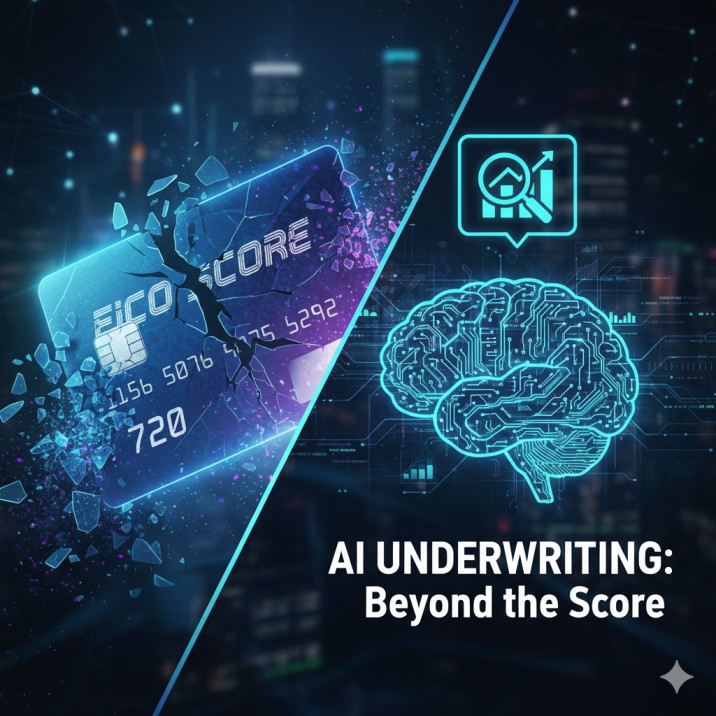
For decades, your financial identity has been boiled down to a single, three-digit number: the FICO score. This score has been the all-powerful gatekeeper, deciding who gets a home, who can start a business, and who gets a personal loan. But what if you’re a successful freelancer with a fluctuating income? What if you’re a new immigrant with no U.S. credit history? Or what if you’re a small business whose real value is hidden in its transaction history, not its owner’s old debts?
To the traditional FICO model, you might look like a risk. You might be “credit invisible” or have a “thin file.” This is the great failing of a system built for a 20th-century economy.
Today, a silent revolution is underway, powered by artificial intelligence (AI) and machine learning (ML). This new world of AI-driven underwriting isn’t just a minor update; it’s a deep-dive replacement for traditional credit scoring. It promises to look beyond that three-digit number and see the real you—your cash flow, your bill payments, and your true financial behavior.
This article is a deep dive into how machine learning is replacing traditional FICO scores for both personal and business loans. We’ll explore the technology, the profound benefits, the serious risks, and what it all means for your financial future.
The FICO Paradox: Why the Old Guard Is Failing Modern Borrowers
Before we explore the future, we must understand the limitations of the past. The FICO score was revolutionary when it was introduced, but its foundation is cracking under the weight of the modern economy.
What Is the Traditional FICO Score, Really?
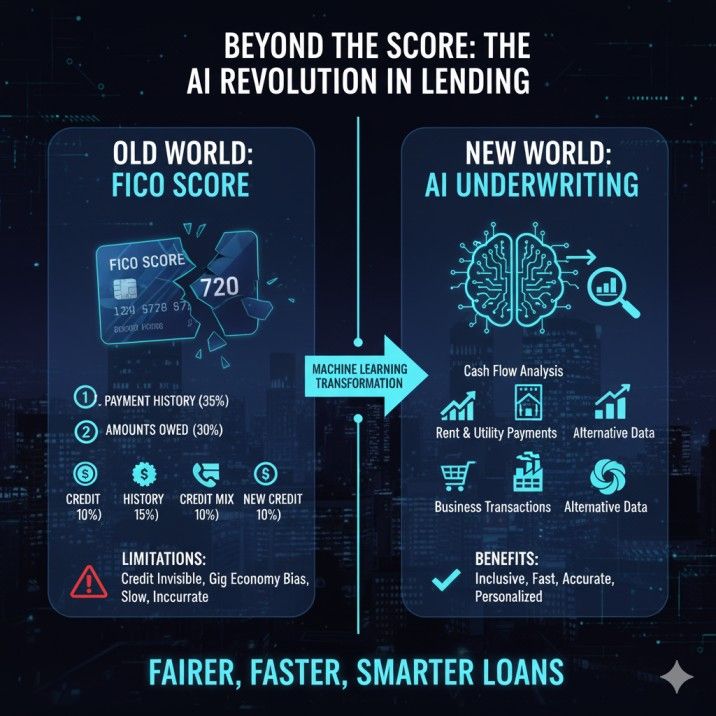
The FICO score is a static snapshot based on five main factors:
- Payment History (35%): Do you pay your bills on time?
- Amounts Owed (30%): How much of your available credit are you using (your credit utilization ratio)?
- Length of Credit History (15%): How long have your accounts been open?
- Credit Mix (10%): Do you have a healthy mix of credit (mortgages, credit cards, installment loans)?
- New Credit (10%): Have you applied for a lot of credit recently?
Notice what’s missing? Your income. Your savings. Your cash flow. Your utility payments. Your rent. The FICO score doesn’t care if you’re a gig worker earning $100,000 a year if you only have one young credit card.
How FICO Scores Create the ‘Credit Invisible’ Problem
The limitations of traditional FICO scores are not just an inconvenience; they are a massive barrier to financial inclusion.
- The ‘Thin-File’ Dilemma: Millions of people are “credit invisible” or have “thin files,” meaning they don’t have enough credit history (or any at all) for FICO to generate a score. This group includes young adults, new immigrants, and people who simply prefer to use debit or cash.
- The Gig Economy Bias: Traditional underwriting loves a W-2 employee with a stable, bi-weekly paycheck. It struggles to understand the variable income of freelancers, gig workers, and contractors. A high-income month followed by a low-income month looks like “instability” to a FICO-based model, even if the person’s average income is very high.
- Small Business Roadblocks: For small business loans, lenders have historically relied on the owner’s personal FICO score. This is a poor predictor of business success. A brilliant entrepreneur might have poor personal credit from a past medical emergency, completely unrelated to their now-thriving business’s cash flow.
This rigid, backward-looking system denies credit to millions of qualified individuals and businesses. This is precisely the problem AI-driven underwriting was designed to solve.
The New Frontier: What Is AI-Driven Underwriting?
AI-driven underwriting is not just a faster FICO. It’s a completely different approach. Instead of a static checklist, it uses dynamic, self-learning machine learning models to assess creditworthiness.
Machine Learning vs. Static Rules: The Core Difference
Think of it this way:
- Traditional Underwriting is like a bouncer with a strict, unchanging checklist. “Over 21? Check. On the list? Check. Dress code met? Check.” If you fail one, you’re out.
- AI-Driven Underwriting is like an experienced concierge who has a conversation with you. They analyze hundreds of data points in real-time—your bank balance, your payment history (even rent), your business’s online reviews, and your income patterns—to build a holistic understanding of who you are and whether you can repay a loan.
This AI concierge can see that you’re a freelance graphic designer who just received three large client payments, so your low-balance week last month doesn’t matter. The FICO bouncer only saw the “instability” and rejected you.
The ‘Secret Sauce’: How AI Algorithms Assess Creditworthiness
These AI models are powerful because they consume and analyze vast amounts of alternative data.
This isn’t your standard credit report. Alternative data for credit scoring includes thousands of data points that paint a much more accurate financial picture.
What Is Alternative Data Used for Loans?
- Bank Transaction Data: This is the most powerful. AI can analyze your cash flow in real-time. It sees your income, your recurring bills (like rent and utilities), your savings habits, and your discretionary spending. Secure platforms like Plaid allow borrowers to safely share this data with lenders.
- Utility and Rent Payments: Have you paid your phone bill and rent on time for five years? FICO ignores this. AI models see it as a powerful sign of financial responsibility.
- Business-Specific Data: For business loans, AI can connect to accounting software (like QuickBooks), e-commerce platforms (like Shopify), and payment processors (like Stripe). It can analyze your actual revenue, profit margins, and customer churn, not just your personal credit.
- Unstructured Data: This is where it gets even more advanced. Some machine learning models use Natural Language Processing (NLP) to analyze your business plan, website, and even online customer reviews to gauge your business’s health and market position.
AI doesn’t just look at this data; it finds complex patterns that no human underwriter or static FICO score could ever detect.
A Deep Dive: How Machine Learning Models Approve Loans in Real-Time
So, how does this technology actually work? Let’s walk through the real-time loan decision-making process, from application to approval.
Step 1: Data Aggregation (Building the 360-Degree View)
When you apply for a loan from a fintech lender, you’re asked to securely link your bank accounts or business software. This “open banking” connection instantly provides the AI model with months or even years of your financial transaction history. This is the raw material.
Step 2: Feature Engineering (Finding the Signals in the Noise)
This is where the magic happens. The machine learning model doesn’t just see “a $50 charge.” It identifies thousands of “features,” or predictive signals, from your data.
It might create features like:
Average_Daily_Balance_Last_90_DaysNumber_of_NSF_Events(Non-Sufficient Funds)Income_Stability_Score(how consistent your deposits are)Savings_Rate_vs_IncomeUtility_Payment_Consistency
For a business, it might create features like Monthly_Recurring_Revenue, Customer_Concentration_Risk (is all your income from one client?), and Days_Sales_Outstanding (how fast you get paid).
Step 3: The AI Model in Action (Predicting Default Risk)
This massive list of features is fed into a pre-trained machine learning model (like a Gradient Boosting Model or a Random Forest). This model has been trained on millions of past loans, learning which combinations of features led to a successful repayment and which led to a default.
The model then assigns a highly precise probability score—the likelihood you will repay the loan. This is far more nuanced than a simple FICO score. It allows a lender to approve someone FICO would reject, perhaps with a slightly different interest rate that accurately reflects the true risk.
<Entry removed>
Step 4: The Instant Decision (From Days to Minutes)
Because this entire process is automated, a loan decision that used to take days of manual human underwriting can now be delivered in minutes.
The Benefits: Why AI Underwriting Is a Game-Changer
This technological shift has profound benefits for both sides of the loan agreement.
For Borrowers: Your Key to Fairer, Faster Capital
- Financial Inclusion for the ‘Credit Invisible’: This is the single biggest win. If you’re a young person, a gig worker, or new to the country, AI underwriting gives you a chance to prove your creditworthiness based on your current financial life, not a non-existent past.
- Faster Loan Approvals: When your small business has a cash flow emergency, you can’t wait two weeks for a bank’s decision. AI provides access to capital at the speed of business.
- More Personalized Loan Terms: Because the AI has a better understanding of your specific risk, it can offer personalized loan terms. Good cash flow management, even with a low FICO, could get you a better interest rate than you’d expect.
- Getting a Loan with Bad FICO (But Good Finances): AI can separate your past from your present. It can see that your “bad FICO” is from a medical debt five years ago, but your current business cash flow is strong and consistent.
For Lenders: Reducing Risk and Expanding the Market
- Lower Default Rates with More Accuracy: AI models are simply better at predicting risk. Lenders using AI have reported significantly lower default rates compared to their FICO-only counterparts.
- Safely Loaning to New Markets: Lenders want to lend money. AI allows them to safely expand their customer base to include the millions of “thin-file” borrowers they were previously forced to reject.
- Automating the Underwriting Process: AI drastically reduces the time and cost of manual underwriting, allowing lenders to be more efficient and pass those savings on to borrowers.
The Risks and Red Flags: Is AI Underwriting Truly Fair?
This new technology is not a perfect utopia. It carries significant risks that regulators, lenders, and borrowers must address.
The ‘Black Box’ Problem in AI Underwriting: Can We Trust It?
The most common criticism of complex AI models is the “black box” problem. This means that while the model is highly accurate, its internal logic can be so complex that even its creators can’t fully explain why it made a specific decision.
If you’re denied a loan, federal law (like the Equal Credit Opportunity Act, or ECOA) requires the lender to tell you why. What happens when the answer is “the algorithm said so”? This is a major challenge, and the industry is moving toward “Explainable AI” (XAI) to solve it.
Algorithmic Bias: Can AI Accidentally Learn Our Prejudices?
This is the most dangerous risk. AI models learn from historical data. If that historical data contains human biases, the AI will learn and amplify those biases.
For example, if past loan officers (consciously or unconsciously) discriminated against applicants from certain zip codes, the AI might learn that “zip code” is a predictive feature and replicate that discrimination. As noted by the Consumer Financial Protection Bureau (CFPB), lenders must ensure their algorithms are tested for and scrubbed of any discriminatory biases, a complex and ongoing task.
Data Privacy Concerns with Alternative Data Collection
To make these models work, you have to give them access to an incredible amount of your personal financial data. This raises critical questions:
- Who owns your transaction data?
- How is that data being stored and protected?
- Could this data be used for other purposes (like targeted advertising) without your consent?
Borrowers must be vigilant about the permissions they grant and lenders must be held to the highest standards of data security.
AI Underwriting for Personal Loans vs. Business Loans: Key Differences
While the core technology is similar, the application of AI-driven underwriting differs for individuals and businesses.
How AI Models Assess Personal Loan Applications (Cash Flow is King)
For personal and auto loans, the AI model is hyper-focused on personal cash flow management. It’s looking at your income-to-expense ratio, your savings habits, and the consistency of your pay. Fintech lenders like Upstart have built their entire business on using AI to lend to individuals FICO scores might overlook.
Why AI is a Game-Changer for Small Business (SME) Lending
This is arguably where AI has the biggest impact. Traditional SME lending was slow, paper-intensive, and heavily reliant on the owner’s personal credit.
AI models for business loans are far more sophisticated. They focus on business health metrics. By integrating with accounting, e-commerce, and payment systems, the AI can answer critical questions in real-time:
- What is the business’s daily sales volume?
- Is its customer base growing or shrinking?
- How quickly are its clients paying their invoices?
- Does it have healthy profit margins?
This allows a lender to grant a $100,000 line of credit to a new e-commerce store with a “thin-file” owner, based purely on its strong Shopify sales data.
The Future: Will AI Completely Replace the FICO Score?
The shift is undeniable, but the FICO score isn’t disappearing tomorrow.
The Rise of Explainable AI (XAI) in Finance
To combat the “black box” problem, the industry is racing to develop Explainable AI (XAI). These are new models designed to provide simple, human-readable explanations for their decisions. Instead of a “no,” an XAI model might say, “The loan was denied because the applicant’s debt-to-income ratio in the last 60 days was 75%, and two utility payments were late.”
A Hybrid Approach: Why FICO and AI Will Co-Exist (For Now)
For the near future, we will likely see a hybrid model. Many traditional banks are beginning to use AI models to supplement the FICO score. They might use FICO as a first-pass filter and then apply AI underwriting to the “borderline” applicants.
However, the fintech lenders and neobanks who are “AI-native” are increasingly ditching FICO altogether, proving that their models are more predictive and more inclusive on their own.
What’s Next? Trends in AI Credit Scoring for 2025 and Beyond
The future of credit is dynamic. As Forbes notes, the pace of financial technology is accelerating. We may soon see “continuous underwriting,” where your creditworthiness isn’t a static number but a live, real-time score. Your bank might be able to pre-approve you for a loan based on your financial health that day, with interest rates that adjust based on your real-time risk.
Conclusion: Embracing a Fairer, Data-Driven Future
The move from the rigid, 3-digit FICO score to dynamic, AI-driven underwriting is more than a tech upgrade. It is a fundamental shift toward financial inclusion. It’s about a system that judges you on your real-time financial habits, not your five-year-old mistakes.
For millions of entrepreneurs, gig workers, and individuals let down by the traditional system, AI offers a pathway to the capital they need and deserve.
However, this power comes with great responsibility. As we embrace this new era, we must remain vigilant, demanding transparency, fairness, and accountability from the algorithms that shape our financial lives. The goal isn’t just better technology; it’s a better, more accessible financial system for everyone.
Frequently Asked Questions (FAQ) About AI-Driven Underwriting
1. Is AI underwriting truly fair or can it be biased?
This is the most important question. AI can be biased if it’s trained on biased historical data. However, when built and tested responsibly, AI has the potential to be far less biased than human underwriters. A properly designed AI model can be explicitly instructed to ignore factors like race, gender, or zip code, which is something a human might unconsciously factor in. Reputable studies, like those from MIT, are exploring how to build these “fair-by-design” models.
2. How can I get a loan if I have no credit history?
This is exactly where AI underwriting shines. You can apply to fintech lenders who use alternative data. By securely linking your bank account, you can show them your consistent income (from your job or gig work) and your record of paying rent and utility bills on time. This “proves” your creditworthiness without a FICO score.
3. What alternative data sources are used for loan applications?
The most common are bank transaction history (cash flow, income, savings), utility payments (electricity, phone), rent payments, and, for businesses, data from accounting (QuickBooks), e-commerce (Shopify), and payment (Stripe) platforms.
4. Will AI-driven underwriting replace FICO scores completely?
It’s unlikely to happen overnight, but the trend is clear. FICO scores are becoming less relevant for many modern lenders, especially in the fintech space. We will likely see a long transition period where many lenders use a hybrid model, but AI-native lenders are already proving FICO is optional.
5. How does AI help with small business (SME) lending?
AI can analyze the real-time health of your business, not just your personal credit. It reads your sales data, your invoices, and your bank statements to see your actual revenue and cash flow. This allows it to approve loans for new but successful businesses that traditional banks would reject.
6. Can I be denied a loan by an AI without a human review?
Yes, many automated systems can deny a loan application in real-time. However, you have the right to request an “adverse action notice,” which must state the specific reasons for the denial. You also often have the right to appeal the decision and ask for a human review.
7. What is the ‘black box’ problem in AI lending?
The “black box” refers to a complex AI model whose decision-making process is so complicated that it’s difficult to explain why it reached a specific conclusion (like denying a loan). This is a major regulatory concern, and the industry is working on “Explainable AI” (XAI) to make these models more transparent.
8. How can AI-driven underwriting improve financial inclusion?
By looking at alternative data like cash flow and utility payments, AI can accurately score millions of “credit invisible” people—like young adults, immigrants, and gig workers—who are unfairly penalized by the FICO system. This gives them access to fair credit for the first time.
9. Are AI underwriting models regulated?
Yes. All lending models, whether human or AI, must comply with fair lending laws like the Equal Credit Opportunity Act (ECOA) and the Fair Housing Act (FHA). Regulators like the CFPB are actively developing new rules to ensure AI models are fair, transparent, and non-discriminatory.
10. How does machine learning for default risk work?
A machine learning model is “trained” by feeding it millions of examples of past loans—both those that were repaid and those that defaulted. The model learns to identify thousands of tiny patterns and correlations in the data that are predictive of default. It then uses this “knowledge” to score new applications.
11. Is it safe to give lenders access to my bank account data?
This is a valid concern. Reputable fintech lenders use secure, encrypted “open banking” platforms (like Plaid or Finicity). These platforms use tokens to give the lender read-only access to your transaction data, often for a one-time analysis. They cannot move your money or see your login credentials. Always verify the lender’s security practices.
12. How does AI underwriting for personal loans differ from for business loans?
AI for personal loans focuses on your personal cash flow, income stability, and bill payment history. AI for business loans is more complex, analyzing the business’s own revenue, profit margins, customer base, and other operational data, often separate from the owner’s personal finances.
13. What can I do to improve my chances of approval by an AI model?
If FICO ignores your good habits, AI is designed to see them. The best things you can do are:
- Maintain a healthy, positive average daily balance in your bank account.
- Avoid overdrafts or Non-Sufficient Funds (NSF) fees.
- Show consistent income, even if it’s from multiple sources.
- If possible, show regular transfers into a savings account, even small ones.
- Pay all your bills (rent, utilities, phone) on time.
14. What are the limitations of using AI in credit scoring?
Beyond bias and the “black box” problem, other limitations include data quality (the model is only as good as the data it’s fed) and data privacy concerns. There’s also the risk of “overfitting,” where a model is too perfectly trained on past data and isn’t flexible enough to handle new, unexpected economic events.
15. Can I dispute an AI loan decision?
Yes. Your rights under the ECOA remain the same. You are entitled to a specific reason for the denial. If you believe the data used was inaccurate (e.g., it misread an income deposit), you have the right to dispute the decision and provide correct information, requesting a re-evaluation or a human review.