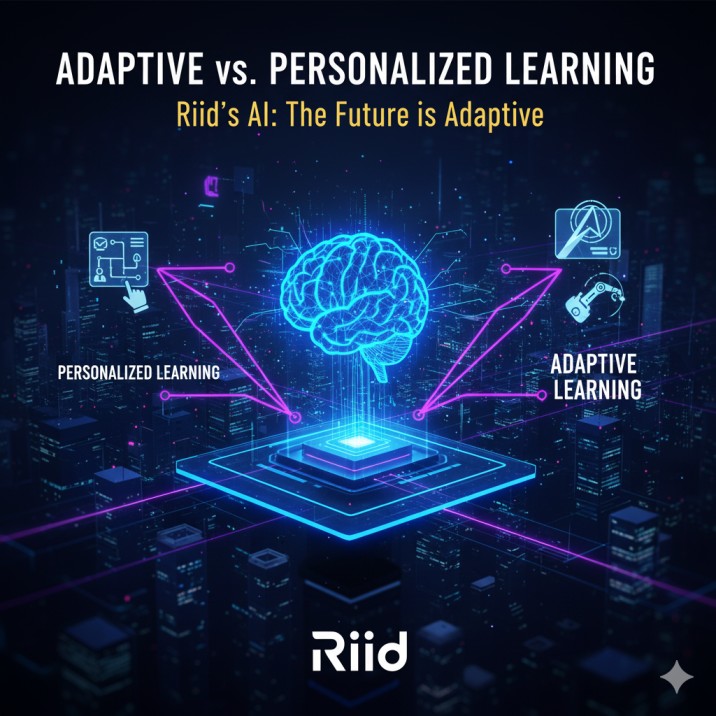
In the world of educational technology (EdTech), two terms are used so frequently and often so interchangeably that they’ve started to lose their meaning: personalized learning and adaptive learning. Both promise to rescue us from the outdated, one-size-fits-all model of education. Both claim to put the individual learner at the center of the experience. But are they the same thing?
The short answer is no. While all adaptive learning is a form of personalization, not all personalized learning is truly adaptive. The difference isn’t just semantic—it’s the difference between a curated playlist and a responsive personal trainer, between a map with suggested routes and a GPS that reroutes you in real-time based on traffic.
One company, more than any other, has brought this distinction into sharp focus: the AI-in-education leader, Riiid. By building one of the most sophisticated learning engines on the planet, Riiid has provided a masterclass in what truly adaptive learning looks like and why it represents the future of effective education.
This deep dive will demystify these critical concepts. We will break down the fundamental differences between adaptive and personalized learning, explore their real-world applications, and use Riiid’s groundbreaking AI model as a case study to understand the profound impact of a truly adaptive system. By the end, you’ll not only understand the jargon but also see why this distinction is crucial for anyone involved in teaching, training, or learning in the 21st century.
Untangling the Terms: What is Personalized Learning?
Let’s start with the broader concept. Personalized learning is an educational approach that aims to customize learning for each student’s unique strengths, needs, skills, and interests. The key element here is learner agency and customization of the path.
Think of it like building a custom workout plan. You might meet with a trainer who asks about your goals (lose weight, build muscle), your preferences (hate running, love lifting weights), and your schedule (can only work out three times a week). Based on this, they create a personalized plan for you. The plan is yours; it’s tailored to your profile.
In a digital context, personalized learning often manifests in platforms that allow learners to:
- Choose their learning path: A student might be presented with several modules and can decide which one to tackle first.
- Select their content format: They might choose to learn a concept by watching a video, reading an article, or completing an interactive simulation.
- Set their own pace: Learners can move through the material as quickly or as slowly as they need, without being tied to the pace of a group.
This approach is a massive step up from the traditional model. It acknowledges that not everyone learns in the same way or at the same speed. However, its core limitation is that the “intelligence” of the system often relies heavily on the learner’s own choices. The platform provides the options, but the learner is largely in the driver’s seat. It can be a fantastic way to boost engagement, but it may not be the most efficient way to achieve mastery.
The Next Evolution: What is Adaptive Learning Technology?
If personalization is a custom-made map, adaptive learning is a sophisticated, real-time GPS. An adaptive learning system is a far more advanced form of personalization that uses artificial intelligence and data analysis to modify the learning path for the student, automatically and in real-time.
The key differentiator is that the system is in the driver’s seat, making data-driven decisions on behalf of the learner to optimize their path to mastery. It doesn’t just offer choices; it makes intelligent, algorithmic recommendations.
Going back to our fitness analogy, an adaptive system is like a personal trainer with a bio-monitor strapped to you during your workout.
- It doesn’t just give you a plan; it watches your every move.
- It sees your heart rate spike on the third set of squats and tells you to take a longer rest.
- It notices your form faltering and immediately suggests a lighter weight or a different exercise to prevent injury.
- It analyzes your performance over weeks and automatically adjusts next month’s plan without you even asking.
This system is constantly collecting data, analyzing it, and adapting the experience based on that analysis. The learner’s every interaction—every correct answer, every wrong answer, every hesitation, every video watched—is a data point that feeds the AI engine.
Riiid’s AI Model: The Ultimate Case Study in True Adaptation
To make this distinction concrete, there is no better example than the AI engine developed by Riiid. What Riiid has built, first with its ‘Santa’ TOEIC app and now with its B2B ‘R.Inside’ module, is the embodiment of a truly adaptive system. It’s not just personalizing a content library; it’s orchestrating a dynamic, optimized learning journey.
Here’s a look at how Riiid’s adaptive learning algorithms work to create a learning experience that simple personalization cannot match.
1. The System Diagnoses, The Learner Doesn’t Guess
A personalized system might start by asking, “What topics would you like to work on?” An adaptive system like Riiid’s starts by saying, “Let me tell you what you need to work on.”
It begins with a short but highly effective diagnostic test. The AI uses this initial interaction not just to see what you get right or wrong, but to infer your underlying knowledge state across hundreds of related concepts. It uses a technology called Knowledge Tracing to build a detailed, multi-dimensional map of your brain’s understanding of the subject. You, the learner, might not even know what your weaknesses are, but the AI does.
2. The Path is Determined by Algorithm, Not Just Choice
Once the AI has this knowledge map, it takes control of the learning path. This is the most crucial distinction. While a personalized system offers a menu of options, Riiid’s adaptive engine makes a specific, algorithmic choice about the single best piece of content to show you next.
It solves a complex optimization problem in milliseconds: “Given this user’s precise knowledge gaps and their goal of a higher score, what is the one question or video lecture out of millions that will provide the maximum learning value at this exact moment?”
This is why an AI-driven approach is the fastest way to master a subject. It ensures that 100% of your study time is spent on material that is perfectly calibrated to your needs—not too hard to be discouraging, and not too easy to be a waste of time.
3. Every Interaction Forces a Real-Time Adaptation
This is where the system’s dynamism shines. A personalized platform’s path is often static once chosen. An adaptive platform’s path changes with every single click.
When a user on a Riiid-powered platform answers a question:
- The AI instantly updates its knowledge map of the user. It knows you just strengthened a specific skill.
- It recalculates your predicted score. This provides a powerful, motivating feedback loop.
- It immediately decides on the next best question. If you answered correctly, it might introduce a slightly more complex, related concept. If you answered incorrectly, it might serve up a foundational question to reinforce the basics or recommend a micro-lecture on the topic.
This continuous loop of assessment -> analysis -> adaptation is what makes the learning process incredibly efficient. It’s a system that never assumes, but always knows. The importance of such systems is widely recognized by educational bodies like EDUCAUSE, which highlights their potential to improve student success.
Head-to-Head: Comparing Personalized vs. Adaptive Learning Models
Let’s lay out the differences in a clear, comparative format to see how these two approaches stack up across key features.FeaturePersonalized Learning (The Curator)Adaptive Learning (The AI Tutor)Driving ForcePrimarily driven by learner choice and pre-set rules or “playlists.”Driven by a real-time AI algorithm and continuous data analysis.Path DeterminationThe learner often selects their path from a set of curated options.The system algorithmically determines and adjusts the optimal path for the learner.Data UsageUses initial profile data and learner selections to suggest content.Uses every single interaction as a data point to dynamically modify the experience.Level of GranularityOperates at the level of topics or modules. (e.g., “Let’s study algebra.”)Operates at the micro-level of individual concepts and skills. (e.g., “You’re struggling with factoring quadratic equations with a leading coefficient greater than 1.”)Main GoalTo increase learner engagement and agency by providing choice and flexibility.To maximize learning efficiency and mastery by optimizing the learning path.Example AnalogyNetflix or Spotify: It learns your preferences and recommends what you might like to watch or listen to next.A self-driving car: It analyzes millions of data points per second to make the optimal driving decision on your behalf to get you to your destination safely and quickly.
This comparison highlights why the potential impact of adaptive technology is so profound. While personalized learning makes education more engaging, adaptive learning has the power to make it fundamentally more effective, a transformation covered by leading publications like Wired in their discussions on the future of AI in education.
The Impact of Adaptive Learning on Corporate Training and Education
The implications of truly adaptive technology extend far beyond standardized test prep. The principles demonstrated by Riiid’s AI model are being applied across the learning spectrum, offering tremendous benefits.
For K-12 and Higher Education
Teachers are overwhelmed. They cannot possibly create and manage 30 unique learning paths in a single classroom. Adaptive learning platforms act as a “virtual teaching assistant” for every student. The teacher sets the learning goals, and the AI manages the moment-to-moment process of getting each student there, providing the teacher with high-level dashboards showing which students are struggling and on which specific concepts. This allows teachers to move from being lecturers to being mentors and facilitators.
For Corporate Learning & Development (L&D)
In the corporate world, training efficiency is paramount. You can’t afford to have a new software engineer spend three weeks on an onboarding course covering topics they already know. An adaptive corporate training solution can:
- Assess a new hire’s existing skills and create a tailored onboarding plan that fills only their specific knowledge gaps.
- Deliver compliance training that ensures true mastery, not just course completion, by adaptively quizzing employees until they demonstrate proficiency.
- Power upskilling and reskilling initiatives by creating the most efficient path for an employee to learn a new role, saving thousands of hours of lost productivity.
The ability of AI to create these efficient pathways is a subject of ongoing research, with many papers available on academic servers like arXiv.org for those interested in the deep technical underpinnings.
Frequently Asked Questions (FAQ)
1. Is adaptive learning just a more complicated version of personalized learning?
Not exactly. It’s better to think of adaptive learning as a highly advanced, data-driven subset of personalized learning. All adaptive learning is personalized, but most personalized learning platforms are not truly adaptive because they lack the real-time, AI-driven decision-making engine.
2. Does adaptive learning remove the teacher from the process?
No, it empowers the teacher. By automating the repetitive task of delivering and assessing foundational knowledge, adaptive systems free up teachers to focus on higher-order skills like critical thinking, collaboration, and one-on-one mentoring with students who need it most.
3. Is Riiid’s AI model the only example of adaptive learning?
While Riiid is a leading example due to its scale and the sophistication of its AI, other platforms use adaptive principles. However, the depth of Riiid’s knowledge tracing and the accuracy of its predictive models, proven on a massive dataset, set a very high benchmark for a truly adaptive system.
4. Can adaptive learning work for creative or subjective topics?
Its application is most straightforward in rule-based subjects like math, science, and language learning, where there are clear right and wrong answers. However, AI is evolving, and adaptive principles are being explored for softer skills, for instance, by adapting the scenarios in a leadership training simulation based on the user’s choices.
5. Does the learner have any control in an adaptive system?
Yes. While the system guides the micro-journey (e.g., the next question), the learner still has macro-level control. They set their ultimate goals, decide when and how long to study, and can access a library of content. The system acts as an expert guide, not a dictator.
6. What is “knowledge tracing” in simple terms?
Knowledge tracing is an AI technique that creates a digital model of a student’s memory and knowledge. It tracks what you know, how well you know it, and even predicts when you’re likely to forget it, so the system can prompt you to review the material at the perfect time.
7. How much data is needed for an adaptive learning system to work well?
A lot. This is a key differentiator. Truly adaptive models like Riiid’s are built on hundreds of millions or even billions of user interactions. This massive dataset is what allows the AI to learn the complex patterns of human learning and make accurate predictions.
8. Is adaptive learning expensive to implement?
Building an adaptive engine from scratch is incredibly expensive and requires elite AI talent. However, the emergence of AI-as-a-Service models, like Riiid’s ‘R.Inside’, is making this technology more accessible. Companies can now plug this AI “brain” into their own platforms without the massive upfront investment.
9. Can adaptive platforms help students with learning disabilities?
Yes, this is one of the most promising areas. An adaptive system can move at the student’s exact pace without judgment. It can identify specific foundational gaps that might be the root cause of a learning challenge and provide targeted practice until the concept is mastered, offering a level of individualized attention that is difficult to achieve in a traditional classroom.
10. What’s the main benefit of an adaptive learning system for a student?
The main benefit is efficiency. It helps you achieve your learning goal (e.g., mastering a subject or passing a test) in the shortest possible time by ensuring every minute of your study is focused on what you need to learn most.
11. Does the Riiid AI model only work for the TOEIC test?
No. While the model was famously trained and proven on TOEIC test data, the underlying AI for knowledge tracing and content recommendation is subject-agnostic. It can be applied to any domain of knowledge, from K-12 math to corporate finance training.
12. What is the future of adaptive learning technology?
The future is likely a seamless blend of human instruction and AI adaptation. AI will handle the personalized knowledge acquisition, while teachers and trainers will focus on mentorship, project-based learning, and fostering social and emotional skills—the uniquely human elements of education.
Conclusion: The Future Isn’t Just Personal, It’s Adaptive
Understanding the distinction between personalized and adaptive learning is more than an academic exercise. It’s about recognizing the true potential of technology to revolutionize how we teach and learn.
Personalization was the first crucial step away from the industrial-age classroom. It gave learners choice, flexibility, and a voice in their education. But true transformation lies in the data-driven, algorithmic power of adaptive learning. As Riiid’s powerful AI model demonstrates, an adaptive system doesn’t just offer a different path; it calculates the optimal path. It acts as an expert tutor for millions, delivering a level of individualized instruction that was once the exclusive privilege of the few.
For educators, trainers, and platform builders, the message is clear: offering choice is good, but offering intelligent, real-time guidance is game-changing. The future of learning won’t just be tailored to our preferences; it will adapt to our needs, moment by moment, propelling us toward mastery with unparalleled efficiency.