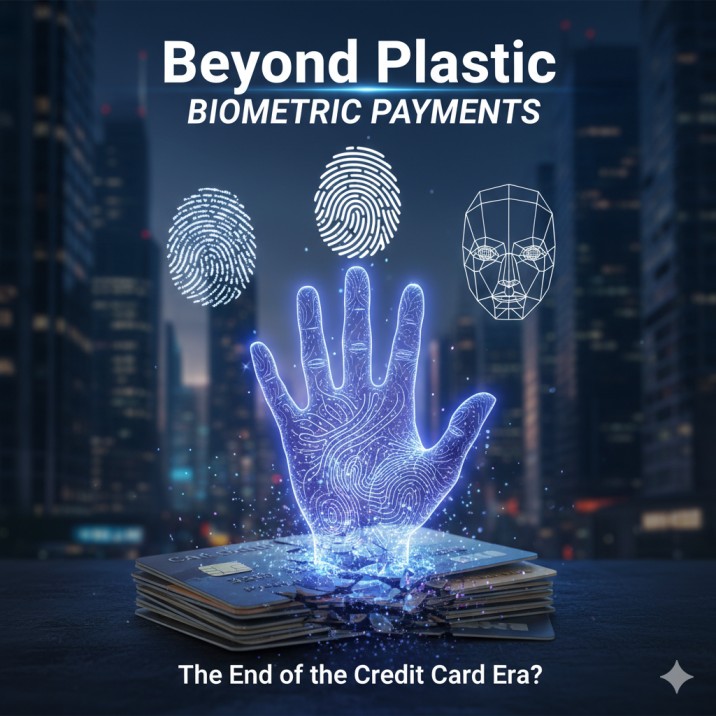
Remember the last time you were at a busy checkout, fumbling through your wallet for the right credit card, only to forget your PIN? Or that tiny pang of anxiety when you hand your card to a waiter and it disappears from your sight? For decades, that piece of plastic has been the key to our financial lives. But its reign is coming to an end. A new era of commerce is dawning, one powered not by what you have in your pocket, but by who you are.
Welcome to the world of biometric payments. This isn’t science fiction; it’s the technology that’s already in your smartphone and is rapidly expanding to change every transaction you make. It’s a system where your fingerprint, your face, or even the palm of your hand becomes your new credit card. This profound shift promises a future of unparalleled convenience and security, making traditional payment methods look as outdated as a horse and buggy.
This guide will explore the fascinating world of biometric payment technology. We’ll break down exactly what it is, how it works, and answer the critical question: are biometric payments secure enough to truly replace the cards in your wallet? Get ready to discover the future of how we pay.
What Exactly Are Biometric Payments? The Sci-Fi Tech in Your Hand
At its simplest, biometric payment is a method of verifying a financial transaction using a person’s unique physical or behavioral characteristics. Instead of relying on something you know (a PIN or password) or something you have (a physical card), it relies on something you are. This fundamental difference is what makes the technology so revolutionary.
The core idea is to replace the weak points of traditional systems. A credit card can be stolen. A PIN can be guessed or skimmed. Biometrics, on the other hand, are incredibly difficult to replicate. Your fingerprint is unique to you, as are the patterns in your iris or the vein patterns in your palm. By using these markers as a form of identification, the system creates a direct and secure link between you and your money.
This isn’t just about unlocking your phone with your thumb. We’re talking about a complete ecosystem where you can walk into a store, pick up your items, and simply walk out, with the payment authorized by a seamless scan of your face or hand. It’s the ultimate frictionless commerce experience.
The Different Flavors of You: Exploring the Main Types of Biometric Payments
The field of biometrics is diverse, with several different methods being used to verify identity. Each has its own strengths and is suited for different applications. Understanding the different types of biometric authentication for payments is key to seeing where this industry is headed.
1. Fingerprint Scanners: The Original Game-Changer
This is the most common form of biometric authentication today. From Apple Pay and Google Pay on our phones to the new biometric credit cards with fingerprint sensors, this method is familiar and widely accepted. A sensor captures the unique ridges and valleys of your fingerprint, converts it into an encrypted digital template, and uses it to approve transactions.
2. Facial Recognition: Paying with a Glance
Made popular by Apple’s Face ID, facial recognition for payments uses advanced cameras and AI to map the unique geometry of your face. It measures dozens of data points, like the distance between your eyes and the shape of your chin, to create a digital identity. This technology is powering checkout-free stores and enabling truly hands-free payments.
3. Iris and Retina Scans: The Ultimate in Security
While less common in consumer applications due to the specialized hardware required, iris and retina scanning represent the gold standard in biometric security. The iris (the colored part of the eye) has a complex pattern that is unique and stable throughout your life. This method is incredibly accurate and used in high-security environments, but we may see it become more widespread in the future.
4. Palm Vein Recognition: The Hidden Pattern Within
This cutting-edge technology works by scanning the unique pattern of veins beneath the skin of your palm. Since these patterns are internal, they are virtually impossible to replicate or “spoof.” Amazon has been a major proponent of this with its Amazon One system, which allows you to pay at Whole Foods and other stores just by hovering your hand over a scanner. It’s both highly secure and hygienic.
5. Voice Authentication: “Authorize My Payment”
Your voice has its own unique characteristics, from pitch and tone to the cadence of your speech. Voice recognition payment technology is being used to authorize transactions over the phone or through smart home devices like Alexa and Google Assistant, creating a seamless way to shop from home.
6. Behavioral Biometrics: How You Act is Your Key
This is a more subtle, yet powerful, type of biometric. Instead of a static physical trait, it analyzes your patterns of behavior. This could include how you hold your phone, your typing rhythm, or even the way you walk. While often used for continuous fraud detection in the background, it can also be a component of the primary authentication process.
The Tech Behind the Touch: How Do Biometric Payments Actually Work?
The magic of a one-touch payment isn’t really magic—it’s a sophisticated, three-step process designed for speed and security. Whether it’s your face, finger, or palm, the underlying technology behind biometric payment processing follows the same core principles.
- Enrollment (The Capture): The first time you set up a biometric payment system, it captures your unique characteristic. For example, your phone’s fingerprint sensor takes a high-resolution image of your thumb. This isn’t stored as a simple picture. Instead, the software identifies dozens of unique points (minutiae) and creates a complex digital map.
- Storage (The Secure Vault): This digital map, or template, is then encrypted and stored in a highly secure location. On modern smartphones, this is a special chip called a “Secure Enclave,” which is isolated from the main operating system. This is a critical point: reputable systems do not store your actual fingerprint or face photo on a server where it can be easily breached. They store an encrypted data representation of it.
- Verification (The Match): When you go to make a payment, you present your biometric again. The scanner captures it, converts it into a new digital template, and compares it to the encrypted template stored in the secure vault. If they match, your identity is verified, and the payment is authorized. This entire process happens in a fraction of a second.
Furthermore, modern systems combine biometrics with another crucial security layer called tokenization. When your identity is verified, the system doesn’t send your actual credit card number to the merchant. It sends a one-time use, encrypted code (a “token”) that represents your card for that single transaction. This means that even if the merchant’s system is hacked, your real card details are never exposed.
The Big Question: Are Biometric Payments More Secure Than Chip and PIN?
This is the most critical question for consumers. While the convenience is undeniable, it means nothing without security. So, how secure are biometric payment methods compared to the old guard of plastic cards? The answer is nuanced, with powerful advantages and some important risks to consider.
The Advantages: Why Biometrics are a Security Powerhouse
- Uniqueness: A four-digit PIN has only 10,000 possible combinations. A strong password can be cracked. Your fingerprint, however, has a 1 in 64 billion chance of matching someone else’s. This inherent uniqueness makes it an incredibly strong key.
- Cannot Be Forgotten or Phished: You can’t forget your face at home. No one can trick you into revealing your iris pattern in a phishing email. Biometrics eliminate the risk of human error that plagues password-based security.
- “Liveness” Detection: A major fear is that a criminal could use a photo of your face or a fake fingerprint to fool a scanner. Modern systems, however, have advanced “liveness detection.” Facial recognition can use 3D mapping to check for depth or track eye movement to ensure it’s a real person, not a picture. Fingerprint sensors can detect the subtle electrical conductivity of human skin.
- Eliminates Skimming: Credit card skimmers, which are devices illegally installed on ATMs and gas pumps to steal card data, become completely useless in a world of biometric payments. There is no physical data to steal from the transaction point.
The Risks and Challenges: What We Need to Solve
Despite these strengths, there are valid privacy concerns with facial recognition payments and other biometric methods.
- The “Irrevocable Password” Problem: This is the single biggest risk. If your password is stolen, you can change it. If your credit card number is compromised, the bank can issue you a new one. But what happens if biometric data is hacked? You can’t change your fingerprint. This is why the secure, decentralized storage of biometric templates (not images) is so vitally important. A breach of a central database holding biometric data would be catastrophic.
- Spoofing and Deepfakes: While liveness detection is good, criminals are always innovating. There is an ongoing arms race between security experts and hackers trying to create realistic masks, fake fingerprints, or deepfake videos that can fool scanners.
- False Negatives and Positives: No system is perfect. A dirty or scarred finger can sometimes lead to a “false negative,” where the system fails to recognize the authorized user. Far more dangerous, though extremely rare, is a “false positive,” where the system incorrectly matches an unauthorized user.
- Data Privacy and Surveillance: Who owns your biometric data? When you use facial recognition to pay at a store, is that data being used to track your movements and purchases? The ethical implications and the need for strong regulations, like GDPR, are paramount to ensuring this technology is not abused.
For a deeper look into the evolving world of digital security, platforms like TechCrunch provide ongoing coverage of both the innovations and the vulnerabilities in this space.
Real-World Revolution: Where Are Biometric Payments Being Used Today?
This technology isn’t just a concept; it’s already integrated into many aspects of our lives. The global adoption of biometric payment technology is accelerating as both consumers and businesses recognize its benefits.
- Mobile Wallets: This is the most widespread use case. Apple Pay, Google Pay, and Samsung Pay all use fingerprint or facial recognition on your phone to authorize secure, contactless payments.
- In-Store Experiences: Amazon Go stores are a prime example. You scan your palm to enter, and cameras and sensors track what you take. When you leave, your account is automatically charged. There’s no checkout at all.
- Biometric Credit Cards: Companies like Mastercard and Visa have been piloting credit cards with a built-in fingerprint sensor. You simply hold your thumb on the card as you tap to pay, adding a powerful layer of security without changing the familiar form factor. You can read more about these innovations directly from payment leaders like Visa.
- Online and In-App Payments: The FIDO (Fast Identity Online) Alliance standard allows you to approve online purchases on your laptop by authenticating with the fingerprint scanner on your phone, eliminating the need to type in card details.
Why Businesses Are Eager to Adopt Biometric Payment Systems
The push towards biometrics isn’t just coming from tech companies; merchants and businesses of all sizes stand to gain significantly.
- Drastically Faster Checkout: Biometric transactions take a fraction of the time of chip and PIN or even standard contactless payments. This means shorter lines, happier customers, and higher throughput during peak hours.
- Significant Fraud Reduction: According to industry reports, counterfeit card fraud is a multi-billion dollar problem. Since biometrics are nearly impossible to counterfeit, they can dramatically reduce chargebacks and fraud-related losses for merchants.
- Enhanced Customer Experience: A smooth, fast, and secure checkout process is a major differentiator. Offering the latest payment technology shows that a brand is modern and customer-focused, which can increase loyalty.
- Improved Data Security: By embracing systems that use tokenization, businesses reduce their own liability. Since they never store or transmit raw credit card numbers, their risk in the event of a data breach is significantly lowered.
Frequently Asked Questions (FAQ)
1. Will biometric payments completely replace my credit card?
Eventually, it’s very likely. While physical cards will coexist for some time, the superior convenience and security of biometrics point to a future where they become the primary method of payment. The transition will be gradual, but the trend is clear.
2. Is my fingerprint or face stored on a company’s server?
In well-designed systems like Apple’s Face ID or Google’s Fingerprint Unlock, no. A mathematical representation of your biometric data is encrypted and stored locally on your device in a secure chip, inaccessible to the operating system or any apps. It never leaves your device.
3. What happens if I get a cut on my finger or my appearance changes?
Modern systems are designed for this. They often enroll multiple angles of your finger during setup. Facial recognition AI is smart enough to adapt to changes like glasses, beards, or makeup. In a worst-case scenario where the biometric fails, you would still have a backup option like a passcode.
4. Can the police or government force me to unlock my phone or payment app with my face?
This is a complex legal area that varies by country. In some jurisdictions, legal protections against self-incrimination may apply differently to passcodes (something you know) versus biometrics (something you are). This remains a significant area of legal and ethical debate.
5. Are biometric payments expensive for small businesses to implement?
While dedicated hardware like palm scanners can have an upfront cost, many businesses can start by simply accepting mobile wallets like Apple Pay and Google Pay through modern NFC-enabled payment terminals. As the technology becomes more common, the costs are expected to drop significantly.
6. Which type of biometric is the most secure?
Generally, iris and palm vein scans are considered the most secure and hardest to spoof. However, for everyday consumer use, modern fingerprint and 3D facial recognition offer an extremely high level of security that is more than sufficient for financial transactions.
7. Can someone use a photo of me to fool facial recognition?
Not on modern, secure systems. They use 3D depth mapping and “liveness” detection to ensure they are scanning a real, live person. A simple 2D photograph will not work on systems like Apple’s Face ID.
8. What is a biometric credit card?
It’s a credit card that has a small fingerprint sensor built directly onto the card itself. To make a payment, you place your thumb on the sensor as you tap the card on the reader. This verifies your identity without needing a PIN, making tap-to-pay even more secure.
9. Are there any health concerns with iris or palm vein scanners?
No. These scanners use a safe, low-level near-infrared light, similar to what’s used in a TV remote control. They are completely harmless and non-invasive.
10. What is the FIDO Alliance?
The FIDO (Fast Identity Online) Alliance is an industry association that develops open standards for passwordless authentication. Their work is crucial for ensuring that different biometric systems can work together securely across different websites, devices, and apps.
11. What if my biometric data is stolen in a major data breach?
This is the biggest long-term concern. While reputable systems don’t store raw images, the theft of encrypted biometric templates would still be a serious issue. This is why the entire industry is focused on decentralized storage (keeping data on your personal device) and continuous innovation in anti-spoofing technology. For more context on data privacy issues, resources like The Verge offer excellent reporting.
12. How does this technology impact people with disabilities?
This is a critical accessibility issue. Biometric systems must be designed to be inclusive. For instance, a person who is unable to use their hands should be able to use an alternative like voice or facial recognition. A multi-modal approach, offering users a choice of biometric methods, is essential for true accessibility.